U.S. Southeast Cooks Up New Labor Solutions (cover) Alabama Florida Georgia Kentucky Louisiana Mississippi Tennessee Request Information |

Florida Some of the Southeast's biggest changes in work-force development have taken place in Florida. Just two years ago Florida ranked No. 44 in the nation in spending for customized training, and it was also identified as one of the few states to not designate funds to incumbent worker training.
"We were not happy with this non-competitive ranking, so the state board applied for and was awarded a competitive U.S. Dept. of Labor demonstration grant," says Curtis Austin, president and CEO of the Florida Work-Force Development Board. "These funds were used to develop an employer-driven incumbent work-force training (IWT) program."
The new program, which was enacted last year, provides employers with funds to train currently employed workers to maintain competitiveness, and it addresses retraining needed to meet changing skills requirements caused by new technology, retooling, new product lines and new organizational structuring.
"During the first four-month start up of the program, projects resulting from 27 companies will generate training for approximately 1,600 incumbent workers within their firms and retain another 360 positions," says Austin. "And an unanticipated benefit of these training partnerships is the creation of 424 new Florida jobs within these 27 companies."
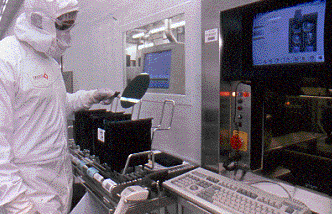
Orlando's ability to produce skilled labor and its universities' availability to industry have resulted in several expansions by Cirent Semiconductors.
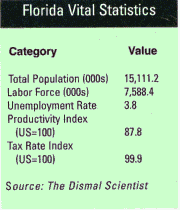
Today Florida's economy is booming with an overall unemployment rate in 1999 of 3.9 percent (the nation's average was 4.2 percent). But these tighter labor markets "elevate the need to provide skilled workers to expanding, maintaining and relocating business," says Austin, who adds that work-force development is the top business climate issue at this year's General Assembly.
And with that, the state is considering Senate Bill 2050, also known as the Work-force Innovation Act of 2000, which attempts to consolidate work-force administration, integrate and simplify work-force funding, connect the work-force system to the business community and improve service delivery. Florida is also one of only five fully approved early implementation states as described under the federal Work-force Investment Act (WIA) of 1998. The state received approval of its five-year implementation plan on March 3.
As part of the implementation, Florida's employment and training programs must be consolidated at locally managed one-stop career centers. The new program is expected to empower individuals to have more choice in the type of training they receive and require training providers to take on more accountability for their performance.
With all these changes in recent years, Florida has become a big winner in the site selection competition. And, as the Alter Group's Gatto says, much of this growth is from companies that are following the labor, especially in the high-tech fields. Last year, Cirent Semiconductors invested approximately $1 billion to expand its operations in Orlando. Orlando offers the quality of life that many of the young workers want today, and it also has good programs at the local universities, which are pumping out the well-qualified labor pool such industries need.
"Our ongoing relationships with the University of Central Florida and the University of South Florida are key to Lucent's continued willingness to invest in Florida," says Dr. Peter Panousis, CEO of Cirent.
The Alter Group is also seeing many high-tech firms come to the state as well, says Gatto. "We did a three-story office building on a speculative basis that turned into a single-tenant lease for the entire building," Gatto explains. "Citrix Systems, which is one of the new-economy companies, took the building. We also leased one to Motorola, and again it was a spec building, and they took the whole building. That was for their cellular division."
©2000 Conway Data, Inc. All rights reserved. SiteNet data is from many sources and is not warranted to be accurate or current.
|