

 Ontario (cover) Ontario's Corporate Climate Warms Up Ontario Economy Stronger than US Automotive: No Longer on Auto-pilot Close On Michigan's Heels Ramping Up Skilled Trades Life Sciences: The Most Organic of Clusters Biotech Outside Toronto ICT Tech Clusters Capital City Tech Center Request Information 
|

ICT Tech Clusters
The ICT sector accounts for the lion's share of R&D spending in the province, led by Nortel Networks and its $5.9 billion R&D payout in 2000, half of it spent in the Ottawa area. The capital city is just another of the triumvirate of tech clusters, the third located in the cluster-within-a-cluster of Kitchener-Waterloo-Cambridge-Guelph. The Kitchener-Waterloo Technology Triangle boasts 4 million sq. ft. (372,000 sq. m.) of office space (6 percent vacancy) and 78 million sq. ft. (7.2 million sq. m.) of industrial space (only 2.4 percent vacancy), backed by strong tech programs and graduates from the University of Waterloo. Among recent projects in the area was the May opening of COM DEV International Ltd.'s $6.8 million surface acoustic wave (SAW) lab in Cambridge, made possible in part by a $1.6 million Technology Partnerships Canada (TPC) investment. 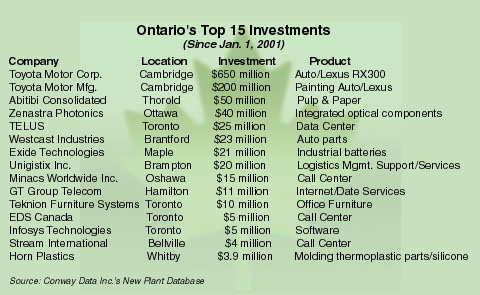
"These new SAW devices will eventually help satellites to deliver high-speed Internet access to Canadians in remote regions," says Janko Peric, Cambridge MP. "COM DEV's new SAW products, now possible with this new facility, will help move us toward our goal of making Canada the most connected country in the world." The provincewide research load is backed by heavy-duty universities and colleges, as well as specialized centers like Toronto's Photonics Research Ontario project and programs like the Ontario Research and Innovation Optical Network. They're building on one of the most fiber-heavy infrastructures around: After all, Canada was the first country in the world to establish a coast-to-coast fiber-optic network. "One of the characteristics of all these clusters is they have at least two universities in the area," Gordon says. "It has its advantages and its drawbacks," he adds, referring to the plethora of well-qualified graduates that Ontario, like every other place it seems, struggles to retain. But if everyone seems to have the "brain drain" syndrome when it comes to keeping qualified talent at homegrown tech companies, then Toronto and Ontario alike are doing everything in their power to be a brain basin. "Sheridan College [known as the "Harvard of Animation"] produces some of the world's best digital animation and media people, and Humber College had the first Microsoft e-College facilities in Canada," says Gordon. The University of Toronto alone has the $5 million Nortel Institute for Telecommunications as well as the $3.8 million Energenius Center for Advanced Nanotechnology. Energenius has also donated significant dollars to the nearby Center for Advanced Robotics, Mechantronics and Intelligent Systems. What's more, UT also boasts new digital-systems labs thanks to CA$1 million from Altera, and a new program in financial engineering and risk management, thanks to a partnership with Algorithmics Inc. After all -- as too many have learned the hard way -- one of high-tech's primary needs is some savvy high finance. "One of the characteristics of the sector in general is there are a lot of niche market parts," says Gordon. "Healthcare and financial services are two of those niche markets." A 1998 KPMG study comparing Toronto to cities like Atlanta, Dallas and Boston found that the city's labor cost advantage for a prototypical financial services firm would range from 22 percent to 38 percent better than all eight U.S. cities studied. That same year saw the deregulation of overseas long distance, adding to the opportunities presented by the deregulation of the long-distance market and sparking the arrival of the first of many facility-based telecom companies and long-distance resellers. Several developments with telecom ties are being pursued, including a 370,000-sq.-ft. (34,400-sq.-m.) project at the former Molson Brewery on Fleet Street. A follow-up study in 2000 by KPMG revealed the advantages held by Toronto were even more pronounced, beating the other eight cities' costs of doing business by from 43 percent to more than 68.
TOP OF PAGE
|
|
©2001 Conway Data, Inc. All rights reserved. SiteNet data is from many sources and not warranted to be accurate or current.
|