"There's no doubt that San Antonio's future is to the South. As trade increases to Mexico and Latin America, it will have a big impact on our community," says Mario Hernandez, president of San Antonio Economic Fund. Since the implementation of the North American Free Trade Agreement (NAFTA) in 1994, San Antonio has benefited from its position as a major hub along the NAFTA highway. Hernandez notes that over the last few years, 20 percent of the firms moving into the greater San Antonio area, whether they are a production or distribution facility, do so because of the area's proximity to Mexican market.
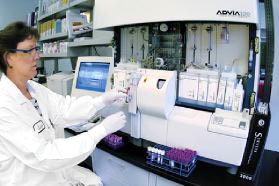
Pathology lab at ILEX Oncology in San Antonio
San Antonio is only 150 miles (93 kilometers) from Mexico, and ranked as the ninth city in the nation in economic strength according to a study published this year by Policom Corp. of Jupiter, Fla. (
www.policom.com). The study ranked cities by categories such as per-capita income, wages and salaries, construction, welfare and Medicaid programs. The combination makes the Alamo City an ideal site for manufacturing and business facilities. "We'll get a firm such as Tekata, a Japanese seatbelt manufacturer, to open here. They ship their product south for final assembly on automobiles in Mexico," says Hernandez.
The city is also an unbeatable spot for distribution and warehousing facilities. Federal Express opened a regional distribution center in late 1999, and two firms, Alamo Aircraft and Fairchild Aerospace, announced expansion of their facilities last year. Hernandez notes the city of San Antonio owns about 4 million-sq. ft. (371,600 sq. m.) of warehouse located at Kelly USA, the former Kelly Air Force base.
Even with the closing of Kelly AFB, unemployment in San Antonio remains low, slightly above 4 percent. Those 17,000 workers that were employed at Kelly are a skilled work force for firms locating in the area. "We've been very fortunate in that we have been able to absorb the majority of those people back into the work force," adds Hernandez. "We have pointed to the unique assets and skills that are available with the closing. Those skills have helped us bring Boeing, Lockheed Martin and Standard Aero to the San Antonio area." Boeing is expanding its work force with the addition of 300 employees at a new hangar at Kelly USA.
Growing Science in South Texas
The largest industry in San Antonio continues to be the biomedical field. In 2000, the industry employed 96,000 workers, or roughly 14 percent of the total work force. "Biomedical has an $8.2 billion impact per year in San Antonio," notes Hernandez. "It's our largest single sector and is a big part of our economy." The industry has captured some large kudos. CHRISTUS Santa Rosa Hospital has been nationally recognized among the top 100 hospitals in the nation for its cardiac programs. For the second year, the University Health Care System has been named to America's Best Hospital list by U.S News & World Report.
San Antonio is also home of the Texas Research Park, a 1,236-acre (500-hectares) facility opened in 1990. In 1991, construction began on the Cancer Therapy & Research Center Institute for Drug Development. Last year, The George Siberry Technical Center, a multi-tenant laboratory facility, opened. The facility is geared to support the growth of bioscience industries in the South Texas area. ILEX, a local pharmaceutical company with headquarters in the park, is developing groundbreaking anticancer compounds to treat adult leukemia.
San Antonio officials say the expansion of the park and other bioscience industries have created a great magnet for other firms. Caremark, a pharmaceutical services company, recently announced an expansion of its mail service pharmacy facility. "They have just added 300 employees, which takes them to more than 1,200," adds Hernandez.
State officials have taken note and continue to fund research and development at local universities. Nearly $23 million of the $1 billion in revenue bonds issued by the state is to go to a new Biotechnology, Sciences and Engineering building at the University of Texas at San Antonio. The University of Texas Health Science Center at San Antonio could receive $29 million.
Local economic development officials believe the recent Texas Economic Development Act will further entice industries to the Alamo City. Officials also cite the exceptional lifestyle and many local attractions the city offers. "It's a good quality of life, but with the cost of a small town," says Hernandez. "Our overall cost of living is 10 percent below the national average. That combination gives us a real leg up in recruiting employers and employees."
--by Ginny Deal