


Go West! (cover) Research Charts BC's High-Tech Allure Vancouver Leads the High-Tech Pack BC Legislature Turns Over a New Maple Leaf Call Centers in BC Alberta's Climate Warms Up Edmonton in Peak Form Calgary's Golden Age Saskatchewan Branches Out Saskatoon's Science Smorgasbord Manitoba: Moving on Up Winnipeg: Manitoba's Success Center Request Information 
|

Research Charts
BC's High-Tech Allure Take for example, British Columbia (BC), which recently revealed its "State of the High-Technology Sector in British Columbia: Inaugural Benchmark Report." KPMG Consulting (www.kpmg.ca) completed the comprehensive report for the Science Council of British Columbia (www.scbc.org). The study compares BC's high-tech sector with those of Ontario, Quebec and Alberta and the U.S. states of Washington, Oregon and Massachusetts. 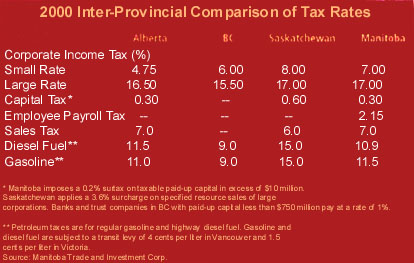
"Its real value is as a tool for strategizing how the industry can be more competitive and what we need to do to foster growth," noted Monty Little, chair of the Science Council, when the report was released in December 2000. The report puts in place a set of benchmarks against which economic development officials, private industry, governmental entities and others can gauge future success in attracting high-tech enterprises to the province. The report's findings have been tied to four goals set forth in BC's High-Tech Strategy. These are to make BC a place of choice, to develop and attract outstanding talent, to expand BC's research and development capability, and to market and promote the province. The analysis is structured around 39 performance indicators in four categories -- resource indicators that reflect public and private inputs into the high-tech sector; innovation indicators such as research and development expenditures; business enablers, which reflect business conditions (corporate tax rates, for example); and results indicators, which reflect outcomes such as gross domestic product. "The report is very much an attempt to describe the way things are rather than an attempt to be prescriptive," says Stuart MacKay, managing director at KPMG Consulting, in Vancouver, BC, explaining the tone of the report. "We identify where the province seems to have a competitive advantage or a disadvantage. We have a big competitive disadvantage right now in terms of our cost structure and our tax structure in relation to other Canadian provinces," he illustrates. "But that is a significant advantage over the U.S. On the other hand, we have an advantage over the Canadian provinces in that we are more able to attract people to this part of the world because of its quality of life. Yet we are at a disadvantage to the U.S., because we don't have the same wage structure. So you wouldn't have as much spending power to consume products as you would in a comparable U.S. jurisdiction."
TOP OF PAGE
|
|
©2001 Conway Data, Inc. All rights reserved. SiteNet data is from many sources and not warranted to be accurate or current.
|