


A Diverse Economy Helps Keep Missouri's Business Climate On Track (cover) St. Louis Expands to the Next River Kansas City Eyes 'Destination' Label Strong Points Dot the Map Request Information 
|
MISSOURI SPOTLIGHT
A Diverse Economy
Helps Keep Missouri's Business Climate On Track
"St. Louis is undergoing a transition from a heavy reliance on traditional manufacturing to higher-tech service businesses."
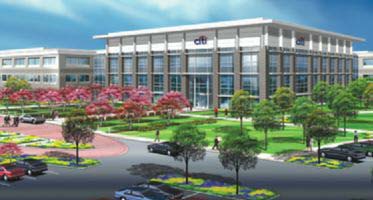
Headquarters to major operations of 13 Fortune 500 companies, employing more than 41,000 people, Missouri also has the 11th most diversified economy in the United States. Average hourly manufacturing pay in 2001 was $14.83, but six of the 10 fastest growing occupations in the state are computer-related, led by computer scientists, support specialists and systems analysts. James Driskill, director of the Missouri Dept. of Economic Development, sees healthy growth in many regions of the state, both urban and rural, in industries that he believes hold great promise for the future. "Most of Missouri's economic regions are experiencing tremendous growth in warehouse/distribution facilities, professional financial service companies, IT and office support firms, and mutual fund companies," he says. All of those industries benefit from recent findings by the American Chambers of Commerce Research Association that Missouri has the third-best cost-of-living index of 43 states surveyed, trailing only neighboring states Arkansas and Tennessee. During the third quarter of the year, the state led all competitors in low-cost housing, utilities and transportation, and no cities in the state reported an above-average composite cost of living. Other types of infrastructure are important, too. From 1989-90 to 1998-99, the average public school teacher's salary in Missouri has grown from $27,094 to $34,807. "Despite deteriorating economic conditions, Missouri has maintained a good quality of life at lower costs than most states," says Driskill. Those hard times have indeed brought some hard knocks to the state's economy and workforce, beginning with the Chapter 11 bankruptcy declared last year by St. Louis icon TWA, subsequently acquired by American Airlines. Later slowdowns in the automotive sector forced cutbacks at plants in the state. "With the current national recession and state budget concerns negatively impacting Missouri, the recent expansion and job retention announcements by Magellan Health and CitiMortgage were definitely good news for the St. Louis region and the state of Missouri," says Driskill. Compliance with state austerity measures meant Driskill and an ad hoc tax force recently had to trim $7.7 million from their $220-million tax credit budget, which they administer through 31 different programs. But most programs came through relatively unscathed, and even those reduced ought to rebound next year. One progressive measure that is seeing fruitful results already is the state's brownfield redevelopment program, which offers tax credits for remediation, investment and job creation. Among projects benefiting from the program have been the redevelopment of light industrial and warehouse space and road improvements in the old industrial district of Kansas City known as the West Bottoms; the renovation of the historic Gateway and Lennox Hotels on the St. Louis riverfront, creating more than 1,000 rooms for the renamed St. Louis Convention Center Hotel; and the location of the $55-million Sigma Aldrich Life Science and High Technology Center in St. Louis, which will benefit from 10 years of brownfield tax breaks. The Sigma Aldrich project is just one of many in the state receiving funds based on reclamation -- not only the reclaiming of dormant land, but of public health. Last spring, Gov. Bob Holden designated $21.5 million from state tobacco settlement funds to increase research capacity in several Missouri research centers, and has proposed to spend $21.6 on those efforts during the next fiscal year beginning this July. That kind of investment mirrors the interest shown in the sector by private projects in the state, primarily in and around the metro areas of St. Louis and Kansas City, two border city economies with unlimited horizons.
TOP OF PAGE
|
|
©2002 Conway Data, Inc. All rights reserved. SiteNet data is from many sources and not warranted to be accurate or current.
|