


FINANCIAL SERVICES
From Site Selection magazine, November 2007
Where the Customers Are
T
wenty percent.
It's the proportion of New York City wages supported by the finance industry. And it's the portion of the entire United States GDP now constituted by the finance, insurance and real estate (FIRE) sector.
Whether that's too much depends on where, literally, you sit.
Earlier this year, journalist Randy Holhut compared today's GDP split, when manufacturing contributes less than 13 percent, to that of 1950, when "manufacturing was 29.3 percent of GDP and financial services contributed 10.9 percent."
Echoing the "financialization" concerns of political analyst Kevin Phillips, he went on to lament this shift, as more money is made in moving money around than in the productive activity of making things. But in the world of corporate facility development, the lamentation may not be so great,
 according to the Conway Data New Plant Database, with multiple facility projects and expansions around the world in the past two years, including the Fidelity campus in Covington, Ky., pictured to the right. Fidelity is also growing in North Carolina, Jacksonville and Westlake, Texas. "Whatever the question, Citi or Fidelity is often the answer," says Steve Bartlett, president and CEO of the Financial Services Roundtable, who as mayor of Dallas welcomed a new call center from the company. He says his message to the mayors of America is that financial services people are easy to work with, and are just looking for a good fit. Witness his experience with Fidelity's regional vice president:
"He made an appointment, and said he was going to put a call center at City Place and employ 450 people," says Bartlett. "The meeting didn't go well because I didn't quite understand. I was saying, 'What can I offer you? What abatements?' And he said, 'We've already signed the lease. Would you mind showing up at the ribbon cutting?' I did a little more than that – we gave them a parade."
as this powerful service sector creates jobs and moves its own capital into communities.
The Numbers on the
Numbers Game
U.S. Bureau of Economic Analysis data show that the value added by the finance, insurance, real estate, rental, and leasing sector of the economy has catapulted from US$1.68 trillion in 1998 to $2.76 trillion in 2006. Within that, finance and insurance alone have grown from $641 billion in 1998 to more than $1 trillion for the first time in 2006.
In that same span, as manufacturing employment has fallen from 17 million to 14 million, FIRE firms have seen their employment numbers rocket by 600,000 to 8.3 million in 2006.
Perhaps most significantly, total compensation paid to FIRE sector employees in 2006 was more than $640 billion. That averages out to a handy $77,000 in annual pay, compared to a none-too-shabby $66,600 in manufacturing.
No wonder, according to a recent report, that the FIRE sector is the top-spending corporate lobby, spending an estimated $2.55 billion on lobbying between 1998 and 2007. The timing is not coincidental, as 1999 saw the passage of the Financial Services Modernization Act, allowing financial holding companies to break down Chinese walls and own many kinds of businesses.
"As you look at the corporate headquarters, now numbering 30, that have come to Tennessee since Gov. [Phil] Bredesen has come into office, most of those have been a large financial operation," says Matt Kisber, commissioner of the Tennessee Dept. of Community and Economic Development. One offshoot of such operations, which often concentrate on accounts receivable and payable or on customer service functions, is the data center niche.
"Bank of New York placed one of its data centers here in the Nashville area," says Kisber. "Learning from projects like that, we went in this year and made some further changes to our tax incentives to more broadly define those operations within the telecom and manufacturing incentives. There is a threshold for large data center operations – equipment that goes into one will be classified as industrial machinery, allowing for a tax exemption and various credits. That's a very significant paradigm shift ... The replenishment cycle on those investments is fairly quick,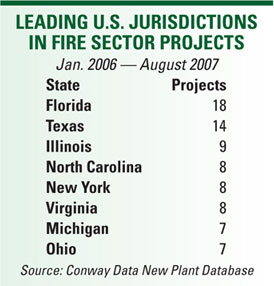 between three and four years, and Tennessee offers inexpensive and reliable power, which is a necessity for data centers."
Northern Kentucky has had a similar experience. When Fidelity Investments first came to Covington in 1992, it was going to invest $20 million and hire 800. Its newest expansion now under way there will bring the total investment to $180 million and total employment to 4,000.
Top North American cities in attracting FIRE sector projects from January 2006 through August 2007, according to new construction criteria established by the Conway Data New Plant Database, include Chicago (5), Jacksonville (5), Atlanta (4), Omaha (3), San Antonio (3) and the St. Louis suburb of Maryland Heights (3). North American cities with two projects each during that span include FIRE-sector stalwarts Mississauga, Ont., Charlotte, N.C. and Miami, Fla., as well as up-and-comers such as Henderson, Nev. (see p. 930), and Dubuque, Iowa.
Other areas such as northeast Pennsylvania, El Paso and Toronto are focusing recruiting efforts on the sector, marshalling to their cause recent studies showing strengths in both costs and skill level. Northeast Pennsylvania, using a U.S. Dept. of Labor WIRED grant, is calling its effort the "Wall Street West Initiative." Meanwhile, hedge funds and other financial firms continue to drive Connecticut's prominent position in the financial services arena. Citing rising costs in New York City and Greenwich, Staubach in May negotiated leases totaling 125,000 sq. ft. (11,613 sq. m.) in Stamford for Greenwich Associates and CRT Capital Management.
Also in May, mutual funds firm Capital Group Companies announced it would add 250 jobs and invest $12 million in the expansion of its American Funds customer service center in Chesapeake, Va., after just opening up shop there in December 2005. The firm employs nearly 800 at three operations in the Hampton Roads area.
As Mississauga demonstrates, the sector's power is by no means confined to the United States. Ontario's first quarter GDP figures showed that financial services, at 3.1 percent, provided one third of the overall output increase in the FIRE sector of 1.3 percent. "Over the last four quarters, the financial sector has provided by far the largest positive contribution to overall Ontario growth of any sector," reported Ontario Economic Accounts.
Among the most recent projects in Ontario is Citigroup's new $59-million headquarters in Mississauga. Employees at Citi Cards offices in Toronto and Burlington, as well as employees from four CitiFinancial Canada sites in Toronto, Mississauga and Concord, will move into the facility when construction is complete at the end of this year. The 200,000-sq.-ft. (18,580-sq.-m.) facility is located in the 1,250-acre (506-hectare) Heartland Business Community.
Just Like the Markets
The ups and downs of the sector are akin to the ups and downs of the financial markets so many of them serve.
Some communities have experienced some fallout in financial services, e.g. MBNA in Maine (since purchased by Bank of America), only to see other financial companies swoop into the abandoned facility space. Others have gone out of their way to retain such operations.
In Wichita, Kan., the selfsame Bank of America had to decide where to go when the building housing its call center went on the block. With the help of the Greater Wichita Economic Development Corp., the company stayed in town, is investing $10 million in a new location and is adding 35 people to its payroll of 280.
According to GWEDC, the agency coordinated a package of incentives from the city of Wichita, Sedgwick County and the Kansas Department of Commerce that includes forgivable loans, tax credits and job training programs.
Countrywide Financial Corp. which made the highly publicized move of thousands of jobs to Texas in the past two years. Now, struck by the mortgage lending crisis, the company may cut as many as 12,000 jobs. After increasing to more than 61,500 employees in July, employment has already fallen to just under 56,000. Approximately 11,500 of those jobs are in Texas, concentrated in the Dallas-Fort Worth Area.
Headquarters Synergy
But the same area is welcoming a new project in the form of Comerica Inc.'s decision in March 2007 to relocate its corporate headquarters from Detroit (where it was the last bank to be headquartered in the city) to Dallas.
"Over the past three years, we have been advancing our strategy to diversify our customer base and extend Comerica's reach into key high-growth markets," said Ralph W. Babb, Jr., chairman and CEO of Comerica.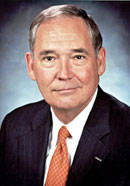 "Today, a significant percentage of Comerica's earnings is generated in the Texas, Arizona, California and Florida markets. Moving our corporate headquarters to Dallas will give us greater proximity to all of our markets, and the additional resources in these markets will lead to accelerated growth for Comerica. In addition, the vibrant and diversified economies of Dallas, Houston and Austin will be particularly helpful to Comerica as we seek to continue attracting and retaining talented employees."
"Given Comerica's long and successful history in the city of Detroit and the state of Michigan, this decision was not taken lightly," Babb continued. "After a comprehensive review of our growth opportunities and very careful consideration, our Board of Directors and executive management believe the relocation of our corporate headquarters is in the best long-term interests of our shareholders, customers and employees. Michigan and the city of Detroit are key markets for us. Comerica will continue to have approximately 7,300 employees throughout Michigan, where we intend to uphold our long-standing commitment to the local communities."
The company stated that Dallas proved to be the most centrally located and most proximal to its key markets. In addition, both Dallas and the state provided incentives to offset some of the costs of the move, projected to cost between $15 million and $20 million over three years. Working with Gov. Rick Perry's office, the Lieutenant Governor, the Texas Speaker of the House, the Dallas Mayor's Office and the Greater Dallas Chamber of Commerce, Comerica received incentives including grants from the Texas Enterprise Fund, economic development grants from Dallas and tax abatements.
Comerica will be the largest bank holding company headquartered in Texas, "which we believe represents an important differentiator as we work to enhance existing customer relationships and build new ones," said the bank.
Comerica also hopes to build some of those relationships with a key demographic: the more than 10,000 corporate headquarters that call Dallas home.
Roundtable Reflections
The Financial Services Roundtable represents 100 of the largest integrated financial services companies providing banking, insurance, and investment products and services to the U.S. consumer. Roundtable member companies alone account for 2.4 million jobs, $65.8 trillion in managed assets, and $1 trillion in revenue.
Leading the group as president and CEO since 1999 has been former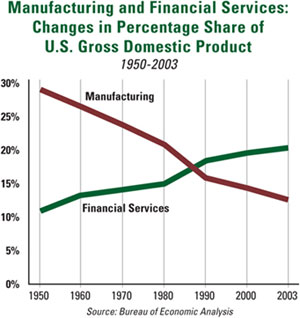 Dallas Mayor Steve Bartlett, who served the city from 1991 to 1995 after serving in Congress for eight years. In addition to helping attract his fair share of those corporate headquarters to Dallas, he has been active as both an elected official and lobbyist in helping shape such legislation as Sarbanes-Oxley, the 2001 tax cuts and the Enhanced Secondary Mortgage Market Act. Before all of that, he was in the injection-molded plastics business. He has served on the board of IMCO Recycling and now serves on the board of fast-growing St. Louis-based HMO Centene Corp.
"The financial services industry is widely dispersed, so there is no longer a concentration of large facilities in one place," he says in an interview. "Clearly there are pockets of corporate headquarters in New York, San Francisco and Charlotte. Our companies have operations in every state. We measure it by politics – there are facilities and employees in every single congressional district. The reason is that's where the customers are."
As with any site selection, every corporate relocation has its own set of dynamics, Bartlett says.
Asked which states excel in terms of regulatory burdens and lack of red tape, he quips, "We all want to locate in Delaware, but we all can't fit there."
But regulatory climate does indeed matter.
"More importantly, the quality of litigation makes a difference," he says. "If there is a tort system that's abusive, companies will avoid it."
Regulations that foster a competitive marketplace, conversely, will attract companies, he says.
"We believe, and the industry believes, that companies should be able to rely on national standards, so that consumer protection is the same in Birmingham or Boise," says Bartlett.
Bartlett is not bothered by offshoring of corporate or outsourced back-office activity, which he says is primarily cost-driven, sometimes litigation-driven, but mostly customer-driven. Besides, he says, having some of these operations overseas helps the U.S. "because it helps our balance of payment."
Asked if business continuity planning in the wake of 9/11 is still driving financial services activities into second- and third-tier markets, he says, "I don't see it," primarily because there are other solutions, such as double piping and working from two grids: "It's a more sophisticated analysis than just locating in another state."
However, those smaller locations' generally lower business costs combined with now-ubiquitous technology advances make many a small city a viable candidate.
"With technology you can offer a national product and platform from anyplace in America," he says.
Rich Niches
Like data centers, other strong sub-niches in financial services include automotive financing and insurance, trading and investment banking. Recent months have seen a number of deals, including from Ford Motor Credit and Toyota Motor Credit in Henderson, Nev.
In June, United Automobile Insurance Group (UAIG) chose to expand its national headquarters in Miami-Dade County, Fla., after considering relocation to Illinois or Georgia. UAIG, founded in Miami nearly 20 years ago, currently writes business in eight states, with licenses in six more.
Along with their more than 500 existing employees, UAIG will hire up to 75 full-time additional employees in the next three years. The company will be expanding to a new, 100,000-sq.-ft. (9,290-sq.-m.) facility in an Enterprise Zone in Miami Gardens, with a capital investment of $16 million.
Also in June, DaimlerChrysler Financial Services announced it had expanded operations of its newly-established, 23,000-sq.-ft. (2,137-sq.-m.) Spanish Americas Contact Center (SACC) in Monterrey, Mexico, to include Hispanic customers in both Mexico and the United States. The center employs 180 full- and part-time employees.
"After more than a year of planning and in collaboration with the Mexican government, we are pleased to start serving our Spanish-speaking customers in both Mexico and the United States from our location in Monterrey," said Paul Knauss, vice president of operations of DaimlerChrysler Financial Services Americas LLC and incoming president and CEO of Chrysler Financial. "We envision Chrysler Financial's new customer contact center to emerge as an international focal point in customer service excellence."
Back in Fort Worth, there is financial services activity well beyond the downtown skyscrapers. At Hillwood's huge Alliance Texas logistics-focused development, Mercedes-Benz Financial in August announced it would lease more than 75,000 sq. ft. (6,968 sq. m.) in a nearly complete spec office building, which it will occupy in January. The firm will employ approximately 350 workers at its new location.
The move is a result of a transfer of assets of Chrysler and Chrysler Financial to Cerberus Capital Management, which is expected to close in the third quarter. Approximately 750 Chrysler Financial employees will remain at the present location in nearby Westlake.
"Alliance was a natural selection for Mercedes-Benz Financial," said Janet Marzett, vice president of customer service and remarketing. "We have had an excellent relationship with Hillwood at the building we lease in Westlake, which supported the combined group, Chrysler Financial and Mercedes-Benz Financial. The location, in proximity to our current employee base, together with the quality environment of Alliance, made our process very easy and keeps our Mercedes-Benz Financial team together."
"Mercedes-Benz Financial took a serious look at new generation office space immediately north of the Dallas Fort Worth Airport, but ultimately decided that both current and future employee demographics favor a location in the Alliance Corridor," said Stuart Smith, senior vice president of UGL Equis who represented Mercedes-Benz Financial in the transaction. "Hillwood's timing of construction completion of Heritage Commons II also fit perfectly with Mercedes-Benz Financial's relocation schedule."
The company, now officially called "Daimler," followed up that development with the Nov. 12 announcement that it would lease a three-story, 204,000-sq.-ft. (18,952-sq. m.) build-to-suit in the Fort Worth section of AllianceTexas. The new building will house 650 employees of Daimler Financial Services Americas.
A Hillwood release stated that the division had expanded its needs since August. The 650 employees in the build-to-suit include 180 from the Daimler Truck Financial operations in Lisle, Ill. and another 35 employees from several Mercedes-Benz Financial locations around the United States.
"The de-merger has given us the opportunity to take a clean sheet of paper approach to our operations and re-engineer the way we serve our dealers and retail customers in the U.S. market," said Klaus Entenmann, president and CEO of Daimler Financial Services Americas, a new company with a new U.S. headquarters in Farmington Hills, Mich. "Co-locating the customer service and dealer credit operations of our to business units – Mercedes-Benz Financial and Daimler Truck Financial – will create a learning environment for our employees that will lead to professional growth opportunities."
Houston, We Have No Problem
The Lone Star state's financial services prowess is not confined to DFW and San Antonio. In October, energy trading action got its groove back in Houston, as Deutsche Bank Securities, Inc., announced a 21,351-sq.-ft. (1,984-sq.-m.) trading operation in Houston, negotiated by Jones Lang LaSalle.
According to JLL, Deutsche Bank "was on a short timeline due to the need to get this operation up and running as quickly as possible in order to accommodate their employee relocation and hiring plan. The Houston team was tasked with identifying properties that could accommodate the size requirement, expansion needs, as well as the backup power and high-speed telecommunication and bandwidth demands of a trading operation.
"There are very few buildings that contain this type of space, along with the critical infrastructure that can support a robust trading operation," said Louis Rosenthal, leasing director, Jones Lang LaSalle. But JLL knew the capabilities at 1301 Fannin St., having acted as landlord rep for the property for 14 years. Renovations and are expected to begin later this year.
"Finding this kind of space and getting a lease negotiated and the space built out in a short time frame was a real challenge," said Rosenthal. "Trading operation leases are quite complex to execute due to the nature of the business. They cannot afford any downtime. They require redundant power, chilled water and fiber connectivity to serve a densely packed trading floor to ensure 100 percent uptime with all telephone and Internet connections," he said.
There to Help
Asked if there were specific skills in need of shoring up in the U.S. to serve the industry, Bartlett says his organization looked at just that issue two years ago, and found that the industry is comfortable with the work force it has, in part because it trains its own.
"I asked our 100 companies if they were interested in a training program, and they said, 'No,'" he says. "They have significant training operations, and they want to train their employees themselves. I assume from that there is not a crisis brewing."
The crisis may be in the general populace, where Bartlett and others say there are too many people coming out of school who can't finance a mortgage, balance a checkbook or avoid overdraft fees. (Hence the rise in financial services work?)
One "crying need" in the industry, however, says Bartlett, is bilingual customer interface, especially in Spanish and in Asian languages, led by Chinese. He points out that much of the sector's employment base is operations employing five or fewer. A recent survey of 60 companies tallied 51,000 U.S. locations where those companies are employing somebody: "Of those 51,000, fewer than 1,000 would be major facilities," says Bartlett.
Bartlett counters concerns about the financialization of the economy by pointing out that the 2.5 million people employed by the financial services sector finance the activities of the rest of us.
"You want to recruit companies that will help finance growth of everybody else," he says. "Even with the job cuts from the mortgage companies, the employment base is still growing. There are small cuts in some facilities, but nothing compared to the growth in the next 10 years. If everything else is getting better, the financial services sector is going to get twice as much better. You can't build it or drive it unless somebody finances it."

It's the proportion of New York City wages supported by the finance industry. And it's the portion of the entire United States GDP now constituted by the finance, insurance and real estate (FIRE) sector.
Whether that's too much depends on where, literally, you sit.
Earlier this year, journalist Randy Holhut compared today's GDP split, when manufacturing contributes less than 13 percent, to that of 1950, when "manufacturing was 29.3 percent of GDP and financial services contributed 10.9 percent."
Echoing the "financialization" concerns of political analyst Kevin Phillips, he went on to lament this shift, as more money is made in moving money around than in the productive activity of making things. But in the world of corporate facility development, the lamentation may not be so great,
Answering the Call
F
idelity and Citigroup are the companies with the project heft,
"He made an appointment, and said he was going to put a call center at City Place and employ 450 people," says Bartlett. "The meeting didn't go well because I didn't quite understand. I was saying, 'What can I offer you? What abatements?' And he said, 'We've already signed the lease. Would you mind showing up at the ribbon cutting?' I did a little more than that – we gave them a parade."
The Numbers on the
Numbers Game
In that same span, as manufacturing employment has fallen from 17 million to 14 million, FIRE firms have seen their employment numbers rocket by 600,000 to 8.3 million in 2006.
Perhaps most significantly, total compensation paid to FIRE sector employees in 2006 was more than $640 billion. That averages out to a handy $77,000 in annual pay, compared to a none-too-shabby $66,600 in manufacturing.
No wonder, according to a recent report, that the FIRE sector is the top-spending corporate lobby, spending an estimated $2.55 billion on lobbying between 1998 and 2007. The timing is not coincidental, as 1999 saw the passage of the Financial Services Modernization Act, allowing financial holding companies to break down Chinese walls and own many kinds of businesses.
"As you look at the corporate headquarters, now numbering 30, that have come to Tennessee since Gov. [Phil] Bredesen has come into office, most of those have been a large financial operation," says Matt Kisber, commissioner of the Tennessee Dept. of Community and Economic Development. One offshoot of such operations, which often concentrate on accounts receivable and payable or on customer service functions, is the data center niche.
"Bank of New York placed one of its data centers here in the Nashville area," says Kisber. "Learning from projects like that, we went in this year and made some further changes to our tax incentives to more broadly define those operations within the telecom and manufacturing incentives. There is a threshold for large data center operations – equipment that goes into one will be classified as industrial machinery, allowing for a tax exemption and various credits. That's a very significant paradigm shift ... The replenishment cycle on those investments is fairly quick,
Northern Kentucky has had a similar experience. When Fidelity Investments first came to Covington in 1992, it was going to invest $20 million and hire 800. Its newest expansion now under way there will bring the total investment to $180 million and total employment to 4,000.
Top North American cities in attracting FIRE sector projects from January 2006 through August 2007, according to new construction criteria established by the Conway Data New Plant Database, include Chicago (5), Jacksonville (5), Atlanta (4), Omaha (3), San Antonio (3) and the St. Louis suburb of Maryland Heights (3). North American cities with two projects each during that span include FIRE-sector stalwarts Mississauga, Ont., Charlotte, N.C. and Miami, Fla., as well as up-and-comers such as Henderson, Nev. (see p. 930), and Dubuque, Iowa.
Other areas such as northeast Pennsylvania, El Paso and Toronto are focusing recruiting efforts on the sector, marshalling to their cause recent studies showing strengths in both costs and skill level. Northeast Pennsylvania, using a U.S. Dept. of Labor WIRED grant, is calling its effort the "Wall Street West Initiative." Meanwhile, hedge funds and other financial firms continue to drive Connecticut's prominent position in the financial services arena. Citing rising costs in New York City and Greenwich, Staubach in May negotiated leases totaling 125,000 sq. ft. (11,613 sq. m.) in Stamford for Greenwich Associates and CRT Capital Management.
Also in May, mutual funds firm Capital Group Companies announced it would add 250 jobs and invest $12 million in the expansion of its American Funds customer service center in Chesapeake, Va., after just opening up shop there in December 2005. The firm employs nearly 800 at three operations in the Hampton Roads area.
As Mississauga demonstrates, the sector's power is by no means confined to the United States. Ontario's first quarter GDP figures showed that financial services, at 3.1 percent, provided one third of the overall output increase in the FIRE sector of 1.3 percent. "Over the last four quarters, the financial sector has provided by far the largest positive contribution to overall Ontario growth of any sector," reported Ontario Economic Accounts.
Among the most recent projects in Ontario is Citigroup's new $59-million headquarters in Mississauga. Employees at Citi Cards offices in Toronto and Burlington, as well as employees from four CitiFinancial Canada sites in Toronto, Mississauga and Concord, will move into the facility when construction is complete at the end of this year. The 200,000-sq.-ft. (18,580-sq.-m.) facility is located in the 1,250-acre (506-hectare) Heartland Business Community.
Just Like the Markets
Some communities have experienced some fallout in financial services, e.g. MBNA in Maine (since purchased by Bank of America), only to see other financial companies swoop into the abandoned facility space. Others have gone out of their way to retain such operations.
In Wichita, Kan., the selfsame Bank of America had to decide where to go when the building housing its call center went on the block. With the help of the Greater Wichita Economic Development Corp., the company stayed in town, is investing $10 million in a new location and is adding 35 people to its payroll of 280.
According to GWEDC, the agency coordinated a package of incentives from the city of Wichita, Sedgwick County and the Kansas Department of Commerce that includes forgivable loans, tax credits and job training programs.
Countrywide Financial Corp. which made the highly publicized move of thousands of jobs to Texas in the past two years. Now, struck by the mortgage lending crisis, the company may cut as many as 12,000 jobs. After increasing to more than 61,500 employees in July, employment has already fallen to just under 56,000. Approximately 11,500 of those jobs are in Texas, concentrated in the Dallas-Fort Worth Area.
Headquarters Synergy
"Over the past three years, we have been advancing our strategy to diversify our customer base and extend Comerica's reach into key high-growth markets," said Ralph W. Babb, Jr., chairman and CEO of Comerica.
Ralph W. Babb Jr., chairman and chief executive officer, Comerica Incorporated and Comerica Bank.
PRNewsFoto/ Comerica Incorporated
"Given Comerica's long and successful history in the city of Detroit and the state of Michigan, this decision was not taken lightly," Babb continued. "After a comprehensive review of our growth opportunities and very careful consideration, our Board of Directors and executive management believe the relocation of our corporate headquarters is in the best long-term interests of our shareholders, customers and employees. Michigan and the city of Detroit are key markets for us. Comerica will continue to have approximately 7,300 employees throughout Michigan, where we intend to uphold our long-standing commitment to the local communities."
The company stated that Dallas proved to be the most centrally located and most proximal to its key markets. In addition, both Dallas and the state provided incentives to offset some of the costs of the move, projected to cost between $15 million and $20 million over three years. Working with Gov. Rick Perry's office, the Lieutenant Governor, the Texas Speaker of the House, the Dallas Mayor's Office and the Greater Dallas Chamber of Commerce, Comerica received incentives including grants from the Texas Enterprise Fund, economic development grants from Dallas and tax abatements.
Comerica will be the largest bank holding company headquartered in Texas, "which we believe represents an important differentiator as we work to enhance existing customer relationships and build new ones," said the bank.
Comerica also hopes to build some of those relationships with a key demographic: the more than 10,000 corporate headquarters that call Dallas home.
Roundtable Reflections
Leading the group as president and CEO since 1999 has been former
"The financial services industry is widely dispersed, so there is no longer a concentration of large facilities in one place," he says in an interview. "Clearly there are pockets of corporate headquarters in New York, San Francisco and Charlotte. Our companies have operations in every state. We measure it by politics – there are facilities and employees in every single congressional district. The reason is that's where the customers are."
As with any site selection, every corporate relocation has its own set of dynamics, Bartlett says.
Asked which states excel in terms of regulatory burdens and lack of red tape, he quips, "We all want to locate in Delaware, but we all can't fit there."
But regulatory climate does indeed matter.
"More importantly, the quality of litigation makes a difference," he says. "If there is a tort system that's abusive, companies will avoid it."
Regulations that foster a competitive marketplace, conversely, will attract companies, he says.
"We believe, and the industry believes, that companies should be able to rely on national standards, so that consumer protection is the same in Birmingham or Boise," says Bartlett.
Bartlett is not bothered by offshoring of corporate or outsourced back-office activity, which he says is primarily cost-driven, sometimes litigation-driven, but mostly customer-driven. Besides, he says, having some of these operations overseas helps the U.S. "because it helps our balance of payment."
Asked if business continuity planning in the wake of 9/11 is still driving financial services activities into second- and third-tier markets, he says, "I don't see it," primarily because there are other solutions, such as double piping and working from two grids: "It's a more sophisticated analysis than just locating in another state."
However, those smaller locations' generally lower business costs combined with now-ubiquitous technology advances make many a small city a viable candidate.
"With technology you can offer a national product and platform from anyplace in America," he says.
Rich Niches
In June, United Automobile Insurance Group (UAIG) chose to expand its national headquarters in Miami-Dade County, Fla., after considering relocation to Illinois or Georgia. UAIG, founded in Miami nearly 20 years ago, currently writes business in eight states, with licenses in six more.
Along with their more than 500 existing employees, UAIG will hire up to 75 full-time additional employees in the next three years. The company will be expanding to a new, 100,000-sq.-ft. (9,290-sq.-m.) facility in an Enterprise Zone in Miami Gardens, with a capital investment of $16 million.
Also in June, DaimlerChrysler Financial Services announced it had expanded operations of its newly-established, 23,000-sq.-ft. (2,137-sq.-m.) Spanish Americas Contact Center (SACC) in Monterrey, Mexico, to include Hispanic customers in both Mexico and the United States. The center employs 180 full- and part-time employees.
"After more than a year of planning and in collaboration with the Mexican government, we are pleased to start serving our Spanish-speaking customers in both Mexico and the United States from our location in Monterrey," said Paul Knauss, vice president of operations of DaimlerChrysler Financial Services Americas LLC and incoming president and CEO of Chrysler Financial. "We envision Chrysler Financial's new customer contact center to emerge as an international focal point in customer service excellence."
Back in Fort Worth, there is financial services activity well beyond the downtown skyscrapers. At Hillwood's huge Alliance Texas logistics-focused development, Mercedes-Benz Financial in August announced it would lease more than 75,000 sq. ft. (6,968 sq. m.) in a nearly complete spec office building, which it will occupy in January. The firm will employ approximately 350 workers at its new location.
The move is a result of a transfer of assets of Chrysler and Chrysler Financial to Cerberus Capital Management, which is expected to close in the third quarter. Approximately 750 Chrysler Financial employees will remain at the present location in nearby Westlake.
"Alliance was a natural selection for Mercedes-Benz Financial," said Janet Marzett, vice president of customer service and remarketing. "We have had an excellent relationship with Hillwood at the building we lease in Westlake, which supported the combined group, Chrysler Financial and Mercedes-Benz Financial. The location, in proximity to our current employee base, together with the quality environment of Alliance, made our process very easy and keeps our Mercedes-Benz Financial team together."
"Mercedes-Benz Financial took a serious look at new generation office space immediately north of the Dallas Fort Worth Airport, but ultimately decided that both current and future employee demographics favor a location in the Alliance Corridor," said Stuart Smith, senior vice president of UGL Equis who represented Mercedes-Benz Financial in the transaction. "Hillwood's timing of construction completion of Heritage Commons II also fit perfectly with Mercedes-Benz Financial's relocation schedule."
The company, now officially called "Daimler," followed up that development with the Nov. 12 announcement that it would lease a three-story, 204,000-sq.-ft. (18,952-sq. m.) build-to-suit in the Fort Worth section of AllianceTexas. The new building will house 650 employees of Daimler Financial Services Americas.
A Hillwood release stated that the division had expanded its needs since August. The 650 employees in the build-to-suit include 180 from the Daimler Truck Financial operations in Lisle, Ill. and another 35 employees from several Mercedes-Benz Financial locations around the United States.
"The de-merger has given us the opportunity to take a clean sheet of paper approach to our operations and re-engineer the way we serve our dealers and retail customers in the U.S. market," said Klaus Entenmann, president and CEO of Daimler Financial Services Americas, a new company with a new U.S. headquarters in Farmington Hills, Mich. "Co-locating the customer service and dealer credit operations of our to business units – Mercedes-Benz Financial and Daimler Truck Financial – will create a learning environment for our employees that will lead to professional growth opportunities."
Houston, We Have No Problem
According to JLL, Deutsche Bank "was on a short timeline due to the need to get this operation up and running as quickly as possible in order to accommodate their employee relocation and hiring plan. The Houston team was tasked with identifying properties that could accommodate the size requirement, expansion needs, as well as the backup power and high-speed telecommunication and bandwidth demands of a trading operation.
"There are very few buildings that contain this type of space, along with the critical infrastructure that can support a robust trading operation," said Louis Rosenthal, leasing director, Jones Lang LaSalle. But JLL knew the capabilities at 1301 Fannin St., having acted as landlord rep for the property for 14 years. Renovations and are expected to begin later this year.
"Finding this kind of space and getting a lease negotiated and the space built out in a short time frame was a real challenge," said Rosenthal. "Trading operation leases are quite complex to execute due to the nature of the business. They cannot afford any downtime. They require redundant power, chilled water and fiber connectivity to serve a densely packed trading floor to ensure 100 percent uptime with all telephone and Internet connections," he said.
There to Help
"I asked our 100 companies if they were interested in a training program, and they said, 'No,'" he says. "They have significant training operations, and they want to train their employees themselves. I assume from that there is not a crisis brewing."
The crisis may be in the general populace, where Bartlett and others say there are too many people coming out of school who can't finance a mortgage, balance a checkbook or avoid overdraft fees. (Hence the rise in financial services work?)
One "crying need" in the industry, however, says Bartlett, is bilingual customer interface, especially in Spanish and in Asian languages, led by Chinese. He points out that much of the sector's employment base is operations employing five or fewer. A recent survey of 60 companies tallied 51,000 U.S. locations where those companies are employing somebody: "Of those 51,000, fewer than 1,000 would be major facilities," says Bartlett.
Bartlett counters concerns about the financialization of the economy by pointing out that the 2.5 million people employed by the financial services sector finance the activities of the rest of us.
"You want to recruit companies that will help finance growth of everybody else," he says. "Even with the job cuts from the mortgage companies, the employment base is still growing. There are small cuts in some facilities, but nothing compared to the growth in the next 10 years. If everything else is getting better, the financial services sector is going to get twice as much better. You can't build it or drive it unless somebody finances it."
Site Selection Online – The magazine of Corporate Real Estate Strategy and Area Economic Development.
©2007 Conway Data, Inc. All rights reserved. SiteNet data is from many sources and not warranted to be accurate or current.
©2007 Conway Data, Inc. All rights reserved. SiteNet data is from many sources and not warranted to be accurate or current.