

RUSSIA & CIS
From Site Selection magazine, November 2007
High Tension,
High Investment
High Investment
I
s a dicey political situation doing anything to stem the immense tide of corporate facility investment into Russia?
No.
Are facility investment prospects looking up in countries such as Kazakhstan, Ukraine, Georgia and the other nine members of the Commonwealth of Independent States?
Yes.
That's what a review of project news and Conway Data New Plant Database reveals. As Russia's wealth of projects illustrates, the automotive industry is leading the way. But consumer-focused projects are coming through in spades as well.
Those include a US$57-million television plant from Samsung Electronics in Kaluga, and Kimberly-Clark's first Russian plant in Stupino.
In a terse public disclosure statement, Samsung said the purpose of the new plant was "to respond to the fast-growing digital TV demands in the CIS market."
Kimberly-Clark's plant will be built in phases and make products under the Huggies and Kleenex brands. The 150-job plant is part of the company's strategy to accelerate growth in developing and emerging markets, which include Brazil, Russia, India, China, Turkey and Indonesia.
"Russia is a strategically important market for K-C due to its rapid economic growth and the long-term potential of its health and hygiene categories," said Tom Davis, president of Kimberly-Clark's Middle East, Eastern Europe and Africa group, in September. "Local manufacturing is a key element of our strategy."
In this case, local means a town located approximately 60 miles (100 km.) southeast of Moscow, where the Kimberly-Clark plant will occupy an area of about 100 acres (40 hectares) when it starts up in early 2009. The project's first phase will include site preparation and construction of manufacturing buildings, offices, warehousing and roads.
"We chose Stupino for its developed infrastructure, highly qualified work force and excellent location for accessing the major cities of Russia and Eastern Europe," said Jonathan Tarr, Kimberly-Clark Managing Director for Eastern Europe.
Increasing speed of delivery and service to a consumer market that has been growing at double-digit rates is chief among the project's goals.
A June report from DuPont highlighted the importance of Russia, a country growing its GDP at a phenomenal rate of 7 percent.
"A formidable, well-educated pool of human talent has emerged to revitalize the Russian business world," wrote John Shmorhun, regional director, DuPont Eastern Europe. "This has enabled us to create a dynamic, experienced and motivated team, of which we are very proud."
The company produces crop protection products at a site in Novocheboksarsk, and OEM coatings at a site in Yaroslavl, where the company this summer opened its newest R&D
Republics on a Roll
In the most recent "Doing Business Index" rankings of 178 countries around the world by the World Bank, the Republic of Georgia ranked No. 18 in ease of doing business, up from 35th the year before, in large part because of improvements in investor protection and business start-up.
According to an interview with Georgian President Mikheil Saakashvili published in August in The Wall Street Journal, Georgia's GDP was less than $3 billion five years ago. He said it now stands at $8 billion, and is expected to double in three years. A letter in response to the interview came from Steve Nicandros, president and CEO of Houston-based energy company Frontera Resources:
"Frontera Resources has invested more than $100 million to date in Georgia's oil and gas exploration sector and our investment plans remain very aggressive for the foreseeable future because of our confidence in the environment that continues to evolve," he wrote.
Energy projects in Kazakhstan, by contrast, have met with delays and regulatory obstacles similar to those associated with projects in Russia.
Ukraine is second to Russia among CIS countries with projects qualifying for the Conway Data New Plant Database between January 2006 and August 2007, with 21 projects. Among the diverse list, and indicative of a construction climate on the upswing, are a $280-million cement plant expansion in Kamenets-Podilsky from CRH, a $51-million wood flooring plant from Berlinek and an $89-million insulation plant from Knauf in Vinnytsya, a separate $70-million plasterboard plant from Knauf in Soledar and an $18-million PVC door and shutter plant from Veka in Kiev. First-half 2007 statistics from CIS show Ukraine to be among the leaders in year-over-year industrial output growth.
Also emerging from the shadows is Turkmenistan. Amid a flurry of diplomatic and development outreach by the country's new president, Gurbanguly Berdimuhamedov, new corporate projects have included facilities from Boeing, Chevron and Chinese firm Capital Longji Sci-Tech, which is investing $67 million in a glass plant in Ashgabat. The country is also making progress on port infrastructure development in the Avaza zone on the Caspian Sea, which officials hope to build on with both industrial and tourism development.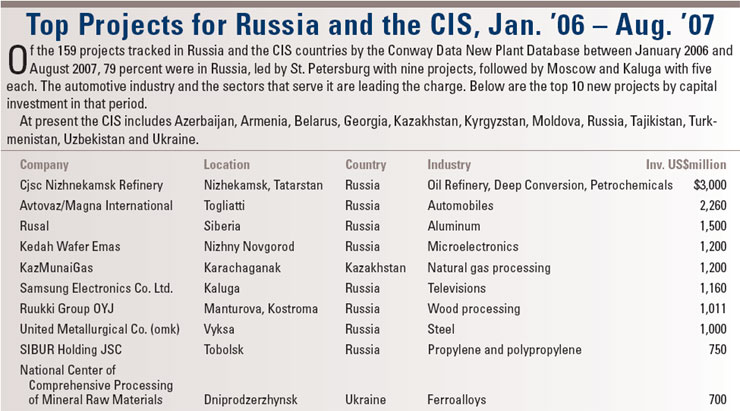

No.
Are facility investment prospects looking up in countries such as Kazakhstan, Ukraine, Georgia and the other nine members of the Commonwealth of Independent States?
Yes.
That's what a review of project news and Conway Data New Plant Database reveals. As Russia's wealth of projects illustrates, the automotive industry is leading the way. But consumer-focused projects are coming through in spades as well.
Those include a US$57-million television plant from Samsung Electronics in Kaluga, and Kimberly-Clark's first Russian plant in Stupino.
In a terse public disclosure statement, Samsung said the purpose of the new plant was "to respond to the fast-growing digital TV demands in the CIS market."
Kimberly-Clark's plant will be built in phases and make products under the Huggies and Kleenex brands. The 150-job plant is part of the company's strategy to accelerate growth in developing and emerging markets, which include Brazil, Russia, India, China, Turkey and Indonesia.
"Russia is a strategically important market for K-C due to its rapid economic growth and the long-term potential of its health and hygiene categories," said Tom Davis, president of Kimberly-Clark's Middle East, Eastern Europe and Africa group, in September. "Local manufacturing is a key element of our strategy."
In this case, local means a town located approximately 60 miles (100 km.) southeast of Moscow, where the Kimberly-Clark plant will occupy an area of about 100 acres (40 hectares) when it starts up in early 2009. The project's first phase will include site preparation and construction of manufacturing buildings, offices, warehousing and roads.
"We chose Stupino for its developed infrastructure, highly qualified work force and excellent location for accessing the major cities of Russia and Eastern Europe," said Jonathan Tarr, Kimberly-Clark Managing Director for Eastern Europe.
Increasing speed of delivery and service to a consumer market that has been growing at double-digit rates is chief among the project's goals.
A June report from DuPont highlighted the importance of Russia, a country growing its GDP at a phenomenal rate of 7 percent.
"A formidable, well-educated pool of human talent has emerged to revitalize the Russian business world," wrote John Shmorhun, regional director, DuPont Eastern Europe. "This has enabled us to create a dynamic, experienced and motivated team, of which we are very proud."
The company produces crop protection products at a site in Novocheboksarsk, and OEM coatings at a site in Yaroslavl, where the company this summer opened its newest R&D
"Russia is a strategically important market for K-C due to its rapid economic growth and the long-term potential of its health and hygiene categories. Local manufacturing is a key element of our strategy."
laboratory. In the last two years, the number of DuPont Russia employees has almost doubled.
— Tom Davis, Kimberly-Clark
Republics on a Roll
According to an interview with Georgian President Mikheil Saakashvili published in August in The Wall Street Journal, Georgia's GDP was less than $3 billion five years ago. He said it now stands at $8 billion, and is expected to double in three years. A letter in response to the interview came from Steve Nicandros, president and CEO of Houston-based energy company Frontera Resources:
"Frontera Resources has invested more than $100 million to date in Georgia's oil and gas exploration sector and our investment plans remain very aggressive for the foreseeable future because of our confidence in the environment that continues to evolve," he wrote.
Energy projects in Kazakhstan, by contrast, have met with delays and regulatory obstacles similar to those associated with projects in Russia.
Ukraine is second to Russia among CIS countries with projects qualifying for the Conway Data New Plant Database between January 2006 and August 2007, with 21 projects. Among the diverse list, and indicative of a construction climate on the upswing, are a $280-million cement plant expansion in Kamenets-Podilsky from CRH, a $51-million wood flooring plant from Berlinek and an $89-million insulation plant from Knauf in Vinnytsya, a separate $70-million plasterboard plant from Knauf in Soledar and an $18-million PVC door and shutter plant from Veka in Kiev. First-half 2007 statistics from CIS show Ukraine to be among the leaders in year-over-year industrial output growth.
Also emerging from the shadows is Turkmenistan. Amid a flurry of diplomatic and development outreach by the country's new president, Gurbanguly Berdimuhamedov, new corporate projects have included facilities from Boeing, Chevron and Chinese firm Capital Longji Sci-Tech, which is investing $67 million in a glass plant in Ashgabat. The country is also making progress on port infrastructure development in the Avaza zone on the Caspian Sea, which officials hope to build on with both industrial and tourism development.
Site Selection Online – The magazine of Corporate Real Estate Strategy and Area Economic Development.
©2007 Conway Data, Inc. All rights reserved. SiteNet data is from many sources and not warranted to be accurate or current.
©2007 Conway Data, Inc. All rights reserved. SiteNet data is from many sources and not warranted to be accurate or current.