

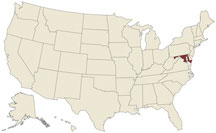
MARYLAND
From Site Selection magazine, March 2009

Act Local
M
aryland state officials unveiled in December 2008 their list of five BRAC Zones and 16 BRAC grants to higher education institutions. Driven by legislation signed into law in May 2008, the measures are intended to enhance community preparation for an influx of new residents and jobs as part of the federal Base Realignment and Closure plan of 2005. But one significant community was not on the list.
It was Harford County, just northeast of Baltimore and just southwest of where the Susquehanna pours into Chesapeake Bay. In early February, the county attracted more than 2,500 job seekers to a BRAC jobs fair, driven by the growth coming to nearby Aberdeen Proving Ground (APG).
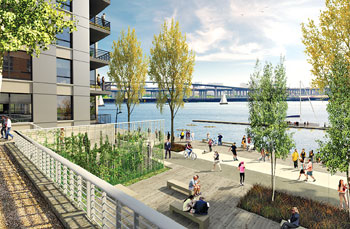
Among the projects benefiting from Maryland's five new BRAC Zone designations is Turner Development Group's Westport Waterfront project, located on the last large parcel of developable waterfront in Baltimore City, approximately half way between Aberdeen Proving Ground and Fort Meade. One month after receiving the zone designation, the project was approved for the largest TIF in Baltimore history, at $160 million. The 50-acre (20-hectare) development will include among its mixed-use components some 2 million sq. ft. (185,800 sq. m.) of office space. Currently, the Westport Waterfront property generates $93,000 per year in taxes for Baltimore City. Once the development is complete, Westport Waterfront will generate up to $43 million per year in taxes.
Image courtesy of Turner Development Group
The Harford County Office of Economic Development has been working on BRAC-related growth for years, and Harford Community College received one of the 16 educational grants. So why no state-designated zone, and all the incentives that come with it?
"We did not apply for that," says Robert B. Thomas, Jr., public information officer for Harford County government. "The reason is quite simple – to be designated a zone you had to have a project or projects that were identified as 'shovel ready.' Although we have several BRAC-related projects that are pending, none are immediately shovel ready."
But that doesn't mean the shovels aren't busy.
"We've already had over a dozen defense contractor-related businesses and science and technology businesses that have moved here or expanded their operations in the last year or two," says Thomas. "And we're looking at at least another 900 people coming to the Proving Ground this year."
That's not quite 10 percent of the total of 8,100 positions moving to the base from seven other bases in five other states. The surge is led by 7,000 positions coming by 2011 from the U.S. Army's Command, Control, Communications, Computers, Intelligence, Surveillance and Reconnaissance (C4ISR) team, relocating from Fort Monmouth, N.J.; Redstone Arsenal in Alabama; and Fort Belvoir, Va.
Altogether, BRAC is expected to bring as many as 25,000 new jobs to Maryland.
Everybody's in the Zone
"Our biggest concern, quite frankly, is infrastructure needs," says Thomas. "We have identified eight roads or intersections that are state roads that must be upgraded in order to meet the demands related to BRAC. If there's a delay with those projects, as far as roads and bridges, it certainly will be felt throughout the county as BRAC is fully implemented."
The federal circle might be closed by seeing some of the new economic stimulus funds driven toward those projects. In mid-February, Gov. Martin O'Malley, whose May 2008 proposal launched the BRAC Zone program, proposed that US$350 million of the state's $3.8-billion portion of the federal stimulus be spent on transportation projects.
Nobody's sitting on their hands in Harford County. Among the local improvements thus far has been more than $96 million in school construction; a $70-million water plant expansion; a $400-million waste-to-energy solid waste plant; moves toward expanded water service in the region; and the first zoning code update in 25 years, which will improve land use and support office and technology development.
Further proof that you don't need a zone to attract BRAC-related projects comes from Columbia, halfway between Baltimore and D.C., where in December 2008 Corporate Office Properties Trust (COPT) announced a long-term 73,000-sq.-ft. (6,782-sq.-m.) lease signed by The MITRE Corporation, a company employed by the Defense Information Systems Agency, the largest agency reassigned to Fort Meade as a result of BRAC. The building, now under construction, will eventually feature 188,000 sq. ft. (17,465 sq. m.) of space, and is the fourth building to be built in phase two of the National Business Park.
COPT President and CEO Randall M. Griffin said the MITRE deal exhibited "the beginning stages of BRAC tenant demand for office space at NBP."
COPT is a major force in both development and redevelopment across the state. In fact, it now is redeveloping a base in Washington County, in western Maryland, that was originally closed in the 1995 BRAC round.
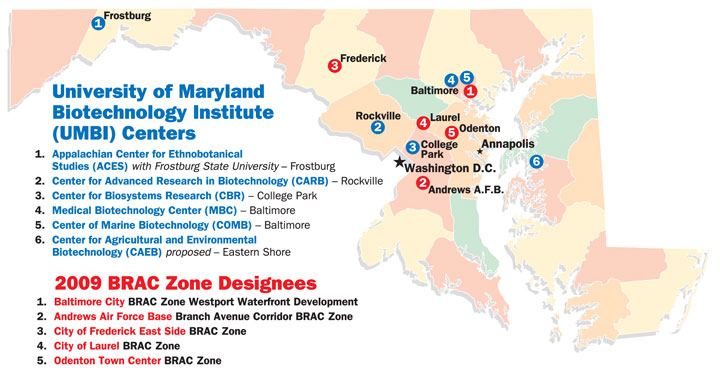
BRACK AND BIOTECH BACKBONE: The biotech research network of the University of Maryland Biotechnology Institute (UMBI) has seen its budget and its influence grow throughout the state in its 24-year history. Meanwhile, the brand new BRAC Zones designated by the state in late 2008 are going to help create infrastructure to deal with the expected influx of 25,000 relocated and new military base-related jobs.
"We couldn't have found a much better teammate than them," says Timothy R. Troxell, CEcD, executive director of the Hagerstown-Washington County Economic Development Commission.
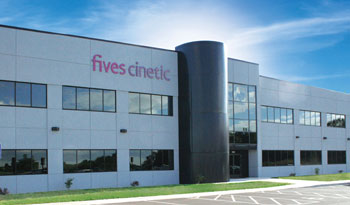
Growth at precision grinding system maker Cinetic Landis is one of several recent economic development highlights in the Hagerstown-Washington County region in western Maryland. With its move from Waynesboro, Pa., Cinetic Landis has invested $10.5 million and hired 150 people at the new manufacturing and office complex, which opened in October 2008.
The dirt's already been moving pretty fast in the Hagerstown area, with major facility projects in the past year from precision grinding system manufacturer Cinetic Landis, Volvo Powertrain North America, FedEx Ground and FedEx Freight. Troxell says the county is expanding the runway at Hagerstown Regional Airport and focusing on attracting aviation and defense firms.
There will be new space to occupy at that airport thanks to a project announced in February: The U.S. General Services Administration/Department of State (GSA) has signed a 10-year lease agreement at a new location in the Liberty Building at Hagerstown's Hunters Green II Business Park. Consequently, GSA is moving out of its 370,000 sq. ft. (34,373 sq. m.) at the airport's Topflight Airpark, which boasts direct runway access and a secured perimeter.
GSA's need for 400,140 sq. ft. (37,173 sq. m.) is spurring an expansion at the Hunters Green building. The 143-acre (58-hectare) development still has space to construct another build-to-suit that could hold as much as 1 million sq. ft. (92,900 sq. m.).
Engineer in Office
Among the five is the Frederick East Side BRAC Zone, encompassing nearly 645 acres (261 hectares). The Frederick application includes plans for office, industrial and warehouse space at Riverside Research Park and 66 acres (26.7 hectares) of mixed-use development at the Frederick Brick Works.
"The City of Frederick is proud to be the home of Fort Detrick and the National Cancer Institute," said Frederick Mayor William J. (Jeff) Holtzinger in December. "This BRAC Zone designation by the state will help the City provide much needed transportation infrastructure, brownfield remediation, and mixed-use infill development."
Other Zones Count Too
D
ecember 2008 saw the expansion of the City of Hagerstown-Washington County Enterprise Zone and the renewal of the Northern Garrett Enterprise Zone located in nearby Grantsville. Currently, 14 Maryland jurisdictions have Enterprise Zones. One of the newest is in Gaithersburg's old town area.
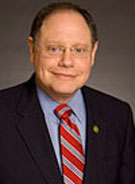
Gaithersburg Mayor Sidney A. Katz
"This governor is a former mayor, and he truly understands the need for local assistance," says Gaithersburg Mayor Sidney A. Katz of Maryland Gov. Martin O'Malley. Katz is a part-time mayor and a business owner who is also the current president of the Maryland Municipal League, which comprises 158 communities. "I was absolutely flabbergasted that the governor himself called me to tell me we'd been awarded the enterprise zone."
Katz has seen a lot of change in his 30 years in city government, 20 as a city council member. Since his boyhood in the 1950s, the town, just 20 miles (32 km.) outside the nation's capital, has grown tenfold from 6,000 to 60,000 residents.
Among various transportation projects at the top of Katz's agenda is a regional mass transit effort called the Corridor City Transitway, which will be either light rail or bus rapid transit.
"In order to get businesses here, we need to get employees here," Katz says, "and in order to get them here, we need a good transportation hub."
Katz explains that each community in Maryland is different in terms of its shared authority. In Gaithersburg's case, the county takes care of water and sewer, but the city has zoning authority. He says Montgomery County has been aggressively courting biotech companies, and points to the area's school system, in addition to its valuable community colleges and satellite campuses for Johns Hopkins University and the University of Maryland.
"That in itself is a great attractor," he says of the public education system, part of a statewide system that was named No. 1 in the nation early this year by Education Week. "The people working in these industries realize the importance of it – not only can they get a good education, but their families can get one too."
Holtzinger, 45 and a native of Frederick, is one of several city mayors interviewed by Site Selection who testified to good relations with their county economic development counterparts. A civil engineer by training, his focus is on "getting our infrastructure ducks in a row" so that corporate end users and citizens have the services they need. In fact, he says he ran for mayor in part because of such unglamorous topics as water and sewer systems.
"It's not very flashy stuff, but if you don't do it right, it can be the thing that really holds you up and keeps you from taking advantage of economic opportunity," he observes. To have the opportunity to supply water to new businesses, he says, "part of that is being realistic about where we can expand. They're generally looking for public water and sewer as the first order of business."
Among the projects he points to with pride are the recent agreement with the county to get water from the Potomac River, which he says has "really shored up our water supply" and which proved crucial in helping the city win a project from SAIC.
He says a similar agreement for managing wastewater capacity is now being worked out. Separately, the city in February 2009 selected Waste Management subsidiary Wheelabrator Technologies Inc. to operate the first greenfield waste-to-energy power plant to be constructed in the U.S. in more than a decade, to serve both Frederick and Carroll Counties.
Frederick's BRAC Zone is the only one that has a strong industrial development component. Holtzinger says the new zone will help the community move toward making more land available for industrial development, in part to handle the already healthy business growth at Fort Detrick. While focused on biotech, he says it's not to the exclusion of other important areas. And, as in Hagerstown, airport hangar development is on the agenda.
In the Frederick City Council's meeting of Dec. 18, 2008, two annexations totaling some 120 acres (48 hectares) were approved. Holtzinger says Frederick is in a year-to-year rotating battle with Gaithersburg and Rockville to be called the state's second-biggest municipality: "We probably have the biggest growth potential, because we're not surrounded like they are. But we're all right there neck and neck."
Like most of his fellow Maryland mayors, Holtzinger hopes to attract some of that stimulus money for several municipal projects. But he agrees that Maryland itself, with its mix of public- and private-sector job creators across a healthy range of industries, has in many ways already been stimulated.
"Yes, we're very fortunate with our location," he says. "We're probably a lot better off than a lot of areas in the country because of the federal influence."
'Out of the Way' Place May Get Its Own BRAC Boost
M
ayor Barrie P. Tilghman has served the Eastern Shore city of Salisbury since May 1998, and will retire from the post after her third term ends in April 2009. Home to poultry processor Perdue Farms and to what she calls "a very strong piece of the world's market for microwave filters," Salisbury-Wicomico County has seen recent facility projects from precision machining firm MaTech, GPS vehicle tracking firm NavTrak and electronic component maker Harvard Custom Manufacturing. Tilghman says she recently met with a business owner who's outgrown his firm's space at the industrial park and wants to make a move downtown, potentially growing his work force from a few dozen to as many as 200.

Salisbury Mayor Barrie P. Tilghman
The area's status as a regional hub comes in part because of the Salisbury-Ocean City Wicomico Regional Airport, the state's second largest behind Baltimore Washington International (BWI).
"The airport is critical, no question about it," says Tilghman. "We'd love to have a second carrier, but it's a strong selling point to the business community and a very important amenity."
The area also boasts the state's second-largest port, which sees significant barge traffic. It's located near the North Prong, a downtown area reachable by drawbridge that used to be home to a cluster of petroleum-industry sites. Tilghman says the city owns a significant parcel of the property, and is working out a possible deal with a property owner in Baltimore who may donate three other parcels. "At some point we'll have a critical mass of property," she says, ready to redevelop along the mixed-use guidelines set forth by a recently completed study done in conjunction with the Maryland Dept. of Planning.
Among the other infrastructure assets in Salisbury are ample water supply, a new wastewater treatment facility and a new bypass road that circulates traffic more effectively around the city.
Among the area's other assets is Salisbury University, home to the Perdue School of Business. Tilghman says the school is working with the University of Maryland-Eastern Shore, just 15 minutes away, on establishing a technology corridor.
Tilghman points to Salisbury-Wicomico County Economic Development, directed by Dave Ryan, as one of the more collaborative city-county agencies around. But the county is one of four in the state that doesn't have a tax differential, or setoff, in areas of duplicate function, something provided for in state law. Tilghman has pushed for the setoff, and analysis is still under way, which also involves the towns of Fruitland and Delmar.
"I'm optimistic that, at this point in time, we can move forward," she says. "Those who live in the municipalities would see reduction in their county property tax bills. And it would make the overall delta between those outside incorporated limits and those inside less dramatic. For businesses, it would be even more beneficial, because it would apply not just to real estate taxes, but to personal taxes."
A Place to Breathe
Tilghman sees growth in the cards for the Eastern Shore, but not for the same reasons other areas of Maryland may indicate.
"I think central Maryland is going to expand with the BRAC job surge, and you'll see a number of people in that very populated section of the state either telecommute or retire," she says. "We're seeing a strong influx of retirees."
Tilghman touts her own family's experience of day trips in one direction to the Smithsonian, and in the other direction to the wild ponies and bald eagles of Assateague Island or the boardwalk and cotton candy of Ocean City. And she thinks quality of life is only rising in prominence on everyone's criteria list, businesses included.
"No matter how great the tax structure is, or how much the city or county is willing to give away," she says, "if the CEO's wife thinks it's a dump, that company is probably not going to locate there."
— Adam Bruns

Site Selection Online – The magazine of Corporate Real Estate Strategy and Area Economic Development.
©2009 Conway Data, Inc. All rights reserved. SiteNet data is from many sources and not warranted to be accurate or current.
©2009 Conway Data, Inc. All rights reserved. SiteNet data is from many sources and not warranted to be accurate or current.