

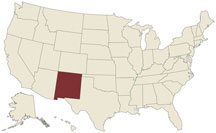
NEW MEXICO
From Site Selection magazine, March 2009

Following
the Sun
the Sun
S
olar photovoltaic module manufacturer Signet Solar believes it found the ideal site for its first U.S. manufacturing platform in New Mexico.
New Mexico receives more than 3,200 hours of sunshine annually, according to the New Mexico Solar Energy Association. That, along with generous state incentives, has helped the industry to flourish. Signet hopes to be part of that momentum.
"The reason we started looking at New Mexico is its deployment of solar panels," says Dr. Prabhu Goel, chairman and co-founder of Signet Solar. "New Mexico has one of the highest installations in the country. If you don't have to ship your panels too far away, it reduces your costs."
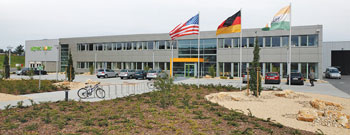
Signet Solar's planned facility south of Albuquerque will be similar to this plant in Dresden, Germany, which began production in October.
Signet will produce large-area thin-film silicon photovoltaic modules for commercial rooftop and ground mounted solar power systems. The first phase of the facility, a US$220-million investment, will have an annual capacity of 65 MW, enough to power about 20,000 homes. Signet plans to eventually reach a capacity of 300 MW with a 600,000-sq.-ft. (55,740-sq.-m.) facility with a total investment of more than $800 million.
"We are already in production in Germany, and we were looking to set up our second plant in the U.S., focusing on significant growth opportunities, especially with President Obama and his focus on renewable energy," Goel says.
Signet's large-area thin-film silicon PV technology helps bring down the cost of solar power and can be used for solar farms and large commercial installations.
Signet will build its facility on 75 acres (30 hectares) in Rancho Cielo, a 6,000-acre (2,428-hectare) property being developed by Coast Range Investments. Coast Range plans to use Signet panels on a 700-acre (283-hectare) solar farm designed to meet the majority of Rancho Cielo's power requirements. Goel says land and other costs are much more affordable in New Mexico than in California and Oregon, two other centers of solar development.
"There is a lot of good infrastructure in New Mexico relative to the location we selected in terms of rail access, which is very critical, as solar panels are bulky by nature," Goel says. "So, transportation access is critical. Power and water access was not a problem there either. New Mexico's work force is highly educated, and there is a reasonable availability of trained workers."
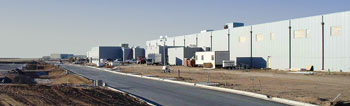
Schott Solar plans to inaugurate its new plant in Albuquerque in May.
Signet's announcement in December came 10 months after Schott Solar, a German-based firm, broke ground for a solar module manufacturing plant in the Mesa del Sol community near Albuquerque. That 200,000-sq.-ft. (18,580-sq.-m.) facility is now complete, with machinery installation under way. Schott expects to begin test production this spring, and plans to eventually employ 350 by the time it becomes operational in May.
"Schott Solar had received incentives to locate in New Mexico," Goel says. "We asked if we could receive similar incentives, and New Mexico officials responded to that. The other thing they pointed out –which we already knew about –is that they would facilitate access to Sandia National Laboratory as well as to Los Alamos. We want to do more R&D to lower our manufacturing costs, so any research we could do would be of great help. It's a very exciting possibility."

toward energy independence.”
Goel says Signet will break ground later this year, with plans to begin production in 2010. How fast the operation expands will depend on market and financial conditions, he says.
"Right now conditions are difficult. If conditions improve, it will be on a faster track. Financial conditions are impacting the solar industry worldwide, not just in the U.S. Even in Europe, solar has slowed down, primarily due to lack of bank financing.
"The good news is that the U.S. is beginning to take steps toward energy independence," Goel says. "The fact that President Obama is pushing energy independence is a very positive development for us."
The other major impediment to solar development is the lack of grid connectivity. Goel is optimistic the new administration in Washington recognizes the need for expansion.
"President Obama's call to lay down 3,000 miles [4,828 km.] of transmission lines to the grid is a good step," Goel says. "That is one thing that is definitely needed."
Intel's Power Project
"We're very excited about this project," said Marty Sedler, Intel's director for global utilities and infrastructure. "The New Mexico solar installation will be a big step for Intel and potentially lead the way for a more aggressive solar program within Intel."
Greater Incentives Proposed
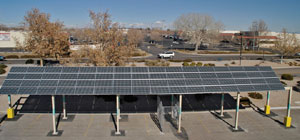
Intel hopes its demonstration PV installation at its site in Rio Rancho will prove that solar energy can power a data center.
"Having clean energy policies and incentives in place is critical," Richardson said. "But states are now competing to receive federal funds and host clean energy companies, and good policy will not be enough. Investors want to see that our state is educating and preparing its work force for the clean energy jobs of the future."
Richardson also signed an executive order directing key state agencies ranging from education to work force development, economic development and energy to form a "Green Jobs Cabinet" to develop an aggressive clean energy strategy.

Site Selection Online – The magazine of Corporate Real Estate Strategy and Area Economic Development.
©2009 Conway Data, Inc. All rights reserved. SiteNet data is from many sources and not warranted to be accurate or current.
©2009 Conway Data, Inc. All rights reserved. SiteNet data is from many sources and not warranted to be accurate or current.