

QUÉBEC
From Site Selection magazine, May 2009
Thriving on Technology
U
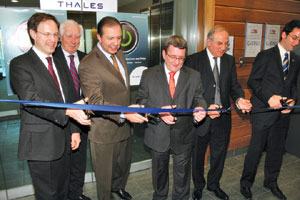
Participating in ribbon-cutting ceremonies for Thales Canada's new Québec City offices were, from left, François Alabrune, Consul General of France; Pierre Jeanniot, chair of Thales Canada; Sam Hamad, Québec Minister of Employment and Social Solidarity; Régis Labeaume, mayor of Québec City; Marcel de Picciotto, president and CEO of Thales Canada; and Pascale-Pierre Paillé, Member of Parliament for the Louis Hebert district.
nemployment rates of below 4 percent are almost unheard of these days in North American cities. Québec City is an exception, logging a rate of 3.9 percent in February.
That compares favorably with the provincial rate of 7.9 percent and Montreal's 8.1 percent rate. The Québec City metro region's economy is sustained by strong technology sectors such as defense and security, and optics and photonics.
The Conference Board of Canada on March 31 named Québec City one of five Canadian metropolitan areas (CMAs) projected to experience economic growth in 2009. The other growing economies are in Saskatoon and Regina, Sask.; Winnipeg, Man.; and Ottawa-Gatineau, Ont.-Que. A strong government presence and historically high levels of investment in public infrastructure will keep Québec City's economy out of recession, the Conference Board said. Real gross domestic product (GDP) is expected to grow, albeit moderately, by 0.6 percent in 2009.
Montréal's manufacturing sector is significantly affected by the global downturn. As a result, the Conference Board forecasts that Montréal's real GDP will decline by 0.5 percent, the area's worst performance since 1991.
Québec City, however, appears to be skating along nicely in perception as well as performance. According to a survey in January 2009 of 200 business executives by economic development agency Pôle Québec Chaudière-Appalaches, 94.6 percent of Québec City respondents said that the local economy was very good or good, compared to 44.3 percent with regard to the Canadian economy as a whole.
That Secure Feeling
Thales Canada, a branch of France-based Thales Group and a prime success story in the defense and security sector, officially opened its new premises in Québec City in February. Client proximity is the main motivator for Thales' presence there.
"This is totally coherent with the Thales strategy," says Marcel de Picciotto, president and CEO of Thales Canada. "Thales does not operate as a multinational. We operate as a multi-domestic. In that regard, we use important opportunities in the countries where we either invest or grow an existing investment. We use opportunities to build a local capability which, when it matures, becomes an inherent part of capital generation for the group."
Thales currently employs 40 in Québec City. De Picciotto expects that figure to gradually rise to between 80 and 100. The Québec City operation is involved in the design of software for command and control systems, primarily for the Canadian army. It is also gradually moving to serve the public safety and security area and other sectors related to operational simulations, he says.
"The reason we started operations seven years ago in Québec City is that we had won a major contract with the army to develop a command and control center. When we hired our first engineers in 2002, we were transferring for use by the Canadian army software that the French army was using. We adapted it and subsequently totally 'Canadianized' it. The army has been satisfied with our service and we have met all milestones to the day, except for one which was missed by one day. That is uncommon in the software industry. The army was so satisfied that they awarded us a 10-year contract in late December. This is going to be a [C]$350-million [US$283-million] contract, so this justified that we grow our team and our facilities."
Thales Canada employs about 300 across the province, all in high-tech fields. Its Québec facilities include a Montréal aerospace center that provides clients including Bombardier with flight control systems. The majority of Thales Canada's 1,370 employees are in Ontario.
"Québec is generally a province based on a palette of varied industries," de Picciotto says. "You have some which are less sensitive to the world economic downturn than others. As far as we are concerned, we happen to be in an upward trend in the defense and security business. In fact, the army has requirements in the direction of what we are producing. We are lucky there. We are happy that the government has committed a contract to us, but obviously government spending is subject to economic pressures."
While de Picciotto says the Canadian Army contract secures Thales' growth in Québec City, business is not so guaranteed in other sectors.
"Our aerospace market is of course dependent on the market for business and regional jets, and that is a different story," he explains. "Bombardier laid off several hundred people in Montreal because the business jet market is in difficulty these days. To illustrate that, the day after the auto executives went before Congress in Washington and were criticized for their use of business jets, orders dropped steeply. That market has been hit hard. The regional jet market of which our clients are airlines tends to space their deliveries and delay orders. Here, we expect a difficult year in terms of orders in the aerospace area."
De Picciotto says Thales makes good use of the province's leading universities, but sometimes the demand for top graduates in technology fields outpaces the supply.
"We obviously find a supply of high-level engineering capabilities in Québec with the great universities that are there such as McGill, Sherbrook and Laval," de Picciotto says. "We find the right level of people, but in terms of quantity, when we are seeking very fast hiring of many people, we sometimes run into a bottleneck."
He says Thales has relationships with key universities and plans to work closely in the future to help them generate the manpower that the industry needs.
Optimal Optics
The optics-photonics sector is also seeing its way clearly through the recession. About 120 companies operate in the province, employing approximately 5,000. The industry's nerve center is in Québec City, fueled by research at the National Optics Institute, Defence R&D Canada-Valcartier, the COPL (Center of Optics, Photonics and Laser), the Canadian Institute for Photonic Innovations (a Canada-wide network of universities and research centers), and Laval University, one of Canada's leading centers for optics research.
The largest company in the industry, EXFO, was founded in the apartment of its current chairman, Germain Lamonde, with just C$100 in 1985. EXFO is a testing and monitoring specialist focused on the telecom market. EXFO's customer list includes Verizon, Time Warner, Qwest and AT&T.
"We started with a clear mission to become a leader in optical testing," Lamonde says. "Now we have about a third of the world market and we've never raised a dime in venture capital. We've expanded by going global with telecom operators."
Lamonde says a key to EXFO's success is its heavy investment in R&D, which involves about a third of EXFO's work force.
"Overall, telecom is a strength in the province," Lamonde says. "The economy is doing rather well. Québec City has a far more solid economy than Montréal. There is strong resilience from an employment perspective."
About 700 of EXFO's 1,200 employees are in Québec. Lamonde says a challenge is finding enough qualified talent to keep up with the company's rapid growth.
"The quality of life in Québec City is outstanding," LaMonde says. "It allows employees to be very productive. We have a loyal work force. We are hiring and growing, going through the recession very nicely."
That compares favorably with the provincial rate of 7.9 percent and Montreal's 8.1 percent rate. The Québec City metro region's economy is sustained by strong technology sectors such as defense and security, and optics and photonics.
The Conference Board of Canada on March 31 named Québec City one of five Canadian metropolitan areas (CMAs) projected to experience economic growth in 2009. The other growing economies are in Saskatoon and Regina, Sask.; Winnipeg, Man.; and Ottawa-Gatineau, Ont.-Que. A strong government presence and historically high levels of investment in public infrastructure will keep Québec City's economy out of recession, the Conference Board said. Real gross domestic product (GDP) is expected to grow, albeit moderately, by 0.6 percent in 2009.
Montréal's manufacturing sector is significantly affected by the global downturn. As a result, the Conference Board forecasts that Montréal's real GDP will decline by 0.5 percent, the area's worst performance since 1991.
Québec City, however, appears to be skating along nicely in perception as well as performance. According to a survey in January 2009 of 200 business executives by economic development agency Pôle Québec Chaudière-Appalaches, 94.6 percent of Québec City respondents said that the local economy was very good or good, compared to 44.3 percent with regard to the Canadian economy as a whole.
That Secure Feeling
"This is totally coherent with the Thales strategy," says Marcel de Picciotto, president and CEO of Thales Canada. "Thales does not operate as a multinational. We operate as a multi-domestic. In that regard, we use important opportunities in the countries where we either invest or grow an existing investment. We use opportunities to build a local capability which, when it matures, becomes an inherent part of capital generation for the group."
Thales currently employs 40 in Québec City. De Picciotto expects that figure to gradually rise to between 80 and 100. The Québec City operation is involved in the design of software for command and control systems, primarily for the Canadian army. It is also gradually moving to serve the public safety and security area and other sectors related to operational simulations, he says.
"The reason we started operations seven years ago in Québec City is that we had won a major contract with the army to develop a command and control center. When we hired our first engineers in 2002, we were transferring for use by the Canadian army software that the French army was using. We adapted it and subsequently totally 'Canadianized' it. The army has been satisfied with our service and we have met all milestones to the day, except for one which was missed by one day. That is uncommon in the software industry. The army was so satisfied that they awarded us a 10-year contract in late December. This is going to be a [C]$350-million [US$283-million] contract, so this justified that we grow our team and our facilities."
Thales Canada employs about 300 across the province, all in high-tech fields. Its Québec facilities include a Montréal aerospace center that provides clients including Bombardier with flight control systems. The majority of Thales Canada's 1,370 employees are in Ontario.
"Québec is generally a province based on a palette of varied industries," de Picciotto says. "You have some which are less sensitive to the world economic downturn than others. As far as we are concerned, we happen to be in an upward trend in the defense and security business. In fact, the army has requirements in the direction of what we are producing. We are lucky there. We are happy that the government has committed a contract to us, but obviously government spending is subject to economic pressures."
Germaine Lamonde founded EXFO in 1985 and is the company's chairman.
While de Picciotto says the Canadian Army contract secures Thales' growth in Québec City, business is not so guaranteed in other sectors.
"Our aerospace market is of course dependent on the market for business and regional jets, and that is a different story," he explains. "Bombardier laid off several hundred people in Montreal because the business jet market is in difficulty these days. To illustrate that, the day after the auto executives went before Congress in Washington and were criticized for their use of business jets, orders dropped steeply. That market has been hit hard. The regional jet market of which our clients are airlines tends to space their deliveries and delay orders. Here, we expect a difficult year in terms of orders in the aerospace area."
De Picciotto says Thales makes good use of the province's leading universities, but sometimes the demand for top graduates in technology fields outpaces the supply.
"We obviously find a supply of high-level engineering capabilities in Québec with the great universities that are there such as McGill, Sherbrook and Laval," de Picciotto says. "We find the right level of people, but in terms of quantity, when we are seeking very fast hiring of many people, we sometimes run into a bottleneck."
He says Thales has relationships with key universities and plans to work closely in the future to help them generate the manpower that the industry needs.
Optimal Optics
The largest company in the industry, EXFO, was founded in the apartment of its current chairman, Germain Lamonde, with just C$100 in 1985. EXFO is a testing and monitoring specialist focused on the telecom market. EXFO's customer list includes Verizon, Time Warner, Qwest and AT&T.
"We started with a clear mission to become a leader in optical testing," Lamonde says. "Now we have about a third of the world market and we've never raised a dime in venture capital. We've expanded by going global with telecom operators."
Lamonde says a key to EXFO's success is its heavy investment in R&D, which involves about a third of EXFO's work force.
"Overall, telecom is a strength in the province," Lamonde says. "The economy is doing rather well. Québec City has a far more solid economy than Montréal. There is strong resilience from an employment perspective."
About 700 of EXFO's 1,200 employees are in Québec. Lamonde says a challenge is finding enough qualified talent to keep up with the company's rapid growth.
"The quality of life in Québec City is outstanding," LaMonde says. "It allows employees to be very productive. We have a loyal work force. We are hiring and growing, going through the recession very nicely."

Site Selection Online – The magazine of Corporate Real Estate Strategy and Area Economic Development.
©2009 Conway Data, Inc. All rights reserved. SiteNet data is from many sources and not warranted to be accurate or current.
©2009 Conway Data, Inc. All rights reserved. SiteNet data is from many sources and not warranted to be accurate or current.