| |
|
From Site Selection magazine, March 2000 M A N A G E M E N T S T R A T E G Y
A Corporation's Experience
Turner sensed a bias in the alliance toward 100 percent lease financing, but he came away from the process knowing that was not necessarily the right answer, and that for some corporations, it's the wrong answer. Sorting out which option was the right one for BellSouth and working with other corporate real estate managers on the question was a valuable exercise, he relates. "It has had some impact as far as our attitudes and direction on what we're doing." Adds Turner, referring to Prof. Gyourko's research, "As the study progressed, it became clear that with some of the higher investment-grade companies -- not the high-growth, high need of capital participants -- ownership became indifferent from a shareholder value standpoint."
Turner has high praise for Barry Varcoe's contribution to the research. "Part of the benefit out of the entire benchmarking effort was his ability to connect some of the functional areas in some meaningful fashion to see how it tied back to the overall management of the portfolio and the financial returns of the corporation or owner," says Turner. "He helped connect a lot of the dots."
Performance Measures That Add Value Go Begging
"There was very little evidence, however, of these measures being tied to business strategies or, more significantly, of their being tied to real estate strategies," Varcoe continues. "They were just things to be measured. Most of the measurement was post-mortem analysis, looking at where you'd been and where you had gotten. Very few articulated through those measures where they wanted to be in the future, which is the key thing about performance measures. It's not about analyzing the past, but about using them to drive to the future. That's where the importance comes in terms of aligning them with your strategy. There was little evidence of that happening."
Varcoe normally uses four categories of measures: economy, efficiency, effectiveness and efficacy, or fitness for purpose. Measures of effectiveness, those that measured the outcomes of what was delivered, were very scarce, as were measures of efficiency. Those that were in place had largely to do with absolute cost issues, Varcoe relates. And efficacy measures were virtually nonexistent. Varcoe's research did uncover one important measure in use; it looks at the relationship between the real estate as a cost and the revenue of the business overall. What percentage of the overall revenues of the business does the property consume?
"If you look at that key ratio over time, it's a good measure of how well a corporate real estate group is doing," says Varcoe. "If the business is expanding, is the cost of the real estate expanding at less of a rate? If so, the corporate real estate group is adding value."
Varcoe says the participants appreciate the importance of using performance measurements beyond mere cost measures as a key portfolio management strategy, which is a step forward in Webber's hope that more organizations start to view real estate assets more comprehensively. As they do, he stresses, real estate managers must also have a plan for bridging the gap between what the measurements say and what the real estate strategy dictates should be the case over whatever period of time has been decided.
"It is important to plot the course between now and then," Varcoe says. "When you are moving from where you are now to an improved level in the future, you shouldn't just straight line or extrapolate between the two necessarily. You have to think about how you'll do it and look over time at what results you'd expect to achieve in making the improvement. That's a key dimension to measurement that people miss. It's like jumping in a swimming pool that's too deep for you and hoping you'll learn to swim."
Varcoe and his service provider and academic colleagues on the Portfolio Alliance research team hope the corporate participants and the industry at large will start to get their feet wet at least on the journey to enhanced, value-added real estate portfolio management. Viewing real estate assets strategically is an initial step any organization can take.
| |
|
| |
 | Site Selection Online | SiteNet | Feedback | Search SiteNet | ©2000 Conway Data, Inc. All rights reserved. SiteNet data is from many sources and is not warranted to be accurate or current.
|

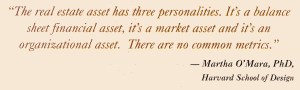 "The main reason for joining the group was to see if we could get something of value in how we finance or refinance our 50 million-sq.-ft. [4.6 million-sq.-m.] portfolio," says Turner. "If and how we do that can have a significant impact." On the buy or lease question, Turner says the alliance experience was "something of a confirmation that maybe we have not been altogether wrong in our thinking of not jumping ship on some of our ownership posture. It was useful to us even though the alliance didn't give us a magic bullet."