| |
|
From Site Selection magazine, March 2000 C O V E R S T O R Y
No. 6 Illinois
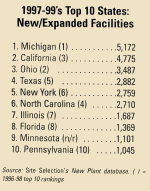
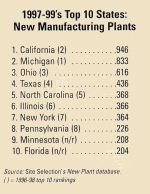
Long a manufacturing mecca, the "land of Lincoln" continued that tradition as 1999's No. 4 new manufacturing state, albeit much of the action had a high-tech edge. Tap Pharmaceuticals' new 500-employee, $54 million Chicago metro facility, for example, includes not only manufacturing, but R&D as well.
1999's No. 2 metro in both overall facilities and new manufacturing, big-shouldered Chicago did a lot of Illinois' heavy lifting. The Chicago metro's east-west I-85 corridor reaped the most high-profile payoff for the state's high-tech recruitment efforts. Naperville, for example, landed Lucent Technologies' 2,500-employee R&D expansion, homegrown Tellabs' 2,500-employee expansion and computer consultant Whittman-Hart's 400-employee, $129 million headquarters.
And Illinois put up its prosperous 1999 largely without major incentives. That began to change, though, in August, when Gov. Ryan sealed a campaign pledge and beefed up incentives. One of those new incentives, EDGE (Economic Development for a Growing Economy) tax credits, fueled the Tellabs' expansion. But it wasn't only the $30 million in incentives that sealed the deal. "The Tellabs decision shows that when state and local officials coordinate their economic development efforts, everyone wins," explained Pam McDonough, Illinois Dept. of Commerce and Community Affairs (www.commerce.state.il.us) director.
Some Illinois attractions, though, remained the same, including O'Hare International's distribution facility magnetism. Chicago's long line of high-profile distribution deals in 1999 included Circuit City, Home Depot, Tenneco Packing and Solo Cup, the latter facility spanning 1 million sq. ft. (92,900 sq. m.).
No. 7 North Carolina
Seemingly a major force since Methuselah's teenage years, North Carolina in 1999 again parlayed those basics into business expansion success.
Long an industrial stronghold, North Carolina ranked No. 7 for new manufacturing. Big-time industrial projects included: CommScope's $135 million expansion in Hickory; Chicopee's $42 million expansion in Benson; Procter & Gamble's $40 million expansion in Browns Summit and Solectron Technology's $34 million expansion in Charlotte.
North Carolina's white-collar sector also expanded appreciably. 1999's major deals included Sykes Enterprises' 500-employee computer support expansion and Microsoft's $75 million office expansion, both in Charlotte, and AT&T Wireless' 410-employee service center expansion in Greensboro. And Durham landed major new R&D facilities for both CREE Research and Sphinx Pharmaceuticals.
Old-line industries also prospered. Major textiles deals, for example, included Freudenberg Nonwovens' $75 million Durham County expansion and Unifi's new $40 million Mocksville plant. And Buckeye Technologies' $100 million, 200-employee expansion in Mount Holly will house the world's largest airlaid nonwovens machine.
Distribution facilities also continued to favor North Carolina's mid-Atlantic coast location, with major deals including QVC's new 800-employee facility and CVS' new $60 million operation.
Predictably, some of '99's highest-end action was at Research Triangle Park (RTP), which landed Biogen's new $57 million plant, BASF's new 150-employee plant science venture and Glaxo Wellcome's $54 million expansion.
1999 also saw Dialog Corp. relocating its headquarters from Silicon Valley to Cary (which also landed a new, 300-employee PricewaterhouseCoopers office). Dialog Senior Vice President Jason Molle called RTP "an East Coast Silicon Valley."
Echoed Gov. Jim Hunt, "[This] relocation is a testament to the Triangle area's international reputation for the highest quality work force, research and technology facilities, and outstanding universities."
No. 8 Minnesota
But whatever the reason, whether it's bodies of water or the body politic, Minnesota's expansion engines are revving. A lot of the hottest action in "the Land of 10,000 Lakes" was in Minneapolis, 1999's No. 4 overall metro and No. 6 in new manufacturing. Some of Minneapolis' most high-profile deals involved headquarters, fitting for the No. 9 city for Fortune 500 operations.
Expanding to take on Wal-Mart, Target, for example, is building a new $60 million high-rise headquarters, and American Express is erecting a new $93 million regional headquarters tower. Medical manufacturer Medtronic is so hot that it's building a second, 3,000-employee headquarters campus in Minneapolis' suburbs, where insurance player Allianz is building its own new $50 million, 700-employee headquarters.
No. 10 in new manufacturing, Minnesota also landed some major industrial projects. Minneapolis' major deals included Seagate Technology's $40 million, 1,300-employee expansion, Advanced Circuits' 235-employee expansion and Diversified Pharmaceutical Services' $43 million new facility, while Saint Cloud cornered New Flyer's new 300-employee plant.
Minnesota flexed its natural resources muscle, too, including Andersen Corp.'s 225-employee wooden window manufacturing expansion in Cottage Grove. In fact, an industry publication recently named Minnesota No. 1 in wood products sector growth.
"Beating out a large state like California shows the tremendous vitality of Minnesota's forest products industry, not only in the U.S., but as a global competitor as well," said Jerry Carlson, commissioner of the Minnesota Department of Trade and Economic Development (www.dted.state.mn.us).
Global linkages are also high on the agenda of Gov. Jesse Ventura, who last year visited Japan, first landing a pork exporting deal for a Minnesota firm, then adding a beef exporting pact.
"The papers said we brought home the bacon," crowed the irrepressible Ventura. "Now we can say, 'Where's the beef?' "
No. 9 Pennsylvania
The Hershey deal also underscored the aggressiveness of Gov. Tom Ridge, who's practically grabbed economic development by the throat, creating, for example, The Governor's Action Team, a group of economic development pros reporting directly to Ridge. Hershey's Chairman and CEO Kenneth Wolfe noted Ridge's hands-on approach at the new project's unveiling.
"We thank Gov. Ridge for his personal involvement in and support of this project and for his administration's responsiveness," Wolfe said.
Ridge also pushed through the creation of Pennsylvania's Keystone Opportunity Zones (resembling Michigan's Renaissance Zones). In their first five months, the tax-free Keystone Zones created 2,500 new jobs in 1999, including Office Max's new $47.5 million, 350-employee East Union Township distribution center and Closeout Distribution's 500-employee Tremont distribution center.
The Keystone State also finished No. 9 in new manufacturing, with its major wins including: Elk Corp.'s new $70 million plant in Lebanon; Nova Chemical's new $45 million, 365-employee manufacturing/headquarters facility and Duferco-Farrell's $54 million, 400-employee expansion, all in Pittsburgh, and Surgical Specialties' new 200-employee plant in the Wilkes-Barre/Hazleton metro.
Pennsylvania's plenty, though, transcended manufacturing. The Philadelphia metro, for example, landed Delaware Investments' 400-employee expansion, Wyeth-Ayerst's 500-employee R&D/office expansion, First Data Investor Services Group's new 550-employee office and Merck's new $55 million office. And Pittsburgh bagged Mellon Bank's new $114 million office, CallTech Communications' 400-employee call center expansion and Seagate Technology's new $30 million R&D facility.
Cooperation was the common denominator in all that action, stressed Sam McCullough, Dept. of Community and Economic Development (www.dced.state.pa.us) secretary. "Partnerships," he explained, "are critical to our success, not only between the state and local taxing bodies, but also between communities within a region."
No. 10 Virginia
Many of those firms rode into Virginia atop the information highway, with a lot of that traffic headed to the areas around Washington, D.C., now one of the hottest U.S. high-tech locations.
Virginia's highly wired environment, in fact, drew Intel Online Services' new $130 million server farm to a Fairfax County site. "A large and growing proportion of the world's Internet traffic flows through Virginia," explained Intel Online Services General Manager Mike Aymar. "That made Virginia a natural location for Intel's expanding Internet services hosting business."
Echoed Gov. Jim Gilmore, "Virginia is cementing its position as the world Internet capital."
Sometimes it seemed that way. North Virginia-based America Online, for example, continued its torrid expansion clip last year with a new $520 million technology center in Prince William County, while Nextel Communications sited a new 700-employee technical/customer support operations center in Hampton. Hampton also landed Gateway Computer's 1,200-worker manufacturing expansion.
Ranked No. 8 in manufacturing, Virginia landed one of 1999's biggest industrial projects: Volvo Trucks North America's 1,300-employee, $148 million expansion in Dublin. An incentive package of $60 million, available through the Virginia Investment Partnership that Gilmore last year signed into law, aided Virginia in its Volvo chase against competing locations in South Carolina and Mexico.
And the yes's to Virginia also sounded out in less populated environs. John Deere's first Virginia location, a new 300-employee manufacturing/R&D operation, for example, is headed for James City County.
Commented Barry DuVal, secretary of Commerce and Trade (www.YesVirginia.org), "Gov. Gilmore's strategic economic development plan, the Virginia Strategy, also supports economic growth in the commonwealth's rural areas." SS

| |
|
| |
 | Site Selection Online | SiteNet | Feedback | Search SiteNet | ©2000 Conway Data, Inc. All rights reserved. SiteNet data is from many sources and is not warranted to be accurate or current.
|

 As Gov. George Ryan noted at late 1999's announcement of MCI-WorldCom's new state-of-the-art 500-employee center in Rockford, "Illinois, traditionally the nation's manufacturing and distribution center, has also become the nation's telecommunications hub."
 With Pennsylvania's sweet year for business attraction, it was only fitting that one of '99's biggest deals was Hershey Food's $55 million, 650-employee Pittsburgh distribution facility. One of the world's best-known names underscored the state's return to SS's top 10.