| |
|
From Site Selection magazine, May 2000 T O P 1 0 D E A L S Case Studies in Fast-Track Strategies (CONTINUED) Eli Lilly: Indianapolis; 7,500 Jobs; $1 Billion A heaping spoonful of sugar -- a 10-year, $214 million incentive package -- is helping Eli Lilly's big corporate location medicine go down into Hoosier soil. A model for urban revitalization, downtown Indianapolis will likely land the lion's share of the 7,500 new jobs added over 10 years. Indianapolis Mayor Stephen Goldsmith puts the deal in its properly mind-boggling perspective. "Lilly's investment compares to a Fortune 500 company relocating here every two years for the next decade," he says. Both the Indianapolis Economic Development Corp. (www.iedc.com) and the Indiana Dept. of Commerce (www.state.in.us) "played important roles in the project," Lilly officials say. In fact, the state and the city virtually split ponying up the mega-incentives, undoubtedly emboldened by the high-end nature of Lilly's new jobs. "These are high-skill, high-paying jobs that will add to our critical R&D mass," explains Lt. Gov. Joe Kernan, who, with Goldsmith, spearheaded recruiting. Concurs Lilly Chairman, President and CEO Sidney Taurel, "Most of these new employees will be highly skilled, educated and paid -- scientists, physicians, computer specialists and other technicians." The deal continues Lilly's old-fashioned hometown stewardship. Even before this deal, Lilly employed 9,000 in Indianapolis, the lifelong home of Eli Lilly (1885-1977), who made the company a pharmaceutical powerhouse. Several major caveats, however, still shadow this deal. As in all expansions, job projections are based on growth forecasts. And Lilly, already facing stiff generic competition, loses its patent on hot-selling Prozac in 2004. Likely more problematic is Indiana lawmakers' 1999 failure to approve the R&D tax incentives Gov. Frank O'Bannon championed. That letdown prompted Taurel to say, "The business community remains very concerned about key proposals like the R&D tax package. Our business is characterized by a high level of risk." At the same time, though, Taurel expressed "our confidence in the state's affirmation . . . to address these shortcomings." Several months later, Lilly took its Indianapolis expansion plans public. Meanwhile, O'Bannon says, "We are committed to working to pass that legislation in the 2000 session." Working, you might say, until the medicine takes.
Seemingly a slam-dunk, this deal turned into a bona fide nail-biter. Already boasting a healthy Microsoft presence, Charlotte in early 1999 seemed the heavy favorite to land Bill Gates & Co.'s consolidated East Coast product support center. But leadership changes can shake up the elusive alchemy between location decisions and business climates. That's just what happened here: Highly regarded Wayne Sterling returned from Virginia to head South Carolina's business recruitment. In his previous stint, Sterling had lived up to his surname, spearheading the state's landing BMW's first U.S. auto plant before leaving in 1994. With Sterling back in the saddle, South Carolina was suddenly in the thick of a full-blown border war. Microsoft started scouting South Carolina sites in York County, just over the border near Charlotte. A York County official anonymously told reporters of his "ongoing dialogue" with Microsoft. And South Carolina could offer more. Since all of Microsoft's jobs would be new in South Carolina, all would qualify for tax credits. But since Microsoft was already in Charlotte, North Carolina's job tax credits would only apply to new jobs, not the whole consolidated shebang. South Carolina also reportedly dangled other Microsoft incentives, including a negotiated fee to lower property tax rates. Then South Carolina withdrew from a 20-state antitrust lawsuit against Microsoft. The timing was coincidental, state officials insisted. Citing the $2.4 billion America Online-Netscape merger, Attorney General Charlie Condon contended, "The trial has been made moot by the actions of the competitive marketplace." (The Justice Dept. later conspicuously differed.) In April, Microsoft broke the tension and picked Charlotte, a move Gov. Jim Hunt hailed as "a wise investment for them and for our state." Microsoft won't divulge the incentives it was offered, but spokeswoman Beth Jordan says, "This was a very difficult decision." However murky the details, though, the deal is clearly a big win in expanding the state's high-tech core. And the decision's early 1999 timing had to help recruiting. Later in 1999, Charlotte, for example, landed Sprint PCS's 1,350-employee customer service center (a '99 honorable mention) and Sykes Enterprises' 500-employee computer support expansion.
Yet another part of 1999's bricks-and-clicks tsunami, this headquarters project never went, as Texas-based ZZ Top once memorably drawled, nationwide. The world's largest travel reservation company, Sabre Group made it clear from the get-go in 1998 that it wouldn't forsake its area roots. However localized the search, though, this one was a monster. "We're just been growing like crazy," says Mary Lynn Coyle, corporate communications vice president with Sabre (previously headquartered in Ft. Worth). With its Travelocity Web site feeding the fire, Sabre's hypergrowth is boldfaced by the 9,000-employee headquarters' scope: The $315 million, six-building campus may span as many as 2.4 million sq. ft. (216,000 sq. m.) on a 156-acre (62.4-ha.) site. And the site may ultimately house a 15,000-employee, $540 million complex. Predictably, just about any local area with open acreage hotly wooed this project, with incentive offers flying like bullets in an old Western. While the relocation's total incentives haven't been disclosed, they include the Southlake City Council's (www.ci.southlake.tx.us) approval of a 10-year, 90 percent property tax abatement that Sabre proposed. But more than money drove this deal. The nature of Sabre's growth and its work force dictated a certain type of location. The company ultimately chose a site inside Southlake's Solano development, where Sabre had already located a 2,000-employee facility adjoining a sizable swath of largely undeveloped land. That roominess was a prerequisite, since Sabre wanted a setting rich in quality of life. Explains William Hannigan, Sabre CEO and president, "Our new campus will provide a world-class facility in an aesthetically pleasing environment that's reflective of our work force. [It] will help us attract, retain, maintain and develop an employee base [to] provide a competitive edge." The huge site, adds Hannigan, "makes efficient use of space and allows for flexible growth." Sabre will phase in construction though 2008, with business demand dictating the schedule. "Commuting times were a major factor in selecting Southlake," adds Carol Kelly, Sabre chief information officer. Not surprising, given the vast work force involved in a move at once short-distance and staggering.
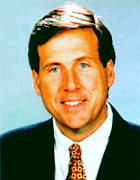
At that meeting were Virginia Gov. Jim Gilmore and Marc Gustafson, president and CEO of Volvo Trucks North America (below left), whose New River Valley Assembly Plant (NRV) was located in Dublin. Unexpectedly, the meeting generated was idea to create the Virginia Investment Partnership (VIP), administered by the Virginia Economic Development Partnership (www.yesvirginia.org) to assist manufacturing expansions and upgrades. In 1999 the idea debuted strikingly. One of the first projects to utilize the VIP, Volvo's NRV expansion will likely get some $60 million in incentives over 10 years. The actual value will be based on total new jobs and, interestingly, total trucks produced.
Making 30,000 trucks annually, the NRV holds Volvo's single-plant production volume record and regularly beats projections by 10-plus percent. But the NRV wasn't a location lock. Volvo took long looks at South Carolina and Mexico. Critically, the VIP incentives could also turbocharge productivity. They'll fund Virginia Tech's work-force development programs for NRV's engineering and supervisory personnel, plus a new "Center of Excellence" providing training for Volvo (and other area residents). "The training incentives were a tremendous deciding factor," says Gene Dillon, Volvo's compensation, benefits and training manager. Though NRV employment will increase by a hefty 40 percent, the combination of training and a substantial technological upgrade will up production by 66 percent. And NRV workers ratified by 2-to-1 Volvo's new six-year labor pact, the industry's longest. "We're implementing a unique one-plant strategy leveraging our skilled work force and economies of scale," says Gustafson. Without previous Gov. George Allen, though, this deal may've never happened. As Volvo considered a new non-Virginia location in the mid-1990s, Allen marshaled the incentives that spurred NRV's $160 million expansion. 1999's deal, then, continues a long history at NRV, the first Volvo plant to create production schedules with the pioneering OptiFlex system, "which mimics the workings of evolutionary biology," says Tom Murphy, Volvo Truck vice president of manufacturing, The same might be said of the Virginia-Volvo connection.
Irish eyes are smiling, if not downright moist, over this deal, which further confirms that the nation's economic revival is no leprechaun's elusive pot of gold. The deal's mammoth dimensions also boldface the aggressive moves Xerox has made in the burgeoning inkjet printer market. In only two years, it's sold 1 million-plus inkjet units and amassed the world's third-largest portfolio of thermal inkjet patents. But like a color digital photo printout, this deal's full scope took shape gradually. First, Xerox announced in July that it would build a 1,000-employee, $325 million printer plant in Dundalk. Major location factors, officials explained, were Ireland's deep high-skill labor pool, continental market proximity, strong industrial base and supporting infrastructure, plus a cluster of skilled high-tech manufacturing suppliers. Xerox also obviously liked Ireland's legendarily low taxes (with a corporate income tax of only 10 percent). Perhaps less obviously, Xerox liked Ireland's presence in the EU's "Euro zone," where common currency pressures drive down capital and construction costs. But Xerox was just getting warmed up. Aiming to speed product development, it announced in September a Dundalk center to develop high-end Xerox printer software. Employment projections rose to 1,900. "Software development is a huge Xerox growth area," says Xerox Ireland Operations General Manager Aidan Donnelly. "One of the main contributing factors for locating this development center in Dundalk -- which is rapidly becoming a solid base for software professionals -- is the Dundalk Institute of Technology," which has been favorably compared with Stanford. Deputy Prime Minister for Enterprise Trade and Employment Mary Harney (www.irlgov.ie) calls the new complex "a very significant endorsement of the Irish economy's competitiveness by one of the world's leading IT companies. It means Ireland has become a strategic European center for Xerox." With its economy growing by some 12 percent, Ireland can anticipate even bigger things from Xerox (which is adding 1,200 more jobs in Dublin). There's ample room to further expand inside the 110-acre (44-ha.) Xerox Technology Park being built in Dundalk. And Ireland's low-level bureaucracy has further enhanced its uniquely attractive mix of modest costs and high skills: The first of Xerox's five Dundalk facilities was finished ahead of schedule and is already online.
Deals like this one further bolster the nation's high-skill cluster -- which is likely already strong enough to diminish the impact of the EU's possible 2010 phase-out of Ireland's low tax incentives.

| |
|
| |
 | Site Selection Online | SiteNet | Feedback | Search SiteNet | ©2000 Conway Data, Inc. All rights reserved. SiteNet data is from many sources and is not warranted to be accurate or current.
|

 An unplanned outgrowth from a summer 1998 meeting helped seal this deal, which will create the world's largest Volvo heavy truck plant.
 And that's swell with Volvo. Whippet-quick product development, manufacturing and distribution have spurred record North American sales -- and Volvo's crying need for more production muscle. As Gustafson explains, "In 1999 80-plus percent of our sales came from products that didn't even exist three years ago."