| |
|
From Site Selection magazine, May 2000 C O V E R S T O R Y Inside Dell's Clicks-and-Mortar Machine (continued)
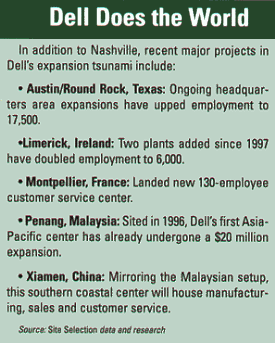
New global markets have wrecked many a real estate model. Dell's paradigm, though, has fared well, despite some difficult barriers. The heaviest expansion has been in Europe, where Dell opened a Europe, Middle East and Africa (EMEA) regional headquarters in 1987 in Bracknell, an English New Town west of London in England's Silicon Valley. But the hottest global action has unfolded in Limerick, Ireland, where in 1990 Dell opened a manufacturing center. In 1997, with its market-share growth running five times the EMEA average, Dell needed turbo-drive expansion. Says Thompson, "We were told again and again, 'That's how it's done in America, not how it's done in Ireland.' And we said, 'We're not doing it the America way or any other way. This is the way we'd like to do it at Dell.' " They did it. In less than two years, Dell expanded from one Limerick plant to three, spanning more than 1 million sq. ft. (90,000 sq. m.), doubling capacity and upping employment to 6,000. Irish Prime Minister Bertie Ahern hailed the third plant's opening as "a big day for Limerick and Dell, but most of all a great day for Ireland."
In Brazil, a "virtual warehouse" enabled doing it the Dell way. With its sluggish customs clearance, Brazil would seem an ill fit for Dell's speed-centric model. Notes Thompson, "Doing the virtual warehouse was the only way we could've gone into Brazil." The virtual facility expedites high-speed export/import. Parts go straight to the $108.5 million plant Dell located last year on a 123-acre (49.2-ha.) site in Eldorado do Sul. Likewise, outgoing shipments load immediately. Brazilian officials monitor the goods online, and Dell pays taxes and duties. But the virtual warehouse was no easy sell. "We went to Brazil, met with the government and educated them on our process and expectations," Thompson explains. "We made it clear up front that we would probably challenge the norms, as we do when we go to a community and, for example, say, 'It typically takes a year to get a permit? That's unacceptable. We need it in X time. What do we need to do to get there?' Then they come back with their expectations. "But it all comes back to our delivering on unreasonable expectations. That demonstrates that others can also go beyond their standard parameters. Once people realize that's possible, they actually think it's pretty cool."
Dell faced perhaps its stiffest challenge in China, where sluggish decision-making is often elevated to a dubious art form. But uber-opportunity was knocking. Tripling each year, Chinese PC sales will reach 10.6 million units in 2002, IDC projects. Dell couldn't squander time. "Our analyses, historical experience and data showed that costs were just phenomenally out of line," Thompson explains. "So we began our education process with everyone involved." The Chinese reeducation took. In Xiamen, a southern coastal city, Dell sited a major manufacturing/sales/customer-service center modeled after its first Asia-Pacific center in Penang, Malaysia, which opened in 1996. "Conventional wisdom would've said the direct-market real estate model just wouldn't work in China," Thompson says. "But we communicated directly with the government, the community and the businesses, tapped local firms and accomplished what we had to. It's gone phenomenally well." So well, in fact, that Dell recorded its fastest-ever sales growth, turning a profit only a year after entering the Chinese market in 1997. Though pitted against mainland competitors with heavy government and military connections, Dell's direct-sales approach blossomed where many thought it doomed. "The direct model may be the only way to avoid Asian leaders' artificial market barriers," asserts Technology Alliance Partners President Mark Anderson, who edits the online Strategic News Service.
The ongoing interplay of physical space and cyberspace is spurring more portfolio changes. Dell's widely lauded online help, for example, has reduced call center requirements, Johnson says. Only 3 percent of customers now call sales reps to complete orders. And Dell's online support now provides downloadable diagnostics and manuals that help users fix their own PCs. "The more touch-less our customer assistance, the more it goes from real money on the phone to pennies through the Internet," Thompson notes. But Dell's keeping the personal touch. In Nashville, for example, it's already set up a 400-employee customer support center. Dell is also continuing its aggressive expansion in cyberspace, where it's established a formidable edge. Its 34,000 "Premier Pages," for example, are 10 times more than its nearest competitor. Such customized Web links -- which allow large corporate customers to track purchases, order products and receive new equipment tips -- have actually enriched customer relations, maintains CFO Meredith: "That kind of experience promotes long-lasting connections." Dell is also creating a raft of Net-centric products and services. Last year, it formed the Internet Partner Division and the Web Products Group, built wireless technology into its corporate PCs, and unveiled Blackberry pagers and WebPCs. With those new endeavors, Dell is "going from conservative first follower to leader," asserts Anthony Bonadero, Dell product marketing director. But Dell's move into that market is uncharacteristically late, say many analysts. And it may spur a rare departure from build-to-order real estate. Dell may make some of its new products; others, though Dell branded, may be third-party manufactured, officials say.
That rush of new activity will further complicate Dell's slam-bang demand scenario. So, what now, real estate? "If we were in the respond business, we'd be dead," Thompson says. "When I came here in 1997, I knew our make-or-break information would be knowing, as well as possible, our real estate requirements." Thompson puts a printout of Dell's real estate demand matrix on the table. It's a huge, intricate thing, looking like something out of Escher with its 3-D design. Perhaps 10-12 vertical rows represent customer segments; 30-35 horizontal rows represent demand variables. "We had to take control of this, to become Dell's experts [on] headcount implications. We set up very dynamic processes with each of the businesses. We continuously revisit this; it's process, process, process. Frankly, we probably spend more time studying headcounts and business plans than actually building. So we're probably more strategists than developers." A developer's mindset, though, is part of what makes Dell real estate tick. The brainy Thompson has a master's in real estate development from MIT (where he also taught for seven years) and spent 12 years directing development and construction for Boston-based Nelson Cos. "Our folks have often been developers in prior lives," Thompson says. "We look for people with that organizational agility and market mentality, who run Dell real estate as if it's their own business." A Himalayan Sherpa's endurance would seem to be another apt Dell real estate qualification. But perhaps even more vital, the unit leader says, is humor. "We have to do a lot of browbeating in all this expectation-setting, so maintaining a healthy sense of humor is real important. But browbeating doesn't get you there. What does get you there is continual press.
"Or," Thompson smiles, "as we say with another Dell corporate real estate mantra: 'No' simply means that you don't yet have enough information." SS

| |
|
| |
 | Site Selection Online | SiteNet | Feedback | Search SiteNet | ©2000 Conway Data, Inc. All rights reserved. SiteNet data is from many sources and is not warranted to be accurate or current.
|

 The Model Goes Global
  Model Scales Great Wall
  More Changes from Cyberspace