From Site Selection magazine, November 2000
C O V E R S T O R Y |
Warp-Speed Buys, Workplace Tests

The Coyote campus will ease Cisco’s San Jose growth concerns. But the company’s ongoing acquisition spree creates more expansion pressures. Cisco in May announced its plan to make as many as 30 acquisitions by year’s end. That Pac-Man pace, which some analysts call “outsourced R&D,” is a key corporate strategy. “What you’re buying is talent,” Garvey says. “You’re a dismal failure if you don’t do everything you can to preserve that intellectual capital.” CEO John Chambers demands monthly retention reports for all of Cisco and its acquisitions. That vigilance has paid off handsomely. While most acquisitions suffer 40 to 80 percent turnover, including most top executives and engineers, Cisco’s bevy of savvy acquisitions has a meager 6 percent turnover rate, 2 percent below overall turnover. And acquired employees make up a striking 20 percent of Cisco’s total work force. Those successful acquisitions, however, create formidable workplace hurdles. “They’re not part of our strategic growth plan,” says Garvey. “So suddenly you find you have 20 to 300 new people, which is a real work-space challenge. “You know,” Garvey chuckles, “most of the time, I’m just hoping they’ve got plenty of space for a long time. But our preferred strategy is to connect all the parts as quickly as possible in Cisco space.” But with most existing facilities at 90 percent-plus capacity, that isn’t always possible. In the Boston metro, for example, Cisco has acquired six firms that will comprise the nucleus of the 580-acre (232-ha.), 5,000-employee New England Development Center. But with that campus not yet completed, Cisco is having to rely on what Garvey calls “survival space.”
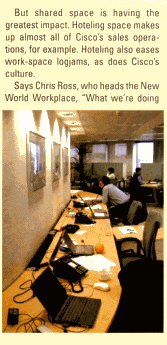
Many firms tackle such workplace concerns with one-size-fits-all standards. Until recently, Cisco did. Garvey, however, decided that was a foolish consistency. “One of the things I wanted to change when I came here late last year was trying to impose the San Jose look on everything,” she explains, “I don’t think that’s appropriate in terms of giving people what they need,” Garvey asserts. “And each country’s norms and laws are very different in terms of, for example, how far people can be from natural light and their expectations on furniture and ergonomics. So we now have a much larger degree of autonomy and flexibility as to what’s appropriate.” The added flexibility also facilitates finding the best workplace solutions for Cisco’s tsunami of acquisitions. “We go in and look at what’s best for each acquisition,” Ross explains. “Some have no space standards or not even good space, with doors for desks, for example. We try to work with them to create a more generic, flexible environment. But we don’t want to not leverage something that’s working.” That wised-up flexibility came into play with an acquisition recently relocated in Cisco’s space in Stockley Park Heathrow in London. “They really felt strongly about what I’ll call, for lack of a better term, chaos,” Ross laughs. “So we developed Stockley Park spaces that capture that chaos in a positive way that works for them and is comfortable.” Likewise, simple math dictated a departure from conventional workplace wisdom in Seoul. While Cisco’s Seoul office is growing more than 100 percent a year, market vacancy is at 1 percent. The solution was hoteling, but with a nod to nuance. “In Seoul’s culture, employees were very uncomfortable without some space of their own,” Ross says. “So we gave them very small dedicated spaces. And they have a variety of options, like cubicles or quiet rooms, they can use when they’re in the office for a longer time.”
In contrast to Cisco’s expansion juggernaut, the company’s Net-centric business model pares back some space requirements. With that model, a whopping 97 percent of business orders come over the Net. Consequently, Cisco can immediately check demand; and it can close its quarterly books in a single day. To great extent, the network is Cisco, a virtually integrated outside-in prototype. What the rest of the world sees as one company is, in fact, a networked conglomeration of Cisco and its far-ranging constellation of assemblers, contract manufacturers and suppliers. That model has huge real estate ramifications. Cisco, for example, can continually ramp up output without building a single plant. It doesn’t even touch 70 percent of its products. Instead, contractors using Cisco’s intranet directly monitor, fill and ship customers’ orders. That online integration has continually compressed order and product development cycles while appreciably increasing customer satisfaction. Similarly, Cisco’s real estate/workplace group is regarded as a cyberspace leader. The group, though, seems to mirror CEO Chambers’ policy of “normal, healthy paranoia.” “We’re always our own worst critic, but we don’t think we’re far enough ahead,” says Garvey. “We want to not just put processes online, but to think about the best way to get the job done two or three years down the road. But when I go out and do public speaking, the audience feedback always makes me realize that, gee, we really do have a tremendous amount of activity online.” Real estate/workplace functions and information that are online range from leases, maintenance, move management and space reconfiguration to project management, documentation and approval. In addition, “e-space planning” enables the real estate/workplace arm to conduct online dialogues with client groups on design ideas. “I really don’t have paper anymore unless someone sends me something from the outside. Everything I need is online,” Garvey says.
But Cisco’s real estate/workplace arm is only beginning to leverage its clout to get service providers fully online. It’s working in that effort with KPMG Consulting Services (www.kpmg.com), in which Cisco invested $1 billion last year to acquire a 19.9 percent stake. “As part of our more concentrated outsourcing program, we’re moving toward being able say to vendors, ‘If you want this job, you’ll have to use Cisco’s Web-based solutions,’ ” says Garvey. “If they haven’t put money into systems, it’s going to be hard to compete.”
Particularly with real estate e-commerce looming, part of Chambers’ push for each business line to develop e-commerce. “By next year,” Garvey explains, “I think we’ll have in place a system facilitating online relationships with suppliers and manufacturers -- a system that enables us, for example, to put out a gazillion feet of rollboard to bid. Then we won’t warehouse it. Our contractors will just pull off our bid and have it delivered to the site.”
Meanwhile, back in the present, workplace challenges keep coming in bunches. Consider that the 20,000-employee Coyote campus (which will soon break ground) won’t provide enough San Jose space. Cisco this year will also begin building out another 2.3 million sq. ft. (207,000 sq. m.) in North San Jose to house 7,000 more employees. And with that, the Building of the Month Club will reconvene. “Trying to do linear accommodation for Cisco’s space needs just doesn’t work,” Garvey says. “So what we will do is multi-campus construction. We’ll probably be building campuses at four different Bay Area sites at the same time, expanding to be less San Jose-centric and more focused on the whole Bay Area.” That Bay Area focus will provide more expansion space and access to 600,000 more electrical engineers, according to Cisco analyses. For Garvey, a respected real estate veteran, the move to Cisco could hardly have been more dramatic. After heading Bank of America’s real estate operations, she retired -- or so she thought. She was spending a lot of idyllic time in Italy when CFO Larry Carter persistently persuaded her to join Cisco.
“Cisco is so different from Bank of America,” Garvey says. “With financial institutions, you’re in a consolidating industry. High tech is consolidating, too, but Cisco is the buyer.
“And it’s the most fun job I’ve ever had,” she adds. “We’re probably the world’s biggest developer.”
That happens when you’re part of the Building of the Month Club.

| ||||
|
| ||||
 | Site Selection Online | SiteNet | Feedback | Search SiteNet | ©2000 Conway Data, Inc. All rights reserved. SiteNet data is from many sources and is not warranted to be accurate or current.
|