 From Site Selection magazine, January 2002
REAL ESTATE TECHNOLOGY
|
|
Real Estate Executives Are Getting Web-Savvy
hen they turn their attention to the Internet, corporate real estate departments have been mainly concerned with improving communications, customer service applications and Web site development. But a Corporate Real Estate Technology Benchmaking Survey conducted in August 2001 by Ernst & Young (E&Y) and the National Association of Corporate Real Estate Executives (NACORE) suggests that they are gradually beginning to focus on where the real value is: Web-enabling business processes to achieve greater efficiencies and substantial cost savings in the corporate real estate function. Meanwhile, technology companies offering real estate solutions have shifted their targets from the real estate industry, which has been slow to adapt to new technology, to corporate real estate departments. Although they usually have limited budgets, real estate departments are more attuned to Web-enablement, because other parts of their organizations have already embraced it.
Technology usage 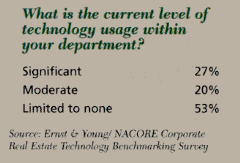 The survey examined technology usage by corporate real estate departments in 30 companies, half of them Fortune 500 companies. Among these organizations, a minority is taking the lead in the use of technology. Slightly more than a fourth reported significant use of technology, while more than half reported limited or no usage. The rest reported moderate usage. Also, only 41 percent of survey participants said they had access to dedicated technology specialists, and only 43 percent had specific technology budgets. In many cases, technology assistance is provided by corporate information technology specialists or outside consultants -- more than half the participants reported using outside consultants in making technology decisions. The survey examined technology usage by corporate real estate departments in 30 companies, half of them Fortune 500 companies. Among these organizations, a minority is taking the lead in the use of technology. Slightly more than a fourth reported significant use of technology, while more than half reported limited or no usage. The rest reported moderate usage. Also, only 41 percent of survey participants said they had access to dedicated technology specialists, and only 43 percent had specific technology budgets. In many cases, technology assistance is provided by corporate information technology specialists or outside consultants -- more than half the participants reported using outside consultants in making technology decisions.
According to the survey, technology and telecommunications companies with dedicated technology specialists are most likely to develop in-house solutions. Nearly half the survey participants say they rely on off-the-shelf applications to meet their technology needs. These purchased applications are often customized to meet specific functionality requirements or for integration with existing systems. According to the participants, their primary objectives in utilizing technology are to improve communications within the department and with customers, enhance data-management capabilities, reduce process redundancies and cut overhead costs. Among the technology solutions they use, the most prevalent focus is on lease administration, space planning, facilities management and portfolio management. 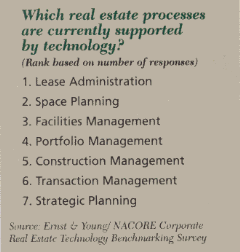 The greatest use of technology is found, as might be expected, among the corporate real estate departments of technology and communications companies, but the departments of financial services companies also reported a relatively high rate of use. The other companies surveyed were in retail, distribution and manufacturing and health sciences. Real estate processes for which most of the participants are responsible include strategy, lease administration, project management and property management. The most likely processes to be outsourced include facilities maintenance, transactions and design and construction. More than two-thirds of the companies surveyed say they had evaluated individual Web-based technologies. Survey respondents say the key strengths of new Web-enabled applications include enhanced communication/accessibility, significant interface capabilities with existing applications, and increased reporting functionality; however, further drill-down capabilities and more flexible ad hoc reporting are needed. Data security is also an important consideration. Nearly all survey participants indicated a concern in utilizing application service provider (ASP) solutions and expressed a need to thoroughly review all security measures associated with the new systems including data encryption, data segregation, database administration and disaster recovery systems. The high level of interest in Web-based technologies suggests the use of such technologies by survey participants may increase in the future, depending partly on the solutions available. For example, retailers with multiple locations indicated a significant need for solutions such as portfolio management, lease administration and site location systems; however, few of the existing systems offer them the specific functionality they require. Survey respondents indicate that new technology solutions must have the ability to integrate with existing systems and, to accelerate adoption, companies themselves must develop change-management plans. Furthermore, respondents say their departments have to build a successful business case for acquiring new technology, and they need a defined methodology for measuring results. Among companies that have completed implementation, returns from investing in Web-enabled technology are not yet fully measurable and are expected to include both quantitative and qualitative results. Web-enablement 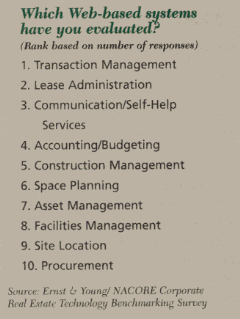 As the survey indicates, corporate real estate departments that have developed significant technology platforms need to develop an evaluation framework before undertaking new technology purchases. In conjunction with that effort, they also need to develop a strategic plan to Web-enable business processes -- identifying solutions, setting priorities, and implementing a plan. However, while two-thirds of the respondents have evaluated individual solutions, only about a third said they had gone further and created Web-enablement plans, although many reported having such plans under development. As the survey indicates, corporate real estate departments that have developed significant technology platforms need to develop an evaluation framework before undertaking new technology purchases. In conjunction with that effort, they also need to develop a strategic plan to Web-enable business processes -- identifying solutions, setting priorities, and implementing a plan. However, while two-thirds of the respondents have evaluated individual solutions, only about a third said they had gone further and created Web-enablement plans, although many reported having such plans under development.
Based on our experience in advising companies on Web-enablement initiatives, companies face a challenge in selecting from a seeming universe of solutions and capabilities and in prioritizing solutions. Among the key questions to address are these:
Outlook 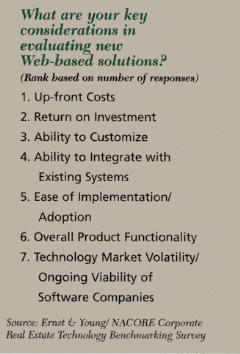 The economy's slowdown and the September 11th terrorist attacks have slowed but not stopped the push of corporate real estate departments to adapt new technology and Web-enable their business processes. Interest in Web-enablement remains strong, and some companies are continuing to move ahead with projects. More companies will launch initiatives as the economy begins to recover. From our experience in working with corporate clients, we are seeing some trends emerge in Web-enablement. Among them: The economy's slowdown and the September 11th terrorist attacks have slowed but not stopped the push of corporate real estate departments to adapt new technology and Web-enable their business processes. Interest in Web-enablement remains strong, and some companies are continuing to move ahead with projects. More companies will launch initiatives as the economy begins to recover. From our experience in working with corporate clients, we are seeing some trends emerge in Web-enablement. Among them:
The economy's downturn has forced companies to look for every opportunity to reduce costs and operate more efficiently, and one of the greatest opportunities is in Web-enabling their back-office business processes. Companies that begin now to reassess their technology usage and needs, to evaluate new Web-based solutions, and to develop, refine, select and prioritize a set of solutions will be well-positioned to realize substantial cost savings, increase operating efficiencies and improve customer satisfaction and profitability. 
 Joseph Rubin is Director of Real Estate eBusiness Solutions of Ernst & Young's Real Estate Advisory Services (REAS) Group and a partner in Ernst & Young's New York office. Brad Hall is Director of Real Estate eTransformation and Business Strategy of the REAS Group and a partner in Ernst & Young's Los Angeles office. Scott Hileman is a principal with the REAS Group, based in New York.
| |
|
| |
 ©2001 Conway Data, Inc. All rights reserved. SiteNet data is from many sources and not warranted to be accurate or current. |