From Site Selection magazine, September 2002
INFRASTRUCTURE
|
From Site Selection magazine, September 2002
INFRASTRUCTURE
|
|
2002 Global Infrastructure Report, page 2
San Diego Feels "We're taking a hard look at the economic impact of the airport on the region - it currently has about a $4.5 billion impact," says Enarson. "We're forecasting a $9 billion impact in the next 20 years if it's allowed to grow unrestricted. However, if the airport stays at Lindbergh Field on our 524 acres [212 hectares] with one runway, that will be difficult to do." Enarson says the current facility will be at passenger capacity in 2018. The addition of a second runway, possible only if the adjacent Marine Corps Recruit Depot were relocated, would add about 30 percent capacity. That would extend the time until peak capacity is reached to only about 2022. "Lindbergh Field is not going to be able to serve the air transportation needs of the region past the 2020 timeframe, which will have a negative impact on the economic growth of the region," says Enarson. A new terminal with nine gates was completed in 2000. And additional terminal expansions are under consideration to meet the annual growth in passenger volume of about 4 percent. A second strategy involves seeking a site for a new airport. More than 300 scenarios have been analyzed for suitability, and 21 sites are now under consideration. Those will be narrowed down to a preferred site alternative, which in 2004 will go to a vote to determine public acceptance. If it's rejected, Lindbergh Field may have to do, for now. Two scenarios involving airport sites at the nearby Mexican border - one right on the border - have been removed from the list of potential sites. Enarson and his colleagues are acutely aware of the importance of resolving the matter correctly and in a timely fashion. "The business community has been very supportive of a new airport location," he says. "They understand the need for corporate America to have good air transportation when they set up shop in a city. Having an airport that can serve those needs from both a passenger and a cargo standpoint is very important." The nearly downtown location of Lindbergh Field is very attractive from a consumer standpoint, but its growth limitations will be restrictive to the business community in the long run. "Businesses support the incremental expansion of Lindbergh Field to keep up with demand," says Enarson, "and they are very supportive of finding a new location and of the process of looking for a new location." Global Airport Expansion Update Expansions and major new facilities are under way at airports around the world as demand for air service and cross-border trade gains momentum. Here are some examples:• Tradeport Hong Kong, a 366,000-sq.-ft. (34,000-sq.-m.) cargo terminal, is now under development at Hong Kong's Chek Lap Kok International Airport. • In the U.K., each of London's four airports are seeing upgrade investments. Terminal Five is planned at Heathrow, the primary international airport; Gatwick's capacity is increasing from 30 million to 42 million passengers per year; Stansted is planning to expand its passenger terminal, improve transit systems and roads and add support, cargo and maintenance facilities; Luton and London City Airport also have expansion plans in the works. • Seattle-Tacoma International Airport - Sea-Tac - is doubling the gates in Concourse A, renovating and expanding the main terminal, modernizing the satellite transit system and building a third runway. • Lambert-St. Louis International Airport has embarked on a $1.1 billion expansion that involves a third runway, a 50 percent increase in the airport's footprint and relocation of seven major roadways west and north of the airport. • A fourth runway under construction at Miami International Airport is scheduled to be completed in May 2003. • In the Middle East, airports in Jeddah, Saudi Arabia, and Sharjah in the United Arab Emirates are embarking on expansions. A multi-billion dollar third terminal is in the works at Dubai International Airport. And Egypt's government is modernizing 26 airports. It plans to expand the Alexandria airport to make it the largest air cargo hub in North Africa. • Canada's Ottawa International Airport is expanding to meet passenger growth for the next 20 years.
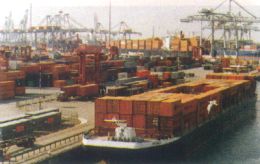
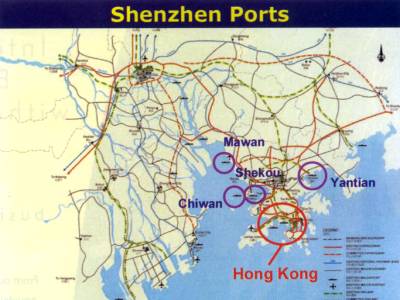
World Intermodal Economy The role of containerized waterborne cargo maintains a pretty low profile given its immense volume. But a look at the stacks adorning ships and terminal landings around the world shows how crucial those colorful mosaics of TEUs (twenty-foot equivalent units) have become. What's more, container ships accounted for nearly a quarter of the new vessel tonnage (2,700 ships) ordered by customers around the world in 2001, soon to join the worldwide fleet of more than 87,000 merchant vessels. Receiving those vessels are some of the busiest hubs of commerce in the world. The chart below displays the Top 20 Container Ports in the world by volume for 2001, with both categories led far and away by Asian cities, filling 10 of the 20 berths on the list. But look out on the horizon, because another Asian city is entering the fray. P&O Ports, a dominant force in the shipping industry with 8 million TEUs (or 4 percent of world trade) moved annually, is partnering with China Merchant Holdings, Swire Pacific and Modern Terminals to build a $200-million container terminal at Shekou, in the white-hot Pearl River region of southern China. Expected to be operational by the end of 2003, the port's 500,000-TEU annual capacity should mesh nicely with the busiest port in the world just across the water: Hong Kong, which moved 17.8 million TEUs in 2001. Eight container terminals in Hong Kong's Kwai Chung port are not enough, so the ninth is now under construction. Expected to handle more than 2.6 million TEUs at its six berths, the terminal will be completed by 2004, and join the other terminals in benefiting from new dredging of shipping channels to a depth of 15.5 meters (51 ft.), allowing the very largest ships to get in and out smoothly. The cranes are speeding up, the containers are stacking higher and the ships just keep getting bigger, with projects underway on the construction of 10,000-TEU vessels. But you can only stack them high if the water is there underneath, adding even more emphasis to the importance of dredging. Call it "brown harbor" redevelopment. "Sediment is being recognized as something to be dealt with," says Omer Kadaster, executive engineer for Atlanta engineering firm Brown and Caldwell and the contract task order leader for the Navy Clean Program at Long Beach Naval Ship Yard. "It used to be dumped into the open ocean. Now all the harbors are dredging, because they have to maintain the water depth. A lot of the old companies are now being asked to clean it up, so they can revitalize the dockyards. Sediment quality in harbors which support industrial activities along its shores, as well as in areas where municipal or industrial discharges into harbors are occurring, has become increasingly more visible."
In fact, much of that sediment goes toward the buildup of new landfill for berths, mimicking the island-building that Hong Kong executed for its new airport several years ago. But containerized cargo never complains at the ticket counter. "The cargo demand for the Hong Kong container port in the next 15 years will grow at an annual rate of 5 percent," said Sandra Lee, Hong Kong secretary for economic services, at the Terminal Operations Conference Asia last year, predicting volume of 30 million TEUs in 2010. "Hong Kong is expected to benefit from the continuing growth in Southern China as the main source of cargo for Hong Kong comes from the Pearl River Delta," she said. She also noted that intermodal links and the city-state's airport are crucial connections to the port's operations "A study is being conducted to examine the feasibility of a Container Port Rail Line to support the long-haul freight transport need between Hong Kong and our hinterland," she announced, noting as well the almost 11 percent growth year-to-year in airport cargo shipments, which has sparked the development of a marine cargo terminal and logistics center on the airport's island, both expected to help in tripling the airport's cargo capacity to 9 million tons annually. And what Lee told multinational shippers in June at an international conference in Greece could just as easily apply to other corporate locators. "Hong Kong offers the conducive business environment and facilities to facilitate the development of the shipping industry," she said. "These include a low tax regime, efficient banking services, excellent communications, modern infrastructures, a sound legal system, business-friendly policies, a clean and accountable civil service as well as a highly educated and skilled work force," she said. Felixstowe is the leading port in the U.K., where three new container facilities are being constructed, including a port and distribution hub in London. But those ports and their labor unions, along with those of other European cities, are fighting a European Union directive that would limit the time range on terminal leases, thereby warning away container giants like Maersk Sealand, P&O, ECT and Evergreen. Hamburg, Germany can rightly claim to have been in business since 1189, when the Count of Schauenburg founded it. It reached the status of third-largest in the world by 1912, but World War II saw 80 percent of its facilities destroyed. Today it offers four container terminals and eight multi-purpose terminals that also handle containers. With a handling capacity of 2,500 TEUs or more in less than 24 hours, these terminals ensure that even the biggest container ships can leave Hamburg again in less than a day. Forty-four percent of its container turnover involves Asian trade, with a growing portion accounted for by Scandinavia. In addition to the waterborne vessels, Hamburg can boast to being Europe's largest rail container handler. Germany as a whole will soon benefit from increased port activity in Bremen, and from the $740 million deep sea container terminal at the port of Wilhelmshaven. 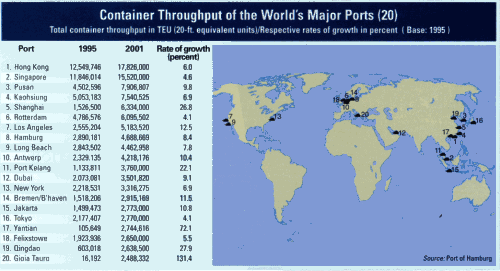 Combined, the ports of Long Beach and Los Angeles represent the third busiest container port complex in the world, after Hong Kong and Singapore. And East Asian trade accounts for more than 90 percent of the shipments through the port (according to port officials, 550 million tons of machinery went to China in 2001). Container throughput has increased by more than 175 percent since 1990. Long Beach plans to invest $1.9 billion in capital projects to improve and enlarge its facilities, creating five container terminals of more than 300 acres (121 hectares) each and two other large terminals. The average container terminal operator is charged a guaranteed minimum of $100,000 per acre per year to lease a terminal. In May, the number of imported containers rose to 231,382 TEUs, an increase of 18 percent over May 2001, and exported containers increased to 84,062 TEUs, a gain of 3.6 percent over May 2001, but still behind the number of empty containers shipped out, at 112,589. The leading exports shipped through Long Beach include factory equipment and raw materials such as plastics, chemicals and recycled metal and paper. Antwerp, Belgium and smaller port Zeebrugge in Flanders were significant factors in the choice by Singapore-based terminal operator PSA Corp. to acquire logistics operator Hesse-Noord Natie. The company will grow to operate a combined 22 terminals in both ports, including three container terminals in Antwerp. Earlier this year, the European Distribution Report by Healey & Baker, a part of Cushman & Wakefield, ranked Belgium first of 16 countries in Europe for logistics and distribution operations, based on population density, geographic access, transportation networks, land supply, and costs of land and labor.
Continue to Page 3 | |||||||
|
| |||||||
 ©2002 Conway Data, Inc. All rights reserved. SiteNet data is from many sources and not warranted to be accurate or current. |