


IAMC INSIDER


And You Thought This Was Small: Intel's February announcement of a $7-billion investment in U.S. manufacturing capabilities for a new 32-nanometer chip comes on the heels of the opening of its first 45-nanometer manufacturing facility in Chandler, Ariz., in 2007, ironically nicknamed Fab 32. Pictured are 300-mm. 45-nm. wafers made at that facility, which received an investment of $3 billion.
Photo courtesy of Intel Corp.
I
ntel in early February announced it would invest $7 billion over the next two years to construct manufacturing facilities for the company's 32-nanometer chip manufacturing process at existing sites in Arizona, New Mexico and Oregon.
"We're investing in America to keep Intel and our nation at the forefront of innovation," said Intel President and CEO Paul Otellini. Thirty-two nanometers equals about 1 millionth of an inch. The less expensive, more energy-efficient chips are expected to be available by the end of 2009.
The announcement came just a couple weeks after the company said it would close two existing assembly test facilities in Penang, Malaysia, and one in Cavite, Philippines; halt production at Fab 20, a 200-mm. wafer fabrication facility in Hillsboro, Ore.; and halt wafer production at its D2 facility in Santa Clara, Calif.
Between the two announcements, the company announced it would move its assembly and test operation in Shanghai, China, to Chengdu, Sichuan province, while still proceeding with its new facility in Dalian, China.
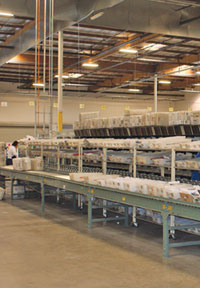
Pitney Bowes' new sorting facility in Corona, Calif., has annual capacity of more than 750 million pieces of Standard-Class letter mail, and brings to 38 the number of mail handling facilities in the company's U.S. portfolio. In October 2008, the company opened a new 78,000-sq.-ft. (7,246-sq.-m.), 70-employee mail presort facility in Urbandale, Iowa, that has an annual capacity of 3 million pieces.
Photo courtesy of Pitney Bowes
C
onnecticut-based Pitney Bowes Inc. in January opened a new U.S. Mail presort and international mail services facility in Corona, Calif. The 84,000-sq.-ft. (7,804-sq.-m.) center will employ approximately 100 people. A week later, it opened a 34,000-sq.-ft. (3,159-sq.-m.) international mail services facility in Waterway Business Park in Hayes, U.K., near London Heathrow Airport, that will employ 55.
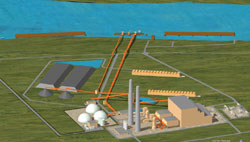
The AMPGS project is a proposed 1,000-MW coal-fired generation facility, to be developed on the Ohio River in southern Meigs County, Ohio.
Image courtesy of AMP-Ohio
I
n January, American Municipal Power-Ohio, Inc. (AMP-Ohio) and Bechtel Power Corp. announced they would partner to construct the $3.25-billion American Municipal Power Generating Station (AMPGS) in Meigs County in southeastern Ohio, on a site originally picked in October 2005. The project will supply 81 municipal electric systems in Ohio, Michigan, Virginia and West Virginia.
AMP-Ohio President/CEO Marc Gerken said the plant would employ 165 when fully operational, and up to 1,600 during the four and a half years of construction. "This will be a state-of-the-art facility and model for responsible use of our nation's abundant supply of coal," he said, with the latest in emissions control technology and plans for carbon capture.
I
n December, Massachusetts-based Thermo Fisher Scientific announced the opening of a $17-million, 150,000-sq.-ft. (13,935-sq.-m.) clinical service facility in Ahmedabad, India, to serve as a hub for packaging, global distribution and logistics management of tightly regulated pharmaceutical samples to patients participating in clinical trials.
The science services provider says it now has the largest presence in India of any company in its industry, with more than 600 employees and 20 facilities, including a demonstration lab opened in Mumbai in 2005.
The project is the latest in an Asian growth trend for the company, which also has been growing in China.
A
lcoa has undertaken a series of curtailment, realignment and expansion projects. Among them:
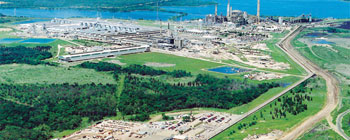
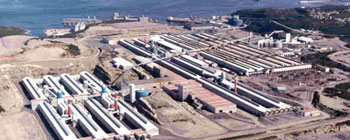
Among the realignment measures taken by Alcoa in the past six months has been the shutdown of its smelting operation in Rockdale, Texas (top), because of ongoing challenges obtaining affordable power. The company will continue to operate its aluminum atomizer in Rockdale as well as its anode operations there, employing a combined 140 people. The company is idling 22 percent of its global smelting production. A partial curtailment at its smelter in Baie-Comeau, Québec (above bottom) is part of a previously announced modernization of the plant. Alcoa recently signed new power agreements with the province that extend until 2040 for its three Québécois operations.
Alcoa images used with permission.
• A new agreement signed in February with the People's Government of Henan Province in China to jointly establish world class projects for the fabricated and primary aluminum industry. Henan Province is home to the second largest bauxite reserves in China, 14 primary aluminum smelters, with a total capacity of 1.3 million million tons per year (mtpy), and seven alumina refineries with production capacity totaling over 2 million mtpy. On the same day, Alcoa announced it would explore opportunities to expand collaboration with Chinalco, at the same time it takes a $1-billion payment from Chinalco marking its exit from the Shining Prospect special purpose vehicle the two companies founded in order to purchase shares of Rio Tinto.
• A new 30-year hydropower contract with the New York Power Authority to supply the company's two smelters in Massena, N.Y., contingent on a $600-million facilities modernization by Alcoa. The company has operated in New York's North Country since 1902.
• Curtailment of 750,000 metric tons per year (mtpy) of aluminum production across its global smelting system. "We have reviewed every asset across our entire system with an eye on how best to maximize profitability as we look to align production with demand," said Bernt Reitan, Alcoa Executive Vice President and President – Global Primary Products. "After careful analysis we have developed a four-part model that spreads the curtailments across our global system and minimizes the costs associated with plant shutdowns and re-starts and, in turn, minimizes the impact on plant communities." The company is reducing headcount by 13,500 (13 percent of Alcoa's global work force), freezing salaries and hiring, selling four non-core downstream businesses and reducing 2009 capital expenditures by 50 percent.
• The signing of a hydropower agreement through 2040 with Hydro Québec that will supply the power needs of Alcoa's three smelters in Baie-Comeau, Bécancour (ABI), and Deschambault, with a combined capacity of 1.1 million mtpy, or what is now equal to 25 percent of Alcoa's global production capacity. The Baie-Comeau plant is due for a modernization that will also increase its output by 110,000 mtpy by 2014.
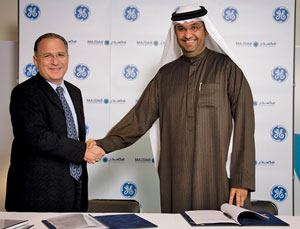
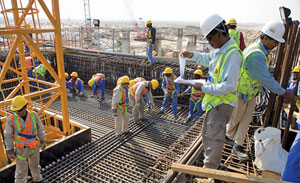
Nabil Habayeb (left), President and CEO, GE Middle East and Africa, and Dr. Sultan Al Jaber, Masdar CEO, sign an agreement on Jan. 20 for the world's first Ecomagination Center in Masdar City, Abu Dhabi, UAE. Ten days later, Masdar officially broke ground on Masdar City (construction photo pictured), touted as the world's first carbon-neutral, zero-waste city, to be completed in seven phases by 2016.
