 You've got to spend money to make money, especially when shipping products to customers around the world. But if there's a way to save 30 percent in transporting that product, that's worth a look. And so Montreal-based Devencore, a real estate adviser and broker, and Montreal International did just that.
Montreal International, a private nonprofit that works to attract foreign investment to the city, obtained Mercer Management Consulting (Mercer), a corporate strategy consulting firm in New York, to study Montreal's distribution activity and its advantages as a distribution hub as compared to other North American hubs. Included among the ports studied were New York/New Jersey, Chicago, Detroit, Toronto, Memphis, Tenn., and Hampton Roads, Va. The study found that companies could save about 30 percent on transporting products by locating a value-added distribution facility in Montreal.
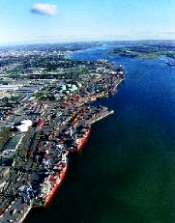
The Port of Montreal is the leading North American container port on the North Atlantic market.
"We studied four different sectors: electronics, the apparel industry, chemical industry and the automotive products industry," says Philip O'Brien, chairman and CEO of Devencore. "And if you have a 250,000-sq.-ft. (23,226-sq.-m.) distribution center -- which would employ about 200 to 300 people and take in on average about 3,000 containers a year, depending on the product -- the cost of running that whole business in the Montreal Corridor is about US$27 million to $28 million. In New York, it's about $50 million to $52 million. That's a big number; you're saving $20 million a year."
Survey Says
The transport of product accounts for only 20 percent of transportation expenses. The remaining 80 percent consists of labor and real estate costs, which makes Montreal a prime candidate for a value-added distribution hub, where parts and unassembled products come into the port to be assembled and shipped to their final destination.
The Mercer study shows that Montreal was the least expensive of all the ports studied in terms of labor, coming in 38 percent lower than the average. Montreal's labor force is also the most available among the sample ports with an unemployment rate of 9.7 percent -- twice the sample average.
As for real estate, Montreal again is very competitive, according to the Mercer report. Rental costs for industrial space in Montreal came in at 23 percent below the average, and construction costs were the lowest among the markets studied at 9 percent below the next-best market, Toronto, and 25 percent lower than the sample average.
Although Montreal is the most distant from major North American population centers, "its easy access to transatlantic routes positions Montreal favorably with regards to total transportation distance for goods from Europe to North America via a distribution center. Only New York offers a shorter access route to major population centers but with only a marginal difference (less than 5 percent on a weighted basis)," Mercer reports.
| Montreal Logistic Competitiveness |
| Final Destinations |
Rank of Montreal's Competitiveness |
Total Logistics Costs vs. Mean |
| Weighted North American destinations (100% pop.) |
7 |
+1.7% |
| West/Midwest (52% pop.) |
9 |
+6.7% |
| East/South U.S. (48% pop.) |
1 |
-16.3% |
| East Coast/Midwest (61% pop.) |
1 |
-13.3% |
O'Brien adds that because the rail tracks are directly on the ports, trains can get out of Montreal faster than they can get out of New York. "So it's a matter of speed," he continues. "Although Montreal is further, the time is shorter from Montreal to Akron, Ohio, than it is from New York to Akron. And the costs for rail are the same as New York."
Transporting by truck is competitively priced in Montreal, according to the Mercer report. Montreal also has very competitive inbound ocean rates (up to 25 percent cheaper than Hampton Roads), and capacity offered is significant. There is a cost catch: Montreal's unit rates for less-than-truckload shipments are approximately 18 percent higher than other ports. Overall, though, Montreal "displays strong costs competitiveness, particularly for logistics activities at a distribution center," according to Mercer.
Devencore decided to further study the market's distribution appeal by obtaining the services of PriceWaterhouseCoopers' (PWC) Brussels office. PWC found that for European companies not currently using the Montreal Corridor, the market "is not even on their radar screens," O'Brien explains. "They didn't even know about it, so the second part for us was to find out how we sell Montreal to the European corporations."
As a result, Devencore and Montreal International are developing a Web site strictly for promoting the Montreal Corridor using the information found in the studies. The site should be ready by year's end. Devencore also is conducting a third study to determine the best sites on which to develop warehousing/distribution space.
For companies that move large amounts of merchandise between Europe and North America, O'Brien concludes, Montreal should definitely be on the short list for value-added operations. "When you think of it, the St. Lawrence River is already like a large funnel coming right into the middle of America, and attached to it are extremely efficient rail, freight and highway systems," he explains. "Add to that the added-value distribution advantage, and you start looking at a whole new NAFTA corridor between North America and Europe."
-- Tracy Heath


