


Why Johnny Moved to the South(cover) Alabama: Rolling Out a Tide of High-End Vehicles South Florida Shines In State's Unemployment Picture Georgia Builds a Better Workforce Grass is Greener in Bluegrass State Pelican State Looks to the Future Nissan Finds 'Advantage' in Mississippi Tennessee: Automotive Hub of the New South Request Information 
|
Why Johnny Moved to the South
Today, you won't find Johnny toiling in an office park in San Jose, Calif. You'll find him working for Highlander Engineering in Lakeland, Fla. 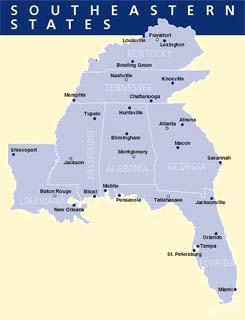
That's right -- Lakeland, Fla. -- a town of 100,000 people in Polk County between Tampa and Orlando. Johnny works for an upstart company that's rapidly becoming a leading provider of middleware for connecting intelligent devices. In Lakeland, Johnny spends less time commuting to his job, lives in a bigger house in a nicer subdivision, and can afford to provide his wife and two sons more of the nicer things in life. "My wife and I still have sticker shock," he says. "In this case, however, it's a positive thing, since the prices we pay in Lakeland for lodging, food, gas and other essentials is so much lower than it was in California. Because of this, the money I make at Highlander in Lakeland goes much further than it did in Silicon Valley. You get to keep more of what you earn in this market." Johnny's not alone. Each year, by the hundreds of thousands, highly skilled workers transplant themselves to the Sunbelt in search of better jobs, more take-home pay, less stressful commutes and a higher quality of life. According to a study titled "The State of the South 2000," a research report funded by the Appalachian Regional Commission, BellSouth, Ford Foundation, Z. Smith Reynolds Foundation, and the U.S. Departments of Labor and Education, the South significantly outperformed the rest of the country in job growth from 1978 through 1997. While the total number of U.S. jobs grew by 42.6 percent over that 20-year span, employment expanded by 110 percent in Fayetteville, Ark.; 150 percent in Orlando; 99 percent in Tampa; 121 percent in West Palm Beach, Fla.; 119 percent in Sarasota-Bradenton, Fla.; 82 percent in Jacksonville, Fla.; 105 percent in Atlanta; 113 percent in Raleigh-Durham, N.C.; 72 percent in Charlotte, N.C.; 63 percent in Columbia, S.C.; and 83 percent in Nashville, Tenn. More importantly for the South's economy, the quality of these new jobs is increasing. In Alabama, the Mercedes-Benz automobile assembly plant along Interstate 20 between Birmingham and Tuscaloosa symbolizes the state's transformation toward higher-end manufacturing jobs and high-skilled labor. In Tennessee, the entry of Dell Computer and Hewlett-Packard signify the state's new focus on "Manufacturing for the New Millennium." And in Central Florida, a burgeoning high-technology corridor stretching from the Gulf Coast in St. Petersburg-Clearwater along Interstate 4 through Orlando to the Space Coast at Cape Canaveral-Titusville (see related story on page 446) is proof that the Deep South is no longer the place of cheap, low-skilled labor. In the following Southeastern States Regional Review, the editors of Site Selection take an in-depth look not only at "why Johnny moved to the South," but also why more corporate employers are placing huge capital investments into new and expanded plants in Southern states.
TOP OF PAGE
|
|
©2001 Conway Data, Inc. All rights reserved. SiteNet data is from many sources and not warranted to be accurate or current.
|