


The Prairie State 'EDGEs' Its Way into the New Economy(cover) New Incentive FIRST with Investors Illinois' Slowing But Steady Economy New Economy, New Initiatives Welcome to RustBelt.com Request Information  |

Welcome to RustBelt.com
Molex's new product design and manufacturing space is a good example of the high-tech path the state is pursuing. With manufacturing remaining the state's top industry, Illinois hopes to not leave that industry behind in its efforts to move into the New Economy, but rather bring its traditional industries along for the ride. 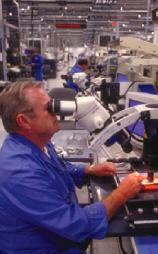
"We've made lots of strides in the last 15 years in improving the efficiency of our manufacturers," says Giertz. "Illinois doesn't receive the recognition it deserves in this area. We've done a lot in terms of incorporating the new technology into our production techniques, and that's why our manufacturing is so efficient. The traditional firms have made use of the technology embedded in their production processes. That's where we've done very well." Ultimately the goal for the state of Illinois, according to McDonough, is to work with the existing technology advantages and invest in the state's education, work force and e-business structures "to position ourselves to take ownership of business-to-business e-commerce and wireless." The Web and e-commerce, in fact, open up Illinois' more traditional industries to a new arena of activity. With business-to-business (B2B) e-commerce expected to reach $7.3 trillion in 2004, according to the GartnerGroup, there is great opportunity for Illinois to market its various manufactured products online. Patrick Blake, for example, left Chicago-based Tunes.com to found a company for selling chemicals and paper online. "The size of the markets is the No. 1 thing you look at in starting a company," he told the Chicago Sun-Times. "The reality is these old-style, legacy companies are gigantic parts of the gross domestic product, unlike business-to-consumer spaces or media plays. The chemical industry is a $1.73 trillion market worldwide compared to $80 billion for the music industry." Besides Blake's company, there is a host of legacy dot-coms popping up around the state. The National Transportation Exchange links member shippers and freight companies, lowering transportation costs and increasing productivity through its online clearinghouse, and TheSauce.com gives independent restaurant owners the advantages of chain restaurant purchasing power from suppliers.
The major Illinois metros are making a play for these types of New Economy companies. Chicago Mayor Daley established city policies aimed at encouraging Internet companies in the city, including a tax subsidy for a new hub for Internet B2B companies on Goose Island. And by early 2000, Divine Interventures, a Chicago-based Internet holding company, had raised more than $500 million to develop business-to-business Internet companies in Chicago and the Midwest. McDonough hopes that these efforts, along with the state's new focus on technology, will change the image of the state as a low-tech environment. "In terms of e-business, the E-business 100 ranking from InfoWeek already put us at No. 2," says McDonough. "With some proactive work behind that, we can bump up. We have a real opportunity to stake out what we think we're good at -- not to be the Silicon Valley, because they have a whole different set of talents. Our assets are different, and if we take a focused approach, we will be able to lead the country in some of these areas." 
TOP OF PAGE
|
|
©2001 Conway Data, Inc. All rights reserved. SiteNet data is from many sources and not warranted to be accurate or current.
|