


Bucking the Trend in the Buckeye State(cover) Ohio: The Crossroads of Commerce Toledo: A Microcosm of Ohio Meeting the Economic Challenges Request Information 
|

Ohio: The
Crossroads of Commerce 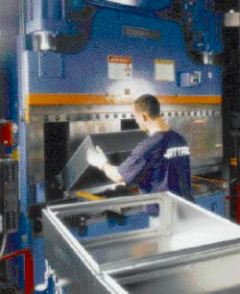
It is no secret, of course, that Ohio is at the epicenter of the American economy. Its central location in the heart of the Midwest makes Ohio accessible by air, highway or rail to most of the country within 24 hours.
Rittal Corp., based in Springfield, is part of a rapidly growing high-tech industry in Central Ohio. Over a three-year period, the company is adding some 300 new manufacturing/logistics jobs.
What most people outside of Ohio do not realize, however, is that Ohio has been remaking itself over the past decade from a Rust Belt survivor into a leader in such fields as biotechnology, e-commerce, high-tech logistics, aeronautical engineering, micro-power plants, liquid crystal development and xerography. From Cincinnati to Columbus to Cleveland -- and in the dozens of "Micropolitan Ohio" small towns in between -- the leaders of this new Ohio economy are investing millions of dollars into new corporate real estate facilities and job creation. "The theme for the Ohio economy this year is how technology is becoming so pervasive in virtually every industry we have," says Steven R. Kelley, manager and senior economist for the Ohio Department of Development in Columbus. "All of our industries are adopting new processes and new product lines. Ohio's dominance in manufacturing, along with our central location, is what's responsible for our solid investment growth." Kelley adds that Ohio -- while still anchoring its economy on the fortunes of the automotive industry -- is today experiencing significant investments from firms in such fields as plastics, e-commerce fulfillment and bio-technology. "Ohio's dominance in manufacturing, along with our central location, is what's responsible for our solid investment growth." "We have a technical labor force that's tuned to the market, and that success continues to attract success," he says. "Our universities clearly are an asset, and our students are encouraged to take a fling at entrepreneurship. Ohio has 136 colleges and universities." In Cleveland, the Case Western Reserve University tie-in with the Cleveland Clinic has led to numerous developments in the biotech business, and the Edison Biotech Center in Cleveland has spawned a number of high-tech companies in the medical field. How is Ohio accomplishing this? Kelley attributes much of the success to a new statewide focus on high-tech industry recruitment. Two such programs -- eCorridor and Ecom-Ohio -- are being used to provide the kind of high-tech diversification the state needs to compete in an economic downturn. "The eCorridor program is really the marketing brand from the vantage point of the Ohio Department of Development," says Kelley. "We are seeking to attract cutting-edge companies and college graduates. We are trying to attract the new thinking and prove that we can be cutting-edge." The Mead paper company, headquartered in Dayton, recently was identified as one of those companies best positioned for e-commerce, and other old-line manufacturers are following suit. Ecom-Ohio, meanwhile, is the state's initiative for attracting e-commerce companies such as online auto "e-tailer" iMotors.com. The company announced last year that it would establish a vehicle certification center in the Cincinnati area that will employ 900 workers at build-out. CEO Adam Simms calls the new facility, which will serve the U.S. East Coast, "a vital component of our national expansion strategy." The refurbished facility in the city of West-chester opened last summer.
TOP OF PAGE
|
|
©2001 Conway Data, Inc. All rights reserved. SiteNet data is from many sources and not warranted to be accurate or current.
|