

 The Turnaround State: How Illinois Became Corporate Central in 2001 (cover) A Pampered Deal Lands in the Suburbs Clusters: From Logistics to Biotech Request Information 
|

Clusters: From
Logistics to Biotech While the transportation and logistics sector continues to dominate much of the corporate real estate landscape of suburban Chicago, look for that picture to change in the coming years, says DCCA's McDonough. "One of the industry clusters that is up and coming in Illinois is the whole bio-technology area," she says. "This is very fertile ground for us. We have recently secured the BIO 2006 Conference for Chicago. This is the world's most important international conference on biotech, and this industry has never focused on what the Midwest has to offer." 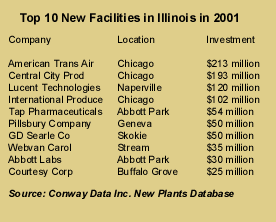
McDonough notes that leading research schools like Northwestern and the University of Illinois will play a major role in growing the state's biotech sector. Another significant asset is the presence of Abbott Laboratories, a $14 billion-a-year pharmaceutical and health-care products company based in Abbott Park near Waukegan. With 12,700 employees in metro Chicago, Abbott is the area's largest private employer. Last summer, Abbott announced that it would expand its drug manufacturing operations in North Chicago and create 500 new jobs for Illinois residents. To accommodate the new positions, Abbott will lease a 110,000-sq.-ft. (10,230-sq.-m.) building in Lake Forest. "This agreement is a win-win for Illinois and Abbott," says Miles White, chairman and CEO of Abbott. "The business incentives provided by the state allow Abbott to create additional Illinois jobs and significant capital investments in Lake County. Consolidating some of Abbott's pharmaceutical business to one location enables the company to leverage existing Lake County resources." Statewide, Illinois officials have identified 12 key industry sectors as part of their five-year state and regional economic development strategy. They include resource-based industries such as agriculture and energy development; tourism; automotive manufacturing; biotechnology; nanotechnology; plastics; transportation and logistics; information technology; wireless telecommunications; legal and accounting services; metal fabrication; and food processing. State officials are hopeful that Illinois' recent ranking as the No. 1 Digital State will go a long way toward reinforcing its image as a haven for high-tech entrepreneurs. Other facts tend to bolster that case:
Peter Block, a director with Cushman & Wakefield in Chicago, says that Chicago's appeal to corporate space users in the area of high technology will only increase. "The cost of doing business in Chicago is an advantage when compared to most cities throughout the U.S.," he notes. "Couple that with the ability to attract very attractive rental rates, and you have a very accommodating city to do business with." 
TOP OF PAGE
|
|
©2002 Conway Data, Inc. All rights reserved. SiteNet data is from many sources and not warranted to be accurate or current.
|