


Lock Improvements,
New Port on Drawing Board
New Port on Drawing Board
|
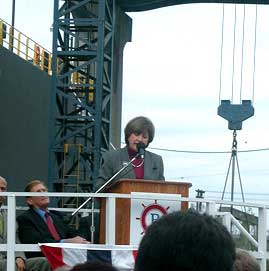
| Ship building continues as a major industry along the river. Louisiana Gov. Kathleen Blanco helped dedicate a new $10-million dry dock in New Orleans at Bollinger Gulf Repair. The company plans to add 500 new shipbuilding-related jobs in Louisiana this year. |
Up and down the river, there's a veritable barge load of ongoing, planned and conceptual projects aimed at improving transportation on and across the Mississippi.
The biggest effort is the long-term plan of the U.S. Army Corp. of Engineers (USACE) to improve navigation along the Upper Mississippi River-Illinois Waterway System. The $2.4-billion plan would build seven new locks and expand five existing locks. The proposal is working its way through government channels, but is also meeting with opposition from several environmental groups.
Ron Fournier, a USACE spokesman, says the upgrading of the Great Depression-era locks system is needed to remove costly transportation bottlenecks. Most of the locks, built some 70 years ago, are 600 feet (183 m.) long, about half the size needed to accommodate modern-day barges efficiently. USACE's plan would build new 1,200-ft. (366-m.) locks and expand others to that length. Barges now often spend several days making their way through the system.
Meanwhile, a bill is being floated in the Iowa Legislature that would give local government the ability to create a port authority at Keokuk in the southeast corner of the state.
"We're in the very early stages of the legislative process," says Iowa State Rep. Phillip Wise, who introduced the bill and represents the Keokuk area. "I think it will be given serious consideration. There's no money being appropriated and there will be no money. But it allows local governments to put their resources together and to finance through revenue bonds.
"We've understood in the eastern part of the state that we have to put a strong intermodal system in place. It's the greatest navigable river in America and we really have not used it to the extent we could."
Wise says port development is part of a larger issue of regional economic development. He says small communities in rural areas of Iowa must join to create the critical mass needed to compete with metro areas.
"If they don't, there's no way they can compete," he says. "We're trying hard to transition to a new economy and that means doing things differently."
The biggest effort is the long-term plan of the U.S. Army Corp. of Engineers (USACE) to improve navigation along the Upper Mississippi River-Illinois Waterway System. The $2.4-billion plan would build seven new locks and expand five existing locks. The proposal is working its way through government channels, but is also meeting with opposition from several environmental groups.
Ron Fournier, a USACE spokesman, says the upgrading of the Great Depression-era locks system is needed to remove costly transportation bottlenecks. Most of the locks, built some 70 years ago, are 600 feet (183 m.) long, about half the size needed to accommodate modern-day barges efficiently. USACE's plan would build new 1,200-ft. (366-m.) locks and expand others to that length. Barges now often spend several days making their way through the system.
Meanwhile, a bill is being floated in the Iowa Legislature that would give local government the ability to create a port authority at Keokuk in the southeast corner of the state.
"We're in the very early stages of the legislative process," says Iowa State Rep. Phillip Wise, who introduced the bill and represents the Keokuk area. "I think it will be given serious consideration. There's no money being appropriated and there will be no money. But it allows local governments to put their resources together and to finance through revenue bonds.
"We've understood in the eastern part of the state that we have to put a strong intermodal system in place. It's the greatest navigable river in America and we really have not used it to the extent we could."
Wise says port development is part of a larger issue of regional economic development. He says small communities in rural areas of Iowa must join to create the critical mass needed to compete with metro areas.
"If they don't, there's no way they can compete," he says. "We're trying hard to transition to a new economy and that means doing things differently."
