



U.S.–MEXICO BORDER
Ports, Lines and Crossings
Sempra, based in San Diego, is looking for a clean landing for its Energía Costa Azul LNG terminal expansion from 1 billion cubic feet per day to 2.5 bcfd, most recently soliciting shipper interest in March. The initial construction phase of the $800-million project was more than 30 percent complete in early April, and is expected to be operational in 2008. The proposed expansion could be ready by 2010. Speaking to the open season for shipper interest that will close in mid-May, Darcel Hulse, president of Sempra LNG, said in March, "Our project will be the first of its kind along the West Coast of North America. Because of the strategic location and the interest expressed by potential clients, we expect this open season to proceed very well."
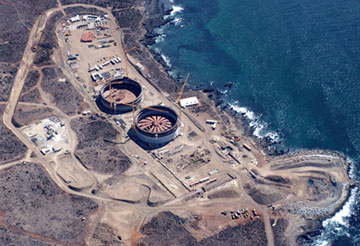 |
Photo: Sempra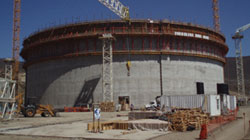 |
| The Energía Costa Azul LNG terminal expansion project in Ensenada from Sempra is just one manifestation of increased port activity along Mexico's western coast and increased industrial activity in Baja California in general. |
The border connection continues to be a coastal one as you travel south. While the Sempra terminal is approximately 14 miles (22.5 km.) north of Ensenada, the site for a proposed new container megaport at Punta Colonet is approximately 50 miles (80 km.) to the south, or 150 miles (241 km.) from San Diego. The project's associated investments, reports the San Diego Union-Tribune, could reach as high as $5 billion, and will include a 180-mile (23-km.) rail line that connects to the U.S. east of Mexicali. The first phase would have a capacity of 1 million TEUs, expanding eventually to 6 million TEUs at the 7,000-acre (2,835-hectare) spread, to be operated by the Port of Ensenada.
Even further south, Kansas City Smart Port is promoting a connection with the Lazaro Cardenas port on Mexico's west coast, in the State of Michoacan. That's where Hong Kong's Hutchinson Port Holdings, Ltd., is investing $290 million over 20 years to expand a terminal and channel in order to accommodate four ultra-large container vessels at once. The shipyard will expand from 37.5 acres to 255 acres (from 15 to 103 hectares) and eventually employ 2,900 workers. Three shipping companies already have service there. And a 180-acre (73-hectare) industrial park is in development by the Port of Lazaro Cardenas.
But rail is just as key to this corridor as ships. Kansas City Southern created Transportacion Ferroviaria Mexicana (TFM) in the wake of the Mexican government's 1997 decision to privative its first regional railroad. In 2002, Mexico launched a Trans-Pacific Multimodal Security System.

|
In March 2005, Kansas City signed a pact with Michoacan to increase cargo volume between the two cities. Mexican customs used to charge a "through bond" of up to $100,000 per container. Today, shippers can move as many containers as they like for a single $55,000 bond. According to KC SmartPort, shipping containers now through Lazaro Cardenas could be up to 15 percent less expensive than going through Long Beach or Los Angeles. In April 2005, Kansas City Southern completed its purchase of a controlling interest in TFM. Together with the Texas Mexican Railway, they now comprise "The NAFTA Railway," a 1,300-mile (2,092-km.) railroad.
A key point on that rail line's journey is Kansas City Southern's rail bridge at Laredo, Texas. The company has installed Spanish language versions of its computer system in order to help reduce terminal waiting times and increase train speeds, and enable a free flow of locomotives and rail cars.
The pressure from those Mexican port possibilities is ratcheting up the pressure to get something done at the Southern California ports whose congestion is causing the traffic diversion. In February, Assemblyman Chuck DeVore introduced a bill modeled after the Trans Texas Corridor concept that would allow two truck-only toll roads to be constructed out of the ports of Long Beach and Los Angeles. The roads would be financed by a private partner that would have the right to operate the roads for 50 years.
