| |
|
From Site Selection magazine, May 2000 C O V E R S T O R Y Inside Dell's Clicks-and-Mortar Machine (continued) 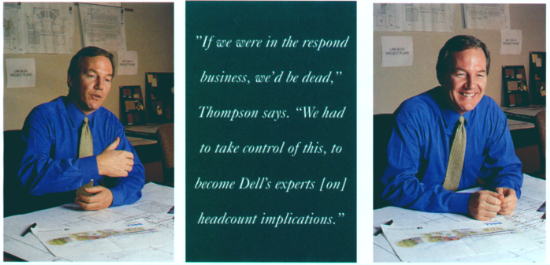 Process, Process, Process How does Dell real estate cope with that blistering clip? Thompson responds by pulling out a handout bearing a Michael Hammer quote: "The 21st century belongs to the process organization that is centered on customers and . . . operates with high quality, enormous flexibility, low cost and extraordinary speed." "That is written on my forehead," Thompson says, tapping the handout. Indeed, "process" is the linchpin in Dell real estate's toenail-curling speed. Strategy, roles and accountability are tightly defined. Bureaucracy gets torched. That, in turn, reflects Dell's drum-tight manufacturing model. Inventory enters a facility and continually flows, with finished products flying out the other end. Likewise, process-driven inevitability earmarked the first Nashville facility. Dell, for example, invited a group of architects and contractors to Austin to make competitive bids -- on the spot. All had seen the plans, and anyone who couldn't meet the deadline was asked to leave. "After we finished the Nashville building, the winning contractor told me they thought we were crazy in Austin. Of course, they were right," Thompson chuckles. "They didn't think we'd be able to deliver, so they thought they had plenty of excuses to not deliver. But we do make decisions, lots of them and fast, so we never hold up our service providers." The eye-popping Nashville pace fairly drips with rapid decision-making: After its initial January 1999 contact with Tennessee, Dell committed to Nashville in May. Then, after the first facility's 62-day building blitz ended on Aug. 2, Dell turned out its 1 millionth Dimension desktop on Jan. 21.
Ongoing service provider alliances might seem a must in such fast-tracking. Nope. Dell does local. "We seldom hire big, obvious multinationals," Thompson explains. "They have their own bureaucracy; they can't move fast enough, and they're substantially more expensive. We've found you get higher quality and better service dealing with the principal. So we find local firms with proven track records as the best, the most entrepreneurial and the fastest." Dell's earth-scorching tempo obviously presents daunting service provider challenges -- and, apparently, compensations as well. Standing on Dell's Nashville site, Mike Bazydola, Turner Construction development and construction manager, says, with a tad of awe, "I've learned more in one month here than I would've in five years on other jobs. After this, any other project will seem easy." Similarly, Thompson notes, "That contractor on the first Nashville facility told me it gave them more efficient ways of working that they're marketing as a core competency."
Unlike many firms, Dell hasn't codified its corporate infrastructure integration. Instead, it uses high-level but more old-fashioned meetings, which facilitate functional coordination and rapid real estate. "Our model is the Facilities Steering Committee, which includes Dell's vice chairmen, vice president, CFO, CIO, the head of worldwide manufacturing and the general counsel, which includes HR," Thompson explains. "It meets twice monthly and reviews every major real estate/facilities decision. We get quick decisions, and it keeps us current and interactive." Corporate integration also gets a boost from Dell's clustering, a conscious effort to preserve small-company culture. "In our early stages, all the business functions were right there and could interact. That's a very effective tool we try to capture with the business centers," Thompson says. The Austin center, for example, has 17,500 employees. And by mid-2000, the Nashville home and small business market center will employ 3,000. "Everything, soup to nuts, will be here in Nashville: manufacturing, customer service, sales and all the related functions. So when anyone gets direct customer feedback, it's shared in an interactive dialogue, getting us much closer to real-time delivery of the exact products customers want."
Dell's site searches often target areas that echo its business model. Tennessee, for example, served up strong corporate customer focus. Explains Thompson, "Starting with Gov. [Don] Sundquist and [Tennessee Economic and Community Development Dept. Commissioner] Bill Baxter, they didn't say, 'This is where you're going and what you've got to do.' They said, 'We absolutely want you, and we think this is the right place. But we want to understand what you need.' "So we helped them understand the really challenging demand period we were facing, that we had to set unrealistic expectations and challenge them to help us exceed them," he continues. "And they got it. It was amazing." Sundquist, in fact, called Thompson several days earlier, asking him to come in and discuss further infrastructure improvements for Dell's site. That site, though, wasn't so responsive. It included a complex of obsolete facilities originally built for the long-ago-closed Middle Tennessee Mental Health Institute. Dell's site search team was still openly skeptical when it joined then-Nashville Mayor Phil Bredesen for a tour of the contiguous acreage he'd identified. But Dell signed on, a $200 million deal that Site Selection named one of 1999's top 10.
"Mayor Bredesen had phenomenal business acumen and a clear vision of the potential," Thompson says. "Going to a greenfield site would've been the easy thing. But the smart thing was to take a challenging site and bring the jobs to where the people are."
| |
|
| |
 | Site Selection Online | SiteNet | Feedback | Search SiteNet | ©2000 Conway Data, Inc. All rights reserved. SiteNet data is from many sources and is not warranted to be accurate or current.
|
