From Site Selection magazine, September 2002
INFRASTRUCTURE
|
From Site Selection magazine, September 2002
INFRASTRUCTURE
|
|
2002 Global Infrastructure Report, page 4
Stifling traffic congestion and antiquated transportation system pose threats to the U.S. economy, federal officials say. "Congestion and bottlenecks damage air quality, slow commerce, increase energy consumption and threaten our quality of life," said Federal Highway Administrator Mary E. Peters in recent testimony before a House subcommittee on transportation and infrastructure. A report released in June by the Texas Transportation Institute supports Peters' statement, citing longer rush hours and a greater number of congested roads. However, help is on the way with a long list of transportation projects either in the works or on the drawing board. Major U.S. bridge construction is brisk these days with impressive new spans proceeding across rivers and bays. Attribute the proliferation of projects to plenty of state and federal money available during the mid and late 1990s, industry observers say. The need for new and replacement bridges is apparent with studies showing about 28 percent of the nation's bridges either structurally deficient or functionally obsolete.
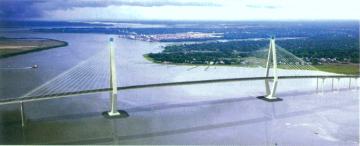
New bridge projects offer economic growth potential in a number of ways. For instance, the Cooper River Bridge replacement project figures to propel much-needed development on the east side of Charleston, says Al Parrish, a professor of business and economics at Charleston Southern University. "It will make the entire area east of the Cooper more attractive by improving traffic flow," Parrish says. "We will be seeing more companies locating east of the river. This will mainly be distribution centers and retail." The Cooper River Bridge will replace both the Grace Memorial Bridge, a cantilever structure completed in 1929, and the Silas Pearman Bridge, a parallel span, built in 1966. The total $631-million price tag makes the new bridge the most expensive in history. The target completion date is July 15, 2006.
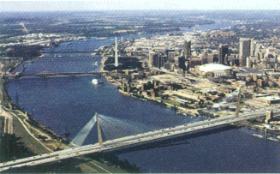
The largest current U.S. bridge project is the east span of the San Francisco/Oakland Bay Bridge. The total replacement project, which includes seismic upgrades, new ramps, a skyway and a new suspension bridge will cost $2.6 billion. The bridge section that will be replaced collapsed during the 1989 San Francisco earthquake. A new crossing from Illinois into downtown St. Louis will certainly be among the top 10 U.S. bridge projects once funding is approved. The estimated $370-million bridge will be a cable-stayed structure with two leaning pylon towers and will carry eight lanes of traffic. New interchanges and highway improvements will push the overall cost to near $1 billion.
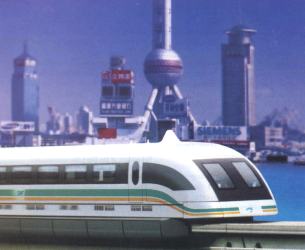
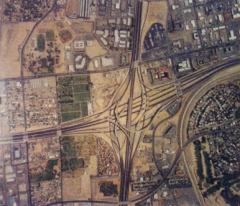
Target Traffic Relief Major highway improvement projects also will make transportation easier in major cities. And in the tradition of Atlanta's "Spaghetti Junction" where I-285 and I-85 intersect, they often acquire colorful nicknames. High on the list of U.S. highway improvement projects is the Springfield Interchange Project in Virginia. The estimated $700-million improvement includes construction in the "Mixing Bowl" area where the Capital Beltway (I-495) meets 1-395 and I-95. An estimated 430,000 vehicles pass through the interchange daily. The 8-year project is nearing its midpoint. In a few years, motorists in the Dallas-Fort Worth area will be given a high five. Construction began in January on a $260 million project to upgrade the intersection of I-635 and U.S. 75. Nicknamed, the "Dallas High Five," the project will take five to six years and is the single largest contract let by the Texas Dept. of Transportation. Boston's Big Dig The $14-billion project, now more than 80% complete, is in the home stretch. It includes two main elements: extension of I-90 (the Massachusetts Turnpike) from its current terminus south of downtown Boston under Boston Harbor to Logan Airport, and the replacement of I-93 through downtown Boston, including a tunnel through the heart of the city. Also in Boston, but not directly related to The Big Dig, is the Greenbush commuter rail line, a $409-million Massachusetts Bay Transit Authority (MBTA) project that will restore rail service from Scituate, Mass., to Boston's South Station. The project, slated for completion in 2005, will restore passenger service, which was discontinued in the 1950s. Another underground path to prosperity is being pursued by Canadian Pacific Railway, which plans to convert its present Detroit River Tunnel to truck traffic and invest hundreds of millions of dollars on a new rail tunnel linking Detroit to its automotive industry twin: Windsor, Ontario. The need was obvious: more than 10,000 trucks – or 30 percent of all U.S.-Canada truck traffic – cross the Ambassador Bridge each day, and trade is predicted to triple between the two countries by 2020. High-Speed Rail Projects Slated to begin operation in 2005 after delays following a 1999 earthquake, the bullet train will cost US$12.7 billion. The train will be able to travel up to 300 km (186 miles) per hour and make the trip, currently a four and a half hour venture, in less than 90 minutes. The Shanghai Transrapid, the world's first commercial high-speed maglev line, is slated to open in China's financial capital next year. The 30-km line is being built between the city's Lujiazui financial district and Pudong International Airport. An end-to-end ride will take about seven minutes at speeds up to 430 kph (267 mph). Construction on the 8.9-billion-yuan ($1.08-billion) project began in 2001. Speculation is that if the Chinese government likes the finished product, it may consider a 1,250-km (777-mile) link from Shanghai to Beijing.
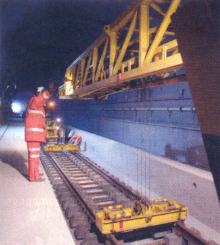
In the United Kingdom, work proceeds on the Channel Tunnel Rail Link (CTRL), 109 kilometers (68 miles) of track, tunnels and bridges connecting London with the Channel Tunnel. Construction began in 1998 and the line is currently on schedule for completion by the end of 2006. Being built by London & Continental Railways Limited, CTRL will be able to carry up to eight Eurostar trains per hour each way. The line will cut travel time between London and the Channel Tunnel in half, to 35 minutes. Journey times from Kent to London will be reduced to 20 minutes and from Kent to Brussels to 90 minutes. It will also allow more Channel Tunnel freight trains by releasing capacity on current lines. CTRL also figures to boost development in the "Thames Gateway" in East London and other areas along the route. "The CTRL has certainly had a significant impact on the area since construction began, making the southeast of England even better connected as a business location," says Paul Wookey, chief executive of Locate in Kent, the inward investment agency for Kent and Medway through which CTRL runs. "The creation of Ashford International Station in the center of Kent County has already proved that a project of this size brings a considerable amount of development to the area." 
Return to Cover Page | ||||||||||
|
| ||||||||||
 ©2002 Conway Data, Inc. All rights reserved. SiteNet data is from many sources and not warranted to be accurate or current. |