NOVEMBER 2008


Peeling Back the Layers of the U.S. Foreign-Trade Zone Program (cover)
Location, Location, Transportation
The Tenn-Tom Waterway Delivers the Goods
Northeast Ohio and FTZ 181 – A Combination for Business Success
The Rockefeller Group has you covered
International Free Trade Zones– Flexibility to Remain Competitive
Dubai Airport Free Zone
RAK Free Trade Zone
The ICON Center
Alabama is Moving Companies Up in the World
Make San Antonio Your Home Base
Metro Little Rock Alliance
Southwest Louisiana Economic Development Alliance
Northwest Indiana & The City of Port Colborne
Request Information


SPECIAL ADVERTISING SECTION
PORTS & FREE TRADE ZONES
PORTS & FREE TRADE ZONES
International Free Trade Zones–
Flexibility to Remain Competitive
Flexibility to Remain Competitive
F
ree Trade Zones are gaining momentum in the U.S. market as global companies work to leverage cost savings in the form of manufacturing and market access to maximize profits. Free Trade Zones offer corporations a degree of flexibility as they manage their businesses and respond to rapidly changing global economic factors such as oil prices and the cost of other commodities and raw materials.
Free Trade Zones provide a platform from which companies can develop strategies to manage inventories and phases of their manufacturing processes, as well as access a country or region's work force. In the increasingly challenging international marketplace, lowering costs is an important driver, and the flexibility offered by Free Trade Zones is quickly becoming a 'must have' on the list of many companies looking to invest in new markets. The existence of a Free Trade Zone in a country or region can significantly increase its competitive position while competing for foreign direct investment (FDI).
"It is clear that Free Trade Zones have become more en vogue in the current economic environment," said Nathan Sparks, Executive Director of the Brunswick & Glynn County Development Authority in Brunswick, Georgia. "With importers feeling the proverbial pinch, the opportunity to improve cash flow by deferring duty payments on shipments until they are actually bound for a customer is huge. Given this, economic development organizations who have FTZ designated sites in their portfolio are clearly at an advantage."
Why Zones Matter
Once the sole responsibility of governments, most Free Trade Zones today are either privatized or public-private partnerships and run on a commercial basis. With custom duties becoming less of an issue, international businesses are increasingly looking for cost savings through streamlined customs clearance, a low cost, yet highly trainable work force, integrated infrastructure, strong transport networks and local tax incentives.
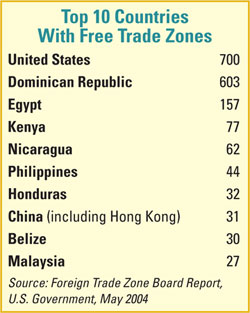
North America and the European Union, which between them attract over a half of the World's FDI, offer new models for how Free Trade Zones can be effectively used to attract overseas investors by creating purpose-built solutions for individual companies. Conversely, poorly designed and operated Free Trade Zones can result in the creation of dual economic structures and welfare reducing distortions in a country, which can be harmful to long-term efficiency in the allocation of resources.
New strategic plans call for new approaches
In developed countries, where knowledge of the market and financial resources are not significant issues,
Free Trade Zones should target companies which can benefit from their local assets and infrastructures or fit into an industry cluster with skilled workers and local suppliers. At the same time, they must be customer led – their strategy should always be defined by the investor's needs.
Security and Intellectual Property considerations will be a major issue for Free Trade Zones – the protection of data will be just as important as the physical security of workers.
For those Free Trade Zones markets seeking to capture the rewards of high-technology industries, the adherence to international intellectual property rights law and the crackdown on counterfeit operations will become a basic requirement for attracting FDI.
There are more Free Trade Zones than ever before, and the market is growing. The investor is spoiled for choice. By strategically targeting specific companies in the global market, FTZs can get to know their individual needs and decision-making drivers and design creative solutions for them.
Where in the World Are the Zones?
A
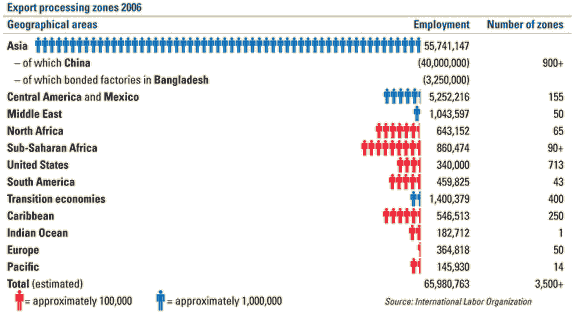
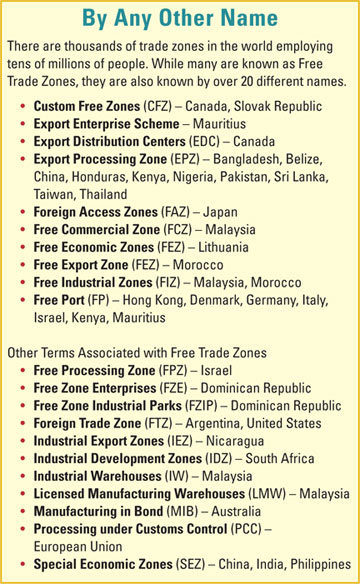
n April 2007 working paper on export processing zones (EPZs) from the International Labor Organization in Geneva reported that Asia and Central America led the world in terms of job creation in such zones through 2006. The ILO defines EPZs as "industrial zones with special incentives set up to attract foreign investors, in which imported materials undergo some degree of processing before being re-exported." The designation includes free trade zones, special economic zones, bonded warehouses, free ports, customs zones and maquiladoras.
Between 1975 and 2006, the number and distribution of EPZs in the world grew from 79 in 25 countries to 3,500 in 130 countries, reported the ILO. The chart below shows their proportional numbers for global regions.
A 2005 report, "Free Trade Zone and Port Hinterland Development," from the United Nations' Economic and Social Commission for Asia and the Pacific (ESCAP) profiled successful ramp-up of FTZs in China, Korea and Singapore, among other Asian economies, concluding, "The traditional FTZ and logistics FTZ may be different in several aspects, but they share one key common purpose, to attract FDI. FTZs are, however, not a panacea for creating nationwide economic development since they cover only [a] relatively small amount of territory. FTZs remain one of several possible options among many policy tools for a country to adopt for its economic development."
Among the report's other conclusions: "A key opportunity for a country to develop its economy is through the provision of logistics cluster platforms around sea/airports: thereby attracting regional logistics centers or distribution centers of both manufacturing and logistics enterprises."
— Adam Bruns