SPECIAL ADVERTISING SECTION
SHOVEL-READY SITES
SHOVEL-READY SITES
Cecil Commerce Center – Well Positioned for Growth
A
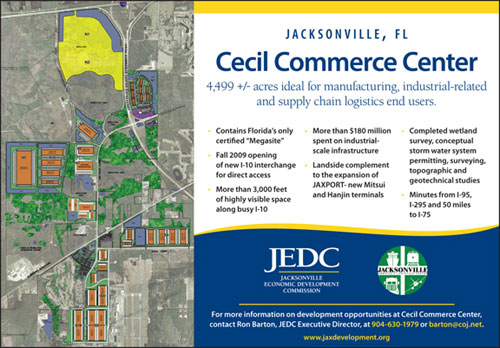
s the largest single industrial land holding in Jacksonville, Florida, Cecil Commerce Center is a significant, long-term economic development asset, representing more than three percent of the land area in Duval County (17,000 acres). It is one of the most sought after locations in the Southeastern United States for manufacturing, supply chain logistics and industrial end users, and well-positioned to be the ultimate landside complement to container cargo growth expected at JAXPORT through two new terminals.
Mitsui O.S.K. Lines recently completed a $200-million, 158-acre container terminal and is expected to have $870 million in new economic benefits to the Jacksonville region. The facility is expected to handle 800,000 twenty-foot equivalent units (TEU), doubling the container throughput of JAXPORT. In addition to this new port growth, in November 2008, JAXPORT signed an agreement with Korean-based Hanjin Lines for the development of a $300-million, 88-acre terminal. It will be capable of handling approximately 800,000 TEUs per year and expected to be operational in the late 2011. These recent JAXPORT developments will triple the amount of container throughput in Jacksonville and potentially may double or triple the economic impact of the port.
Due to this growth, the Jacksonville Economic Development Commission (JEDC) issued a formal request for proposals (RFP) for a master developer of 4,499 +/- acres of City-owned property at Cecil Commerce Center. Staff is currently reviewing proposals. Ron Barton, executive director of the JEDC, said "the decision to issue an RFP was driven by the need to capitalize on market momentum created by JAXPORT and leverage the experience and financial resources of a private developer that will bring the property to shovel-ready status thereby attracting quality end users and higher wage jobs to Cecil."
The JEDC believes that Cecil Commerce Center is positioned to be a world-class distribution and logistics center with market dominance and a critical mass of factors converging in its favor. Extensive site due diligence, permitting and core infrastructure investment has been performed by several public sector agencies. These efforts and resulting entitlements have better positioned the property for development opportunities and should serve to expedite transfer to a private sector development partner who will implement the community's long-term vision for the site.