Company projects are attracted to the tri-state region known as Siouxland like bees to honey.
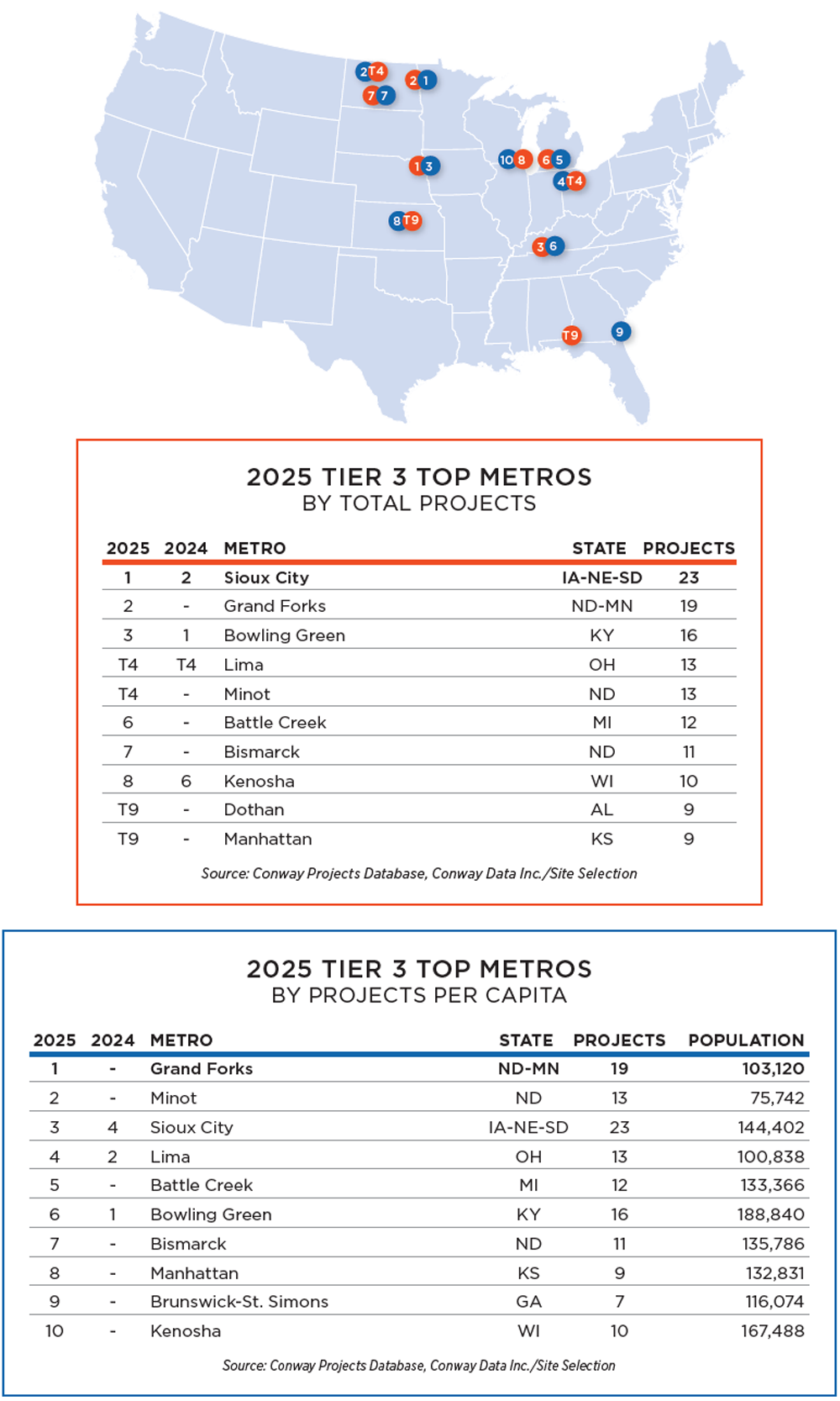
After a brief hiatus at No. 2 last year behind Bowling Green, Kentucky, with 23 projects Sioux City, Iowa-Nebraska-South Dakota, has returned to the No. 1 ranking among Tier 3 Top Metros of 2025. That project total for an area with a population under 200,000 ties the same number achieved by No. 10 Tier-2 Top Metro Fargo and is just one shy of the Tier-2 ties for No. 8 Greensboro-High Point, North Carolina, and Omaha, Nebraska, the latter located just 90 minutes’ drive to the south of Siouxland.
Honey is not a metaphor in Sioux City, where Sioux Honey Association produces more than 40 million pounds of honey annually under its Sue Bee and Aunt Sue’s brands. In December 2025 the Iowa Economic Development Authority board awarded the beekeepers co-op a $2 million forgivable loan and tax benefits through the state’s High Quality Jobs program to incent a $130 million investment in a new facility to expand production capacity. The move is expected to create and retain 70 jobs.
Surely an organization embedded in the community for more than 100 years didn’t consider moving, did it? Turns out they did.

“The Sioux Honey Association is the largest honey marketing co-op in the world. We are proud of their legacy which began in this community in 1921,” says Chris McGowan, president of the Siouxland Chamber of Commerce and The Siouxland Initiative since 2011. “Their Board of Directors instructed the executive management team to examine the best long-term location for the company, and they carefully considered several different states. We are delighted that they ultimately elected to remain in the community that they have called home for over a century.”
The Siouxland agenda includes a continuing focus on attainable housing, child care and quality-of-life assets, aspects of the community that were important to the Sioux Honey Association. “Their executive management team was keenly focused on retaining their current workforce, and the quality of life their employees already enjoy in Siouxland helped keep them in the place they’ve called home for 105 years,” McGowan says.
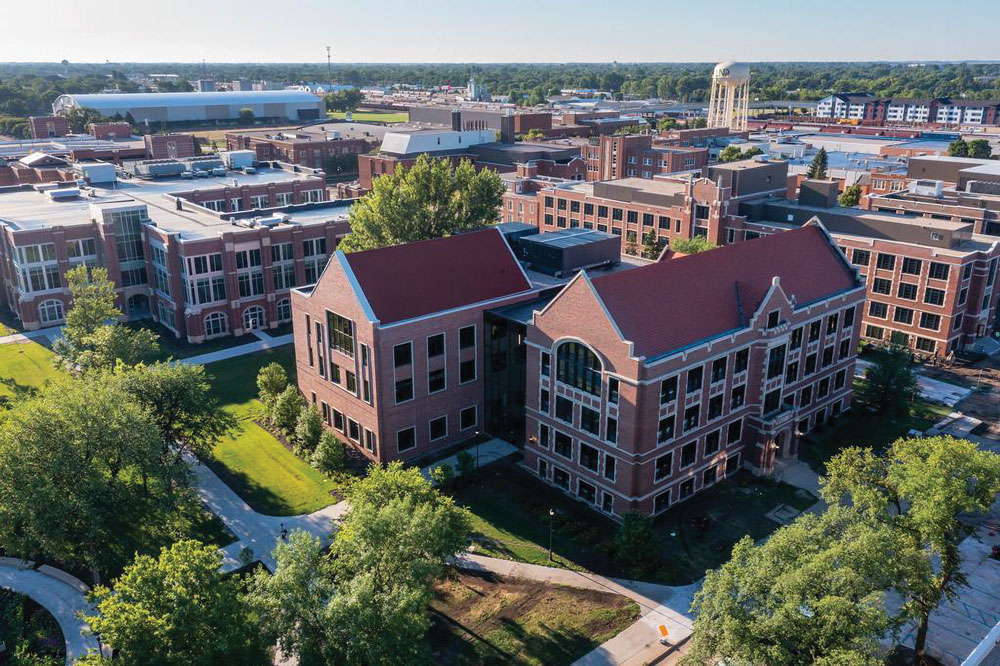
The University of North Dakota is located in Grand Forks, Site Selection’s No. 1 Tier 3 Top Metro by Projects Per Capita.
Photo courtesy of UND
McGowan often takes visitors on a quick ride through the metro area’s three states to demonstrate just how close all the assets sit to one another. Asked which legislative or policy changes in those three states have helped economic development in his area over the past year, he says, “Iowa Governor Kim Reynolds and the legislative leadership have focused on making Iowa’s tax climate far more competitive and they are succeeding.” Those changes include a transition of the individual income tax from a graduated-rate tax with a top rate of 5.7% in 2024 to a flat 3.8% tax as of January 1, 2025. When the state’s reforms began, Iowa had a top marginal rate of 8.98%, the Tax Foundation reports. Under legislation enacted in 2021, the state’s inheritance tax is also fully phased out as of January 1, 2025.
McGowan says the area’s investment in recreational amenities continues with what he calls “one of the finest mountain bike parks in the upper Midwest” at Cone Park, which also boasts a tubing hill, lodge and outdoor fire pit. Infrastructure of the more traditional variety is also receiving attention. “In the last two years our focus has been primarily on additional land acquisition for future economic development, and we have invested millions of dollars in acquiring greenfield sites for future growth,” McGowan says.
Grand Forks Tops Per-Capita Tallies
Second place behind Sioux City goes to Grand Forks, North Dakota-Minnesota, where 19 projects also have helped the area to No 1 in the per-capita rankings.
“This recognition reflects the steady momentum our region has built through strong public-private partnerships and a business climate that supports long-term investment,” says Keith Lund, president and CEO of Grand Forks Region Economic Development Corporation. “Whether it is a new company opening in Grand Forks or an existing employer expanding, this ranking reflects the confidence investors have in the Grand Forks region,” he says, calling it a reflection of “the region’s collaborative approach to economic development, which is our greatest strength.”
The region didn’t make the top 10 last year in either category. Grand Forks is one of six new Top 10 metros overall this year vs. last year. The others are Minot, North Dakota; Battle Creek, Michigan; Bismarck, North Dakota; Dothan, Alabama; and Manhattan, Kansas.
Meanwhile, there are seven new entries on the per-capita side, three of which are the aforementioned North Dakota metros. Joining them there as first-timers are Battle Creek; Manhattan; Brunswick-St. Simons, Georgia; and Kenosha, Wisconsin, which also ranks No. 8 in the overall category.
Cross-indexing with Milken Institute’s Best-Performing Cities scorecard finds Brunswick-St. Simons at No. 24 in their national ranking of small cities. But the absolute highest-ranking metro from Site Selection’s three Top Metros population tiers is Kenosha, which comes in at No. 3 in the nation on the Milken scorecard.