Texas Again Reigns No. 1 In Annual State Business Climate Rankings
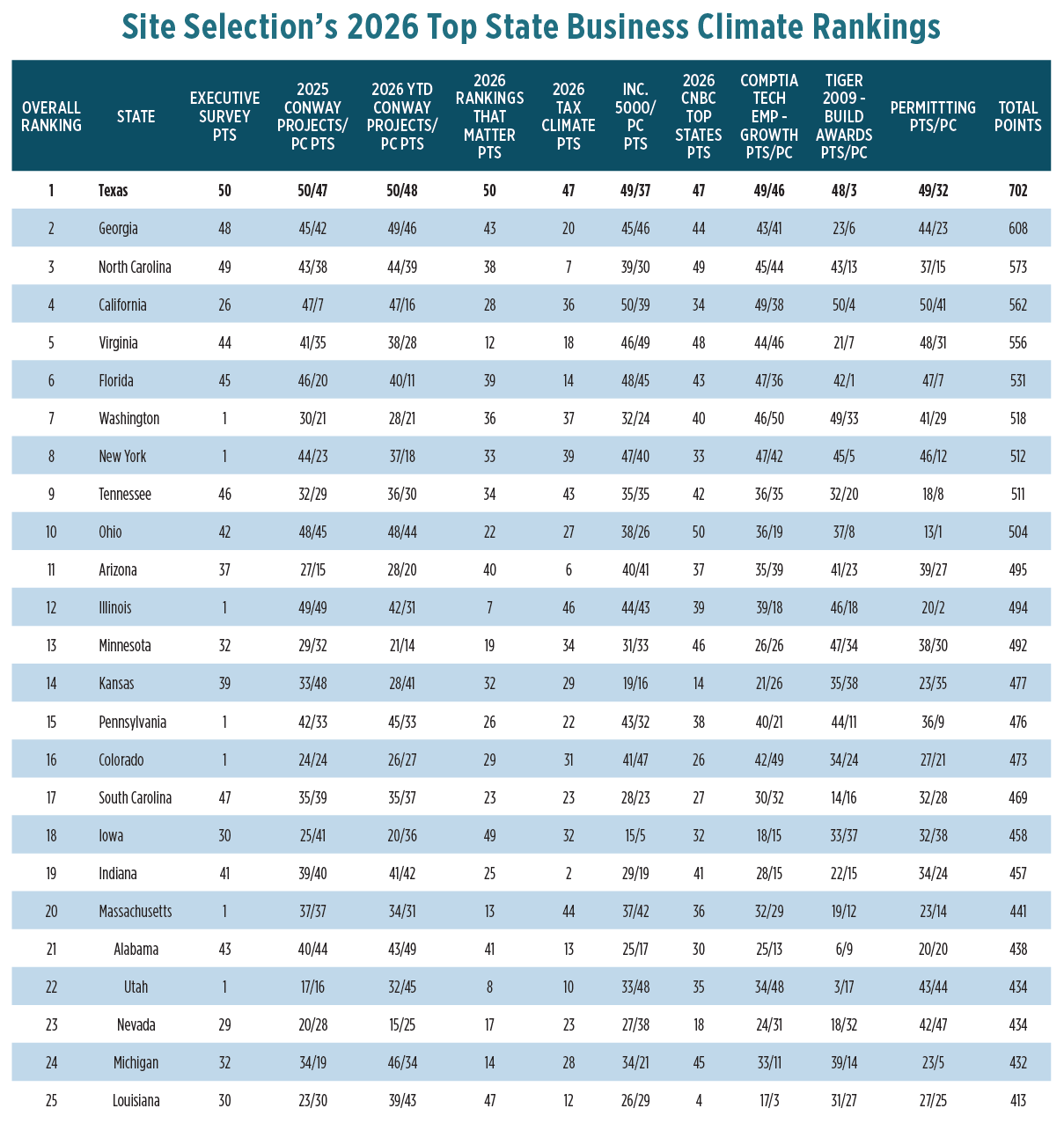
A16-part index incorporating everything from tax climate, executive perspectives and affordable power to tech jobs, facility projects, fast-growing firms and infrastructure comes to the same conclusion that so many corporate leaders continue to reach: Texas makes sense.
Site Selection’s annual Business Climate Rankings once again have found Texas at the No. 1 position, followed by Georgia, North Carolina, California and Virginia in that order. Florida, Washington, New York, Tennessee and Ohio round out the top 10.
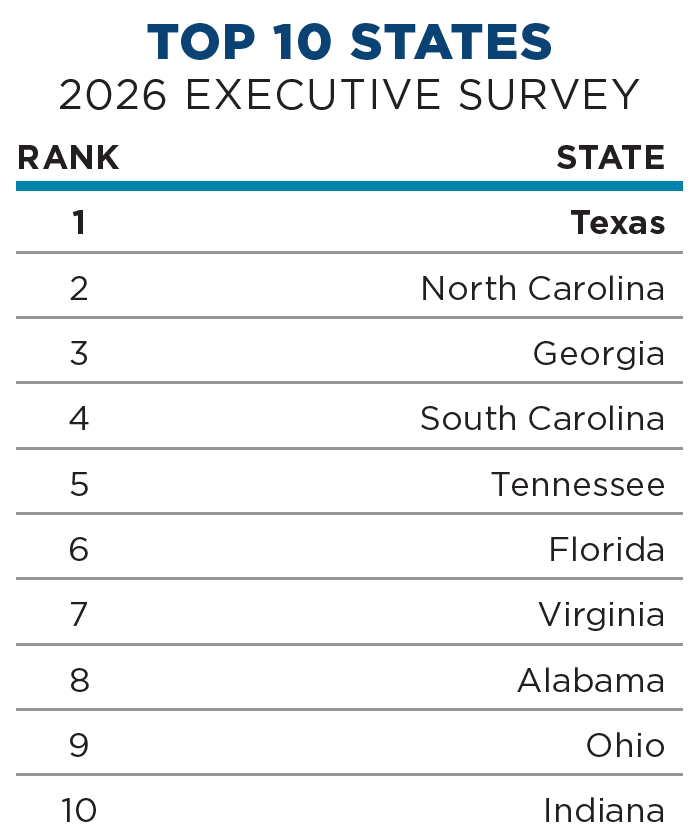
In the executive survey asking which states have the best business climate, Texas led the way, followed by a bloc in the Southeast composed of, in this order, North Carolina, Georgia, South Carolina and Tennessee.
“Texas’ economy continues to show remarkable strength, with job growth that once again outpaces national trends,” said Texas Comptroller Don Huffines in September as he announced job growth of 159,000 nonfarm jobs between August 2025 and August 2026. “Even as individual industries rise and fall month to month, the broader picture is clear: Texas is powering forward with a vibrant, fast-moving economy fueled by strong freemarket principles. I’m confident that we can keep this momentum going while advancing meaningful property tax relief that lowers housing costs and lets Texans hold on to more of their hard-earned money. These efforts will help families, workers and businesses thrive — and keep Texas positioned for even greater success.”
Source: Conway Data Projects Database
Evidence of Texas leadership springs forth like oil gushers no matter which direction you look. Among recent snapshots:
The U.S. Department of Commerce and the Republic of Korea have selected Related Companies and NextEra Energy Resources, in partnership with Lewis Energy Group, to develop a $22.3 billion joint-venture energy infrastructure campus called Project Star in Encinal, Texas, with 6.47 gigawatts (GW) of generation capacity powered by natural gas from Texas.
The Plastics Industry Association in September reported that the state is No. 1 in the nation in plastics industry workforce with 91,600 employees.
The state’s reputation as a financial center continues to blossom: In September, Dillard’s, Inc., a Texas corporation in the Fortune 500 headquartered in Little Rock, Arkansas, announced that it would voluntarily transfer the primary listings of its securities from the New York Stock Exchange to the Texas Stock Exchange. The company had reincorporated from Delaware to Texas in August 2025.
“The move aligns Dillard’s deep roots and strong retail presence in Texas with TXSE’s technology-driven platform,” the company said, reinforcing the state’s strong showing in Site Selection’s January 2026 North American Tech Hub rankings, which found Dallas-Fort Worth-Arlington at No. 1 and Austin at No. 7. “Dillard’s Texas heritage dates back to 1956, when founder William T. Dillard acquired a store in downtown Tyler. The Lone Star State has since grown into the company’s largest market, now home to 54 locations.” That’s 20% of all Dillard store locations.
The financial sector takes other forms too: Morgan Stanley Services Group, Inc. in September announced it is establishing a new U.S. hub in Dallas with a $684 million capital investment that will create more than 3,800 jobs. “A Texas Enterprise Fund (TEF) grant of $43,849,500 and a Veteran Created Job Bonus of $40,000 have been extended to Morgan Stanley,” said the announcement from Gov. Greg Abbott’s office.

“All of a sudden, transformers are a sexy product and we’re getting a lot of attention.”
— John Bailey, COO, Hammond Power Solutions
“Texas is the financial capital of America,” said Governor Abbott. “We welcome Morgan Stanley’s expanded investment in Texas, where the depth of talent and access to America’s rapidly expanding financial center attracts the world’s leading brands across indus-ries. Opportunity’s address is now Y’all Street.”
Bloomberg reported in October that Taiwan Semiconductor Manufacturing Corporation (TSMC) is considering a multibillion-dollar manufacturing campus in Texas “with multiple fabrication plants each expected to cost at least $20 billion.” Already home to Samsung’s and Texas Instruments’ expanding operations, the state in August also welcomed the groundbreaking in Grimes County for Terafab by SpaceX and Tesla, who called it “the most epic-chip building effort in the world — combining logic, memory and advanced packaging all under one roof.” The project was preceded by a new research fab on the north campus of Tesla’s Giga Texas site.
“Texas has become central to our operations through Starbase, Bastrop and McGregor, thanks to its commitment to innovation, manufacturing and American leadership,” the companies stated. “SpaceX’s growing Texas footprint alone has already generated more than 56,000 direct and indirect jobs, over $28 billion in estimated economic impact since 2024, and hundreds of millions in indirect tax revenue since 2024. The initial phase of Terafab is estimated to require approximately $16.8 billion in capital investments from SpaceX and Tesla, with potential future expansion phases bringing total investment much higher. This facility will employ at least 3,000 people, many of whom will be from Grimes and nearby Brazos County — continuing the trend of our other Texas sites where between 60% and 80% of new hires are local residents.”
The companies went on to say that Grimes County offers strategic advantages for long-term industrial investment, “including infrastructure access, available land and proximity to major Texas markets. This project represents a significant opportunity for skilled trades, construction employment, suppliers and contractors, and long-term technical workforce development.”
A Case Study in Texas Site Selection
One company’s recent decision to invest in a new U.S. production facility in Fort Worth embodies not only the competitive advantages of the state, but its leading role in one of the most pressing issues of our time: The need for electrical power driven by a powerful upsurge in industrial demand.
In September, Hammond Power Solutions, a provider of magnetic and power electronic solutions based in Guelph, Ontario, announced that it had signed a long-term lease for a new manufacturing facility in Fort Worth that will expand its ability to serve U.S.-based customers requiring large standard and custom-engineered transformers. The company was advised on the site selection by Netherlands-based BCI Global.
“Demand for transformers continues to increase, particularly from large projects tied to data centers, electrification and power infrastructure,” said HPS CEO Adrian Thomas. “The Fort Worth facility gives us additional capacity in the U.S. to improve responsiveness, support shorter delivery distances for certain customers and help us continue to provide the reliability and service our customers expect from HPS.”
HPS enables electrification through its “portfolio of power conversion, power distribution and power quality solutions, including dry-type transformers, power electronics and related products used across critical electrical infrastructure and industrial applications.
HPS COO John Bailey, a veteran of the automotive industry, spoke to me from his home office in Guelph, close to where the founder of the company launched the original firm 117 years ago as a radio manufacturer. HPS celebrates its 25th anniversary this year.
“We always said we didn’t sell a sexy product,” Bailey says. But with the power crunch, “all of a sudden, transformers are a sexy product and we’re getting a lot of attention.”
The company has three facilities in Canada; three in the United States (California, Illinois and Pennsylvania); five manufacturing sites employing around 1,400 employees in Mexico; and three manufacturing facilities in India. “Despite being spread across North America, about 71% of our business is in the U.S. and a small percentage in Mexico, and then about 25% in Canada and about 4% in India,” says Bailey, whose early sources for the site selection process included this publication. Soon his team engaged with BCI Global, whose president and CEO René Buck Bailey had met a few years ago. What seven months of hard data and research subsequently told them was to trust their instincts.
“We ended up right in the same state and spot we had initially had a gut feel for,” he says. But first there was a six-stage process.
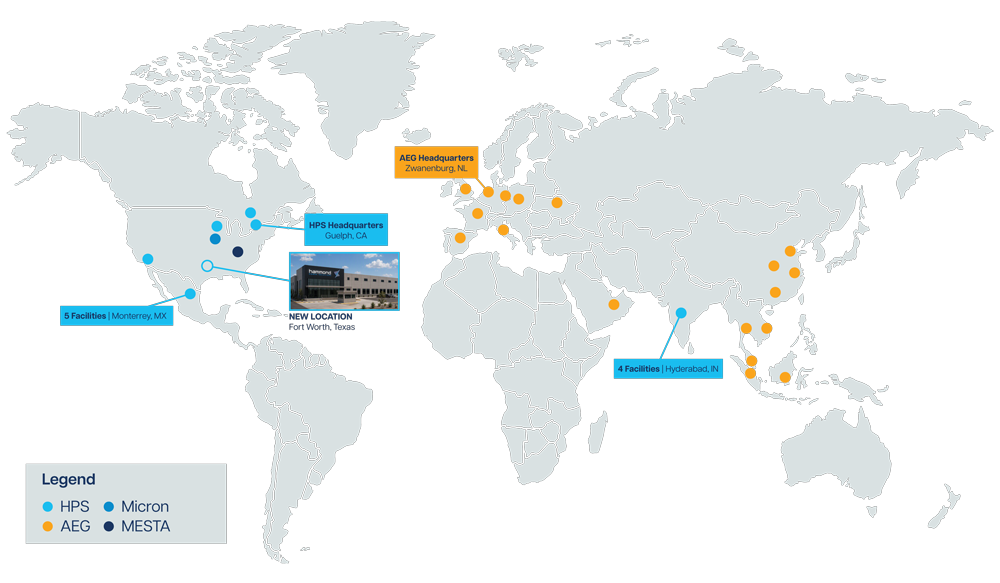
The Fort Worth location joins Hammond Power Solutions’ fast-growing global portfolio.
“Before we got BCI involved, we built out a project scope and put together the kind of profile that we wanted Bailey says. “We looked at our sales concentration, where the markets we play in are, and that was really in three pockets within the U.S. We looked at our supply base as well as our existing distribution routes. We have 11 distribution centers across the U.S. and all of our Mexico plants ship in through a distribution center that we have in Dallas-Fort Worth. With that transportation network set up, with the concentration of customers and with our supply base, that kind of narrowed it down. But we didn’t want to just stick on that because there’s a ton of other things that come into play. So our second stage then was doing a kickoff workshop with BCI Global, where we took a look at our intended investment, the total profile scope. We specified critical location factors that would be used in the next phase. We identified some of the assessment criteria based on cost, quality of business environment and risk factors. Then we had our kickoff meeting and created the definition around the search area and some focused discussion on what those factors were.
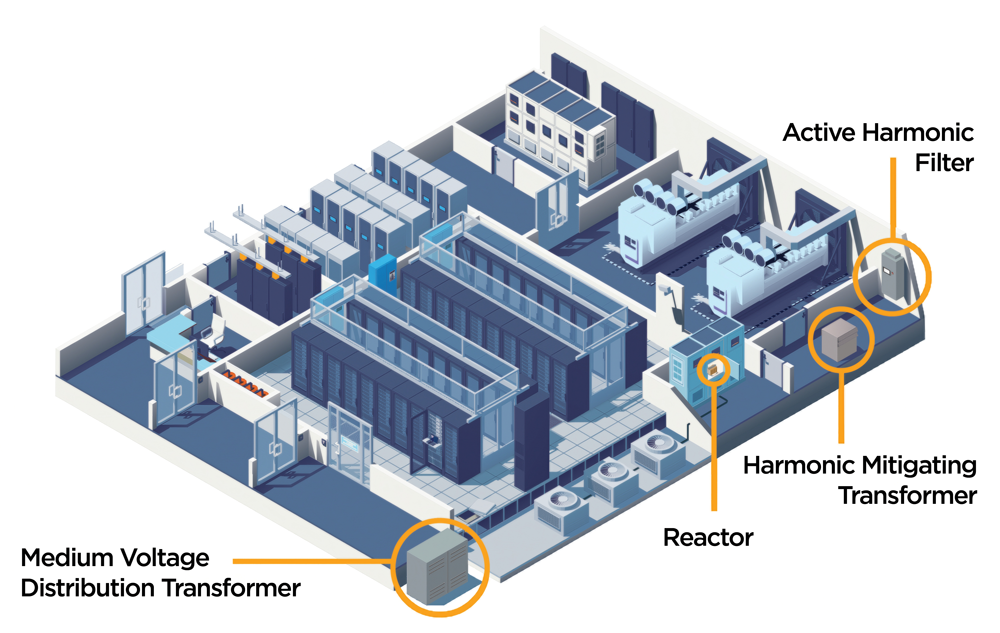
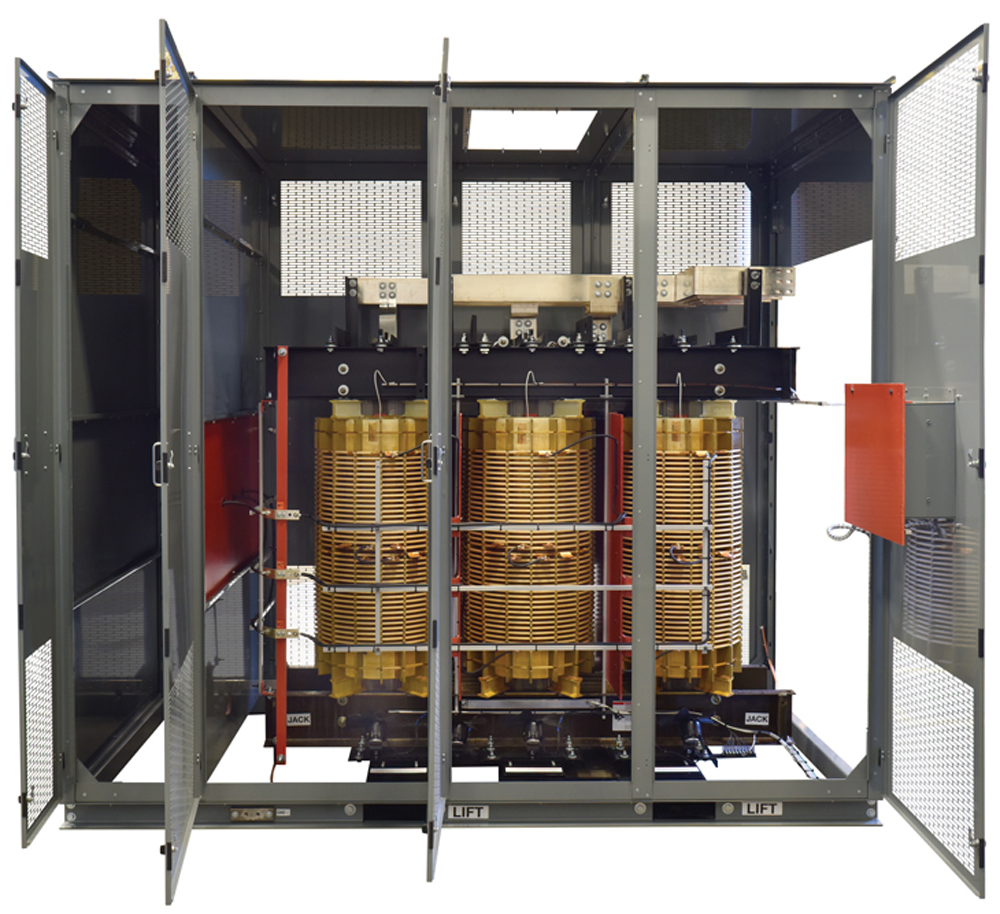
An example of a Hammond Power Solutions medium-voltage transformer and how such equipment is deployed at a data center.
All Hammond images courtesy of HPS
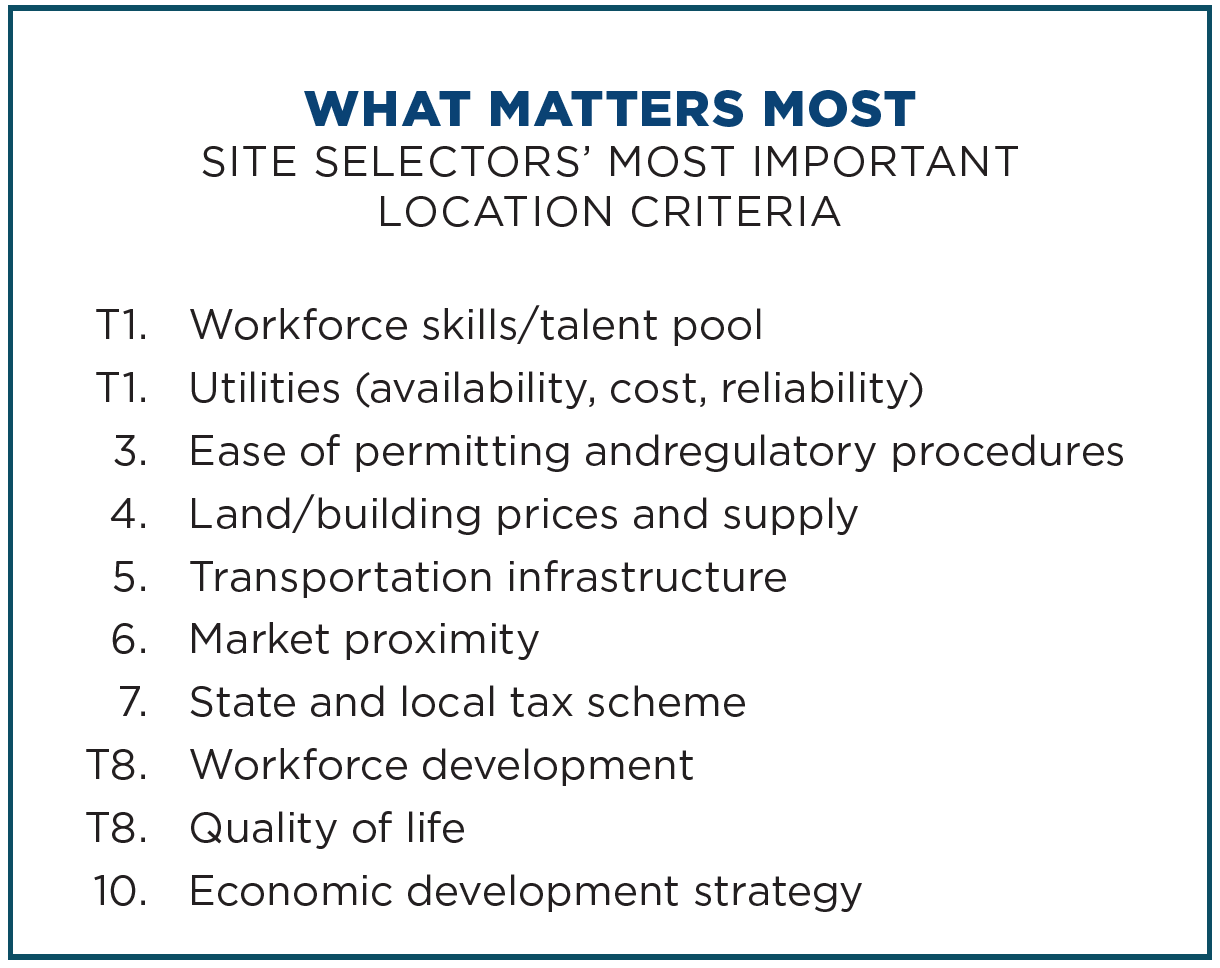
“The third phase was limiting the search to 12 target counties,” he continues. “We assessed eight states that we had in scope with a max of 30 strong-performing industrial locations in the total areas. That high-level assessment narrowed in on 12 areas across those eight states. The next phase was the 12 most promising locations and sites within them were evaluated on cost, quality and risk factors. Each one of those had a different number of criteria in them. Labor and workforce was one of them, and we would weight that very heavily, like 35%. Whereas something like ease of doing business, while important, may have had a lower percentage, like 10%. The number of university graduates, engineering talent, all of these sort of things were in there, and then we applied weight to each. Then we went through those and did that CQR [cost, quality, risk] on each one of those sites, and reviewed those results. We used that to decide on four focus areas in our fifth stage.
“Those four were four counties with many sites within them,” Bailey says. “Over the span of a few weeks, we sent a team to each of those four areas. They would visit anywhere from two to six sites within each.” Those four areas included Atlanta, Georgia; Charlotte, North Carolina; and Cincinnati, Ohio — regions in states ranked No. 2, No. 3 and No. 10 in this year’s Business Climate Rankings.
“We reconvened, we looked at those site visit results, and that included things like how many buildings were available, size of manufacturing workforce, overall costs, incentive packages, competing employers, proximity to highways, what utilities were in there,” Bailey says. “All of these things played in. We had a weighting of those. From there, we narrowed it down to Fort Worth. And then we had a couple of sites within Fort Worth. They were both great groups of people and wonderful sites,” he says. “It really came down at the end to building layout and location within the city.”
Bailey says his team felt Atlanta “had very competitive costs compared to other manufacturing hubs in the U.S. It had some of the highest anticipated incentives across the locations in scope. It had a really large metropolitan area with high numbers of buildings and sites available. It was a very fast-moving market and it was well connected to key markets in the U.S. Charlotte had solid manufacturing base and talent depth, very good market access and interstate connectivity to the Southeast, strong ease of implementation, top business climate rankings, and numerous real estate options across the area with existing buildings, as well as build-to-suit options.
“Cincinnati, interestingly enough, was one that I wasn’t really initially focused on,” Bailey says. “It was sort of a surprise to me how well it ranked across our scoring. It had really good power reliability, and stable operating conditions compared to many of the southern markets. Strong talent depth, high graduate output supporting long-term workforce sustainability, we felt. Favorable overall risk, particularly strong security and infrastructure stability, which is sometimes a problem in other areas. And then excellent Midwest logistics hubs and interstate connectivity. About 78,000 was the number in the workforce for manufacturing-specific jobs out of a population of 2.3 million.”
Meanwhile, Dallas, with a population of about 8.4 million, showed around 200,000 in the manufacturing workforce and, for technical graduates, approximately 35,000 versus around 10,000 college graduates in Ohio.
“Dallas really had the largest manufacturing and engineering workforce across all of our locations in scope,” Bailey says. “Really strong business climate at both the metropolitan and state level. So Texas in general was just a favorable location for ease of doing business. There was a very competitive real estate market, and the ability to locate in and around large areas. You can be near an airport without being right on top of it. And with it being in the northern part of Texas, you’re really centrally located east to west. That’s why our distribution hub is there too, coming out of Mexico. It’s kind of a great point before it splits. A real big driver is this will get us closer to our customers. One of our biggest growth areas right now is data centers and the modernization of industry in general with electrification. There’s huge demand in and around Texas, and we have a lot of customers there.”
With demand so high everywhere all at once, how is HPS managing its business and its ramp-up?
“That’s a great question,” Bailey says. “We’ve invested a lot in our existing plants in Canada and Mexico. We’ve invested over $80 million in the last number of years, building out the existing plants we have. And a few years ago, we opened a 100,000-square-foot facility, our fourth facility in Monterrey, Mexico. Then in the last year, we opened up our fifth 100,000-square-foot facility in Mexico in the same industrial park. In that same time, we completed an acquisition. And just this past June, we completed the acquisition of AEG Power Solutions, a European company that has a great reputation and a great value to us, very much aligned in terms of cultures and brand identity. They’re a much more global operation, whereas we’re North America-focused.”
As a Canadian company, how have U.S. tariffs impacted HPS? “Tariffs have impacted the cost of our goods because we do use steel and conductor,” Bailey says, “and we don’t make enough of that in North America. So certainly tariffs have played a role in the cost of our products. They didn’t so much play a role in the decision on our sites because our growth strategy had the U.S. as a play for many years. One could ask, ‘Why not Mexico or why not Canada?’ It’s because we have such a large presence there already, so this was really about balancing the risk across our manufacturing footprint.”
To get an idea of the company’s range, Bailey says HPS last year shipped over 400,000 transformers, around 52% of them being custom-made. Overall, the company’s operations involve over 9,000 SKUs.
In a sense, could HPS’s global transformer business be a proxy for the corporate facility projects Site Selection’s Conway Projects Database tracks, which are a major component in our rankings?
“That would be a pretty good substitute, yes,” Bailey says. “Certainly within North America. We are on every continent. We’re in every ocean. We’re in space. We help power the things to get to space. We are in the control panels that SpaceX uses to launch shuttles. We’re in the control panels of the chopsticks that catch it. We’re at the top of the CN Tower. If you look across the skyline of a major city, we’re powering some of that … We don’t think of it a lot because transformers are often behind closed doors. But when you start to think of what we do, it’s pretty awe-inspiring and pretty humbling.”
Bailey makes special mention of Cherie Gordon, economic development coordinator for the City of Fort Worth.
“She actually traveled to the last sites with us. She was very helpful when we were going through our lease agreement and we had questions about finalizing the last things about zoning to make sure we’re good, and comparing the two sites. It wasn’t just a ‘Let me check and get back to you.’ It was a ‘Hold on,’ and they pulled other people into the phone call and got us answers right then and there.
“It was really about simplifying the process for us and standing behind what they said they would do,” Bailey says. “When you think of economic development, you have in your head what you hope to get from folks. Very early on, we’ve already seen that they will just jump into it with you.”
Hammond Power Solutions has made the jump into Texas. If their experience is like that of so many other companies in the state, they won’t be jumping out anytime soon.
Houston Seizes Texas Life Sciences Momentum
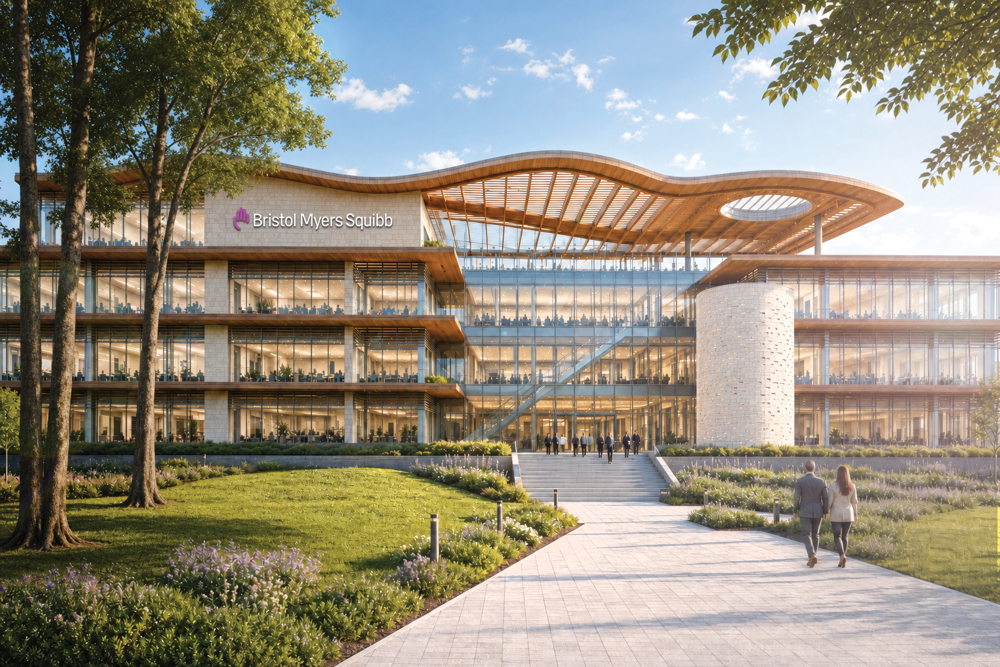
A rendering of Bristol Myers Squibb’s planned $2.3 billion state-of-the-art manufacturing campus in Houston, Texas.
Rendering courtesy of Bristol Myers Squibb
In less than one year, Greater Houston has welcomed a $6.5 billion investment from Eli Lilly and Company and a $2.3 billion from Bristol Myers Squibb in manufacturing facilities located in Generation Park, a 4,300-acre master-planned development in northeast Houston. The two projects combined will create more than 1,100 jobs. They are the icing on the cake for a life sciences ecosystem that’s been building in Texas for some time.
The two projects’ groundbreaking ceremonies occurred within a month of one another as summer turned to fall. Bristol Myers Squibb said in August that the selection of Houston “marks a significant milestone in BMS’ $40 billion commitment to invest in the United States over five years across research and development, technology and domestic manufacturing,” adding that the state’s “pro-business environment, commitment to economic development and growing life sciences ecosystem make it an ideal home for an investment of this scale and ambition.” Christopher Boerner, Ph.D., board chair and CEO of Bristol Myers Squibb, said, “Houston and the state of Texas offer the talent, infrastructure, and partnership needed to help bring that vision to life.”
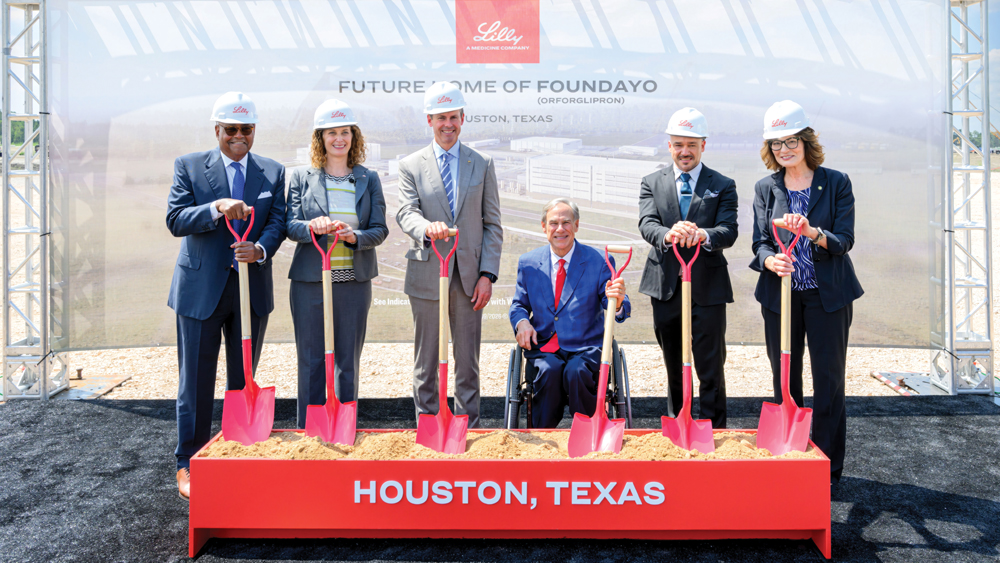
Texas Gov. Greg Abbott joined Eli Lilly and Company executives and local officials for a groundbreaking in September for the company’s $6.5 billion complex in Houston’s Generation Park (rendering below).
Photos courtesy of Eli Lilly and Company
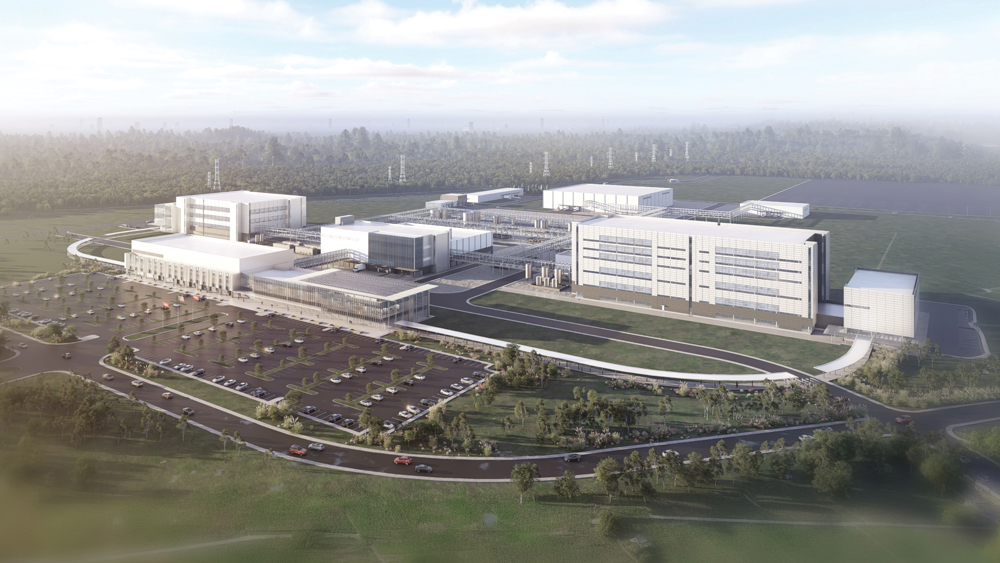
At its own groundbreaking in September, Eli Lilly and Company stated in a release that the Houston site will manufacture Foundayo (orforglipron), Lilly’s first synthetic oral GLP-1 medicine, along with other small-molecule medicines and advanced therapeutics. The company said the project is “part of the company’s $50 billion push to reshore medicine production to meet growing demand at home and export American-made medicines to people around the world.”
A big part of the plan is workforce training. Lilly is providing $12.5 million to support a relationship with San Jacinto College to “give Houstonians a pathway into advanced chemical synthesis manufacturing careers, with no prior experience required.” The company is separately providing a $2.5 million charitable donation to the San Jacinto College Foundation to support scholarships for eligible students. “When you invest in a place like Houston, you invest in its people first,” said Edgardo Hernandez, executive vice president and president of Lilly Manufacturing Operations. “This facility will run on the talent of this community, powered by our relationship with San Jacinto College. We’re hiring across the greater Houston area to help residents build careers close to home.” — Adam Bruns
Business Climate & Rapid Company Growth Align
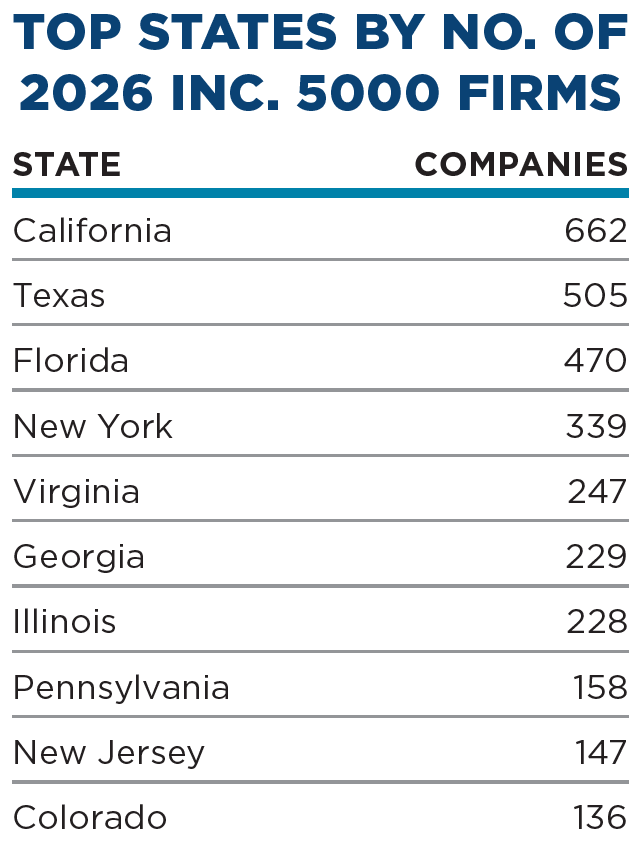
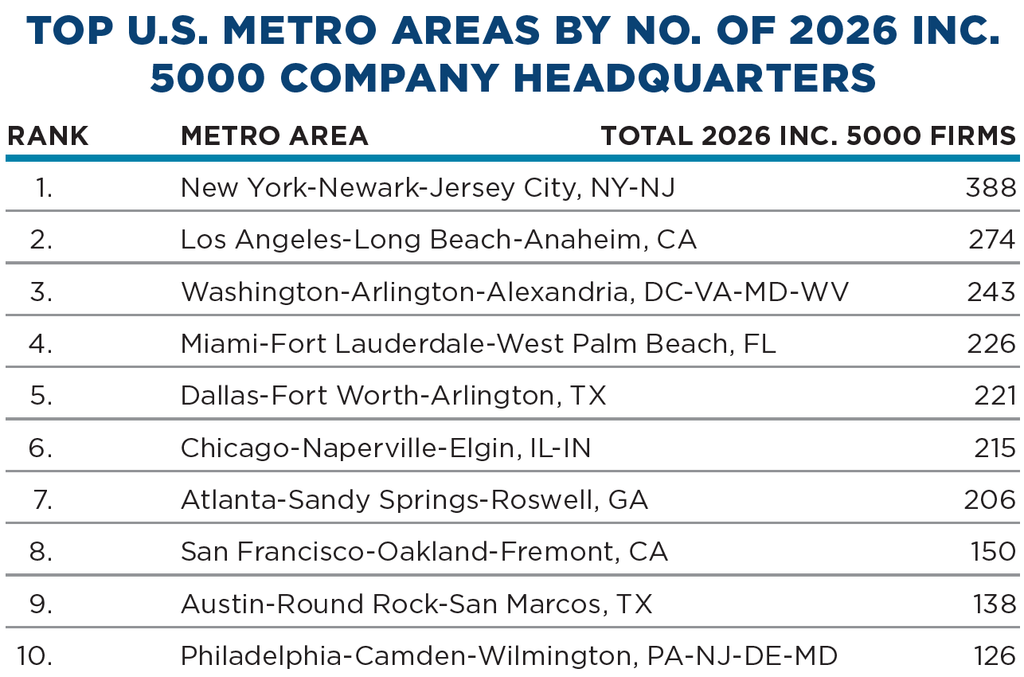
Every fall, Site Selection examines where every single Inc. 5000 company is headquartered and tallies up totals by state, metro area and city. The subsequent rankings (cumulative and per capita) are factored into the overall Business Climate Rankings index alongside 15 other factors. But as the charts here show, the Inc. 5000 findings alone are a strong indicator: The top six states here are found among the top eight states in the overall Business Climate Rankings. Per-capita Inc. 5000 leaders fare less well, though No. 2 Virginia is No. 5 on Site Selection’s scorecard.
At the metro level, eight of the top 10 Inc. 5000 metro regions fall within Site Selection’s top 10 Business Climate states, with Chicagoland just missing out in No. 12 Illinois and Greater Philadelphia located mostly in No. 15 Pennsylvania. As for municipalities, No. 1 Business Climate state Texas and No. 4 California account for three each among the top 10 Inc. 5000 cities, led by overall No. 2 Inc. 5000 city Austin, Texas. — Adam Bruns