
If you want to know how Texas put together a corporate facility deal-making dynasty, it pays to look at the numbers.
That’s what we did in assembling the annual Site Selection tally of the top-performing states in the Prosperity Cup rankings. For the second straight year, Texas takes the crown for registering the highest scores across the 10 categories of data in the index.
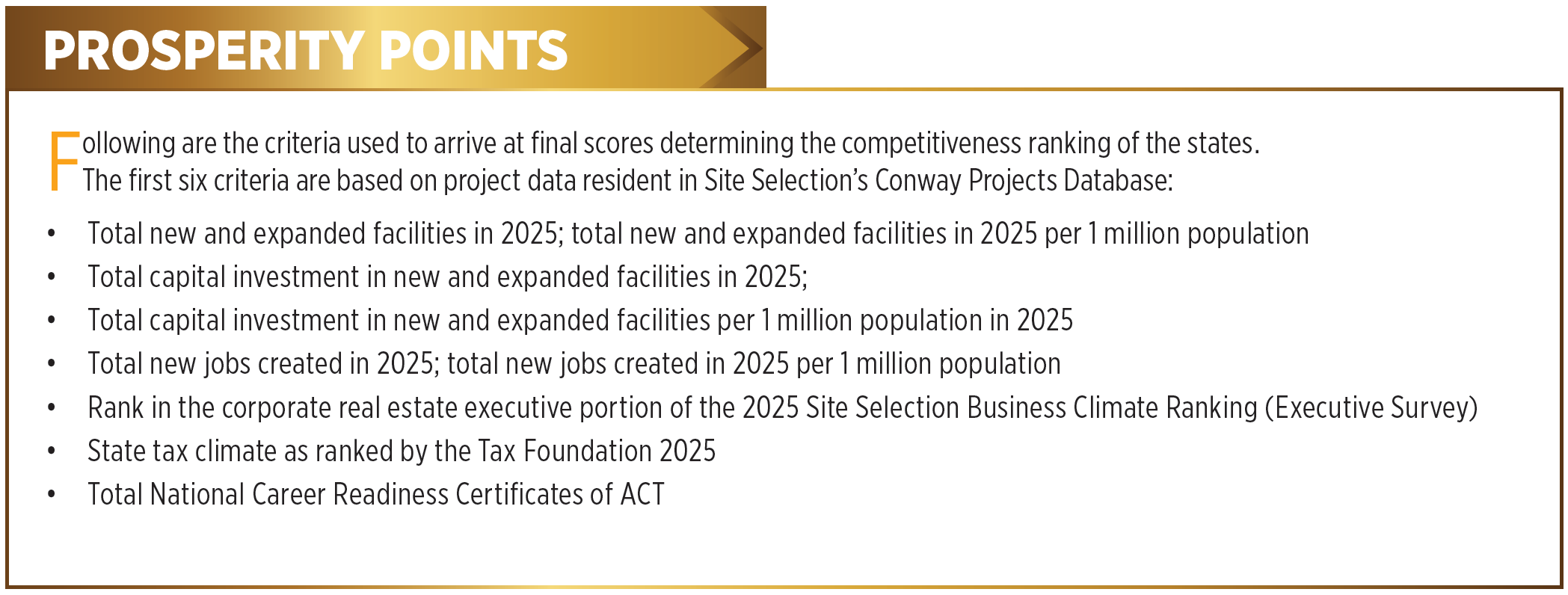
Drawing upon various data points in the Conway Projects Database, the most recent annual business climate survey of Site Selection readers, 2025 Tax Foundation rankings and 2025 National Career Readiness Certificates of ACT, the index measures the relative overall competitiveness of the 50 U.S. states.
We call this ranking the Prosperity Cup because the real measure of success comes in the form of wealth building, standard of living and quality of life of the citizens of each state.
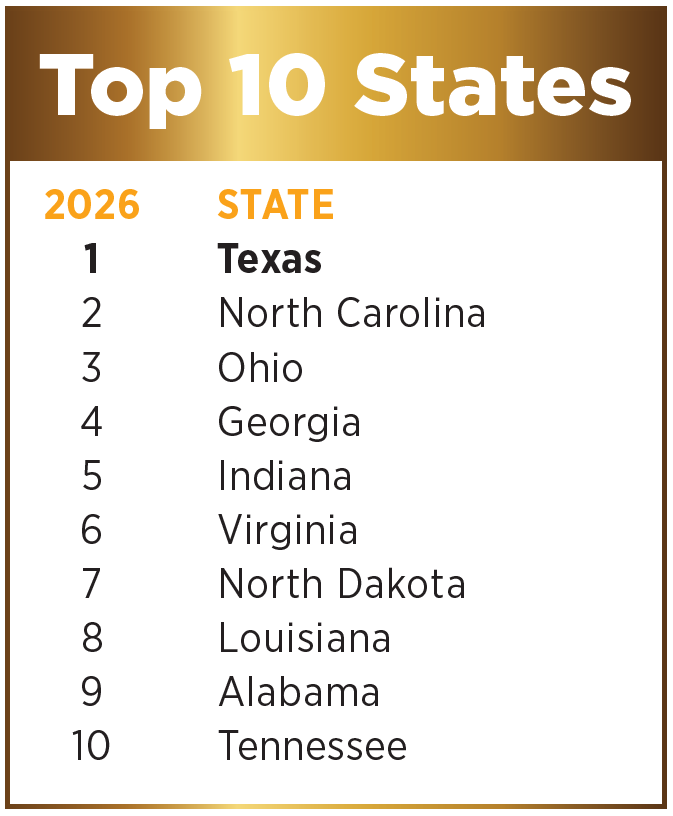
By any measure employed by Site Selection, Texas outperforms all comers and does so by a wide margin. A running 14-time winner of the Site Selection Governor’s Cup for landing the most corporate facility projects in the nation, Texas is no stranger to taking home the hardware. Last year, the Lone Star State wrangled a rare trifecta by winning the Governor’s Cup, the Prosperity Cup and the top Business Climate Ranking from Site Selection.
When I asked Aaron Demerson, president and CEO of the Texas Economic Development Corp., to describe the process employed by the state to consistently produce best-in-class results, he said it comes from measuring every aspect of the state’s performance, following the strategic plan adopted by Gov. Greg Abbott, and benchmarking the performance of Texas against the other 49 states.
“We measure our success according to the goals set by the governor, the Texas Economic Development and Tourism Office, and our TXEDC investors,” says Demerson. “Every measurement is associated with our marketing goals and metrics. We never stand pat. We always adjust and add new programs. We constantly work to increase awareness, and we’re achieving that goal.”
Governor Never Stops Tinkering
Asked how closely Texas watches what other states do, Demerson says, “We’re always paying attention to what other states are doing and their marketing. We’re No. 1 in a number of areas, and we don’t take that for granted. We’re doing what we need to do in order to be first in business. We look at the workforce, education, water, energy and infrastructure of our state and every other state. And finally, we always look to go further. We’ll continue to do what’s right by our people and our businesses in Texas.”
Demerson says the tone is set at the top by Gov. Abbott in Austin. “The governor never rests in working to make Texas more competitive for jobs and industry,” he notes.
Abbott traveled to Levelland a half hour west of Lubbock on April 14 to highlight the new Texas Jobs Council and discuss its role in strengthening the state’s workforce pipeline in a visit to South Plains College’s automotive technology and welding facilities.
“We are building and manufacturing the future of the entire world right here in the state of Texas,” the governor said. “We are united on a mission that benefits all Texans: Keep Texas the number one state for business, jobs, employment opportunities and workforce training programs to ensure great careers for generations to come.”
Abbott and Texas lawmakers allocated more than $7 billion to career training programs across Texas over the past two years. Additionally, he signed House Bill 20 and House Bill 120 into law last year to expand career and technical education opportunities for students across Texas by establishing partnerships with institutions of higher education and improving college and career advising.
Ray Perryman, founder, CEO and lead economist at The Perryman Group in Waco, says that measures like these “have notable implications for future economic development patterns in the state. While some of the [bills] were mostly about signaling intentions, others will have significant implications for competitiveness.” He cited the expansion of the R&D tax credit through the passage of Senate Bill 2206: “The returns on investments in R&D can be very high, leading to commercialization and spillover benefits across the economy. In essence, the multipliers are high, and Texas is doing very well.”
Tar Heels, Buckeyes Step Up
The Prosperity Cup corroborates Perryman’s assessment of Texas, but other states also demonstrate long-term staying power. Coming off a No. 1 finish in Site Selection’s annual Workforce Development rankings in January, North Carolina once again flexed its muscle by showing depth and breadth of competitiveness in multiple categories to land the No. 2 spot in this year’s Prosperity Cup standings.
With strong showings in the Conway Projects Database findings, Tax Foundation ranking, NCRC scores and Site Selection Business Climate Survey, North Carolina proved that its third-place finish in the Prosperity Cup last year was no fluke. The Tar Heel State finished fourth in 2024 after claiming the No. 1 spot in the Prosperity Cup rankings in 2021, 2022 and 2023.
Also showing remarkable resilience is third-place Ohio, which has become a mainstay in the Prosperity Cup Top 10. The Buckeye State finished seventh in 2022, third in 2023, sixth in 2024 and fourth in 2025. Ohio has also finished second or third in the Governor’s Cup race every year since 2020.
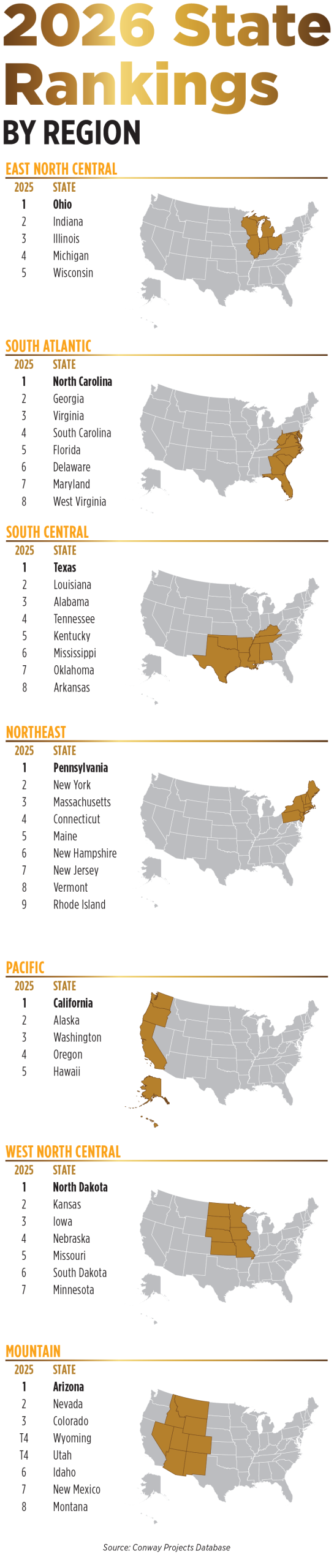
Ohio (East North Central) and North Carolina (South Atlantic) also finished first in their respective regions this year. Other regional winners are Arizona in the Mountain Region, Pennsylvania in the Northeast, California in the Pacific, Texas in the South Central and North Dakota in the West North Central.