Sleek, on-demand, low-cost, seamless — these aren’t buzzwords, they’re the reality of an innovative transportation infrastructure pursuit spearheaded by Atlanta Airport Community Improvement District (AACID) leadership.
To this day, the Hartsfield-Jackson Atlanta International Airport remains the world’s busiest airport. In 2024, the airport moved more than 108 million travelers throughout our shared global airways, the second highest volume in its history. Future projections are set to rise, especially as the city prepares to host eight matches of the 2026 FIFA World Cup at Atlanta’s Mercedez-Benz Stadium.
Over a decade ago, Airport West and Airport South CIDs — encompassing Fulton and Clayton counties — began forward-looking conversations with organizations and state agencies such as the Metropolitan Atlanta Rapid Transit Authority (MARTA) and the Georgia Department of Transportation (GDOT). According to AACID Executive Director Gerald McDowell, this outreach focused on transit expansion opportunities that benefit travel within Atlanta’s south metro region. In 2018, a year-long feasibility study was launched and led to the recommendation of three emerging mobility solutions.

At the 2025 State of the Region event, I had the chance to board and interact with a Glydcar and speak with Glydways SVP of Growth Brian Gettinger (right).
Photo courtesy of Glydways
“We were recommended autonomous shuttles, microtransit and personal rapid transit. That was then presented to our board members and to our property owners,” McDowell continues, “A decision was made for us to move into a phase two.”
The following four years were spent traveling to over 10 locations where these solutions were already finding integration. In the U.S., the team visited various metro areas — including Los Angeles, San Francisco, Orlando, Phoenix and Arlington, Texas — while also tapping into transit solutions abroad in Amsterdam and at London’s Heathrow Airport. These experiences guided fresh conversations with MARTA, GDOT and other groups, who were now interested in gathering data on which solution had the best opportunity in Atlanta.
Vital Demonstrations
It was decided that pilot projects would be created for all three options — two of which have already found fruitful momentum.
ACCID was successful in gaining funding from the Atlanta-Region Transit Link Authority for a two-year microtransit pilot, providing 30% of its own matching funding. The total $2.6 million microtransit service was officially launched in August 2025. Since the AACID’s area was identified as a 24/7 district, this project provides travelers with an on-demand transit alternative within this service zone.
Meanwhile, MARTA stepped in to support a two-year personal rapid transit (PTR) pilot with a $10 million investment of its own. The initial project will span close to half a mile, creating a simple connection from the airport’s ATL Skytrain Station at the Georgia International Convention Center to the nearby Gateway Center Arena. The AACID team received preliminary information that the pilot’s cost would be roughly $20 million, so when forming a Request for Proposal (RFP), a stipulation was put in place that if a company’s proposal calls for more than $10 million, they must cover the additional costs.
“We received seven RFPs for the personal rapid transit pilot and Glydways is the company that we selected,” says McDowell. “They had a proposal for $18 million, so Glydways is bringing $8 million to the table.”
Specializing in autonomous transit systems, the San Francisco-based transportation technology company was officially announced as part of the Atlanta Personal Rapid Transit Solutions Team in 2024, joining ACS Infrastructure, FlatironDragados and ICE Engineering. Glydways’ technology is foundational to the system that will power a suite of electric driverless vehicles — resembling futuristic pods — on the half-mile demonstration pilot set to launch by the end of 2026.
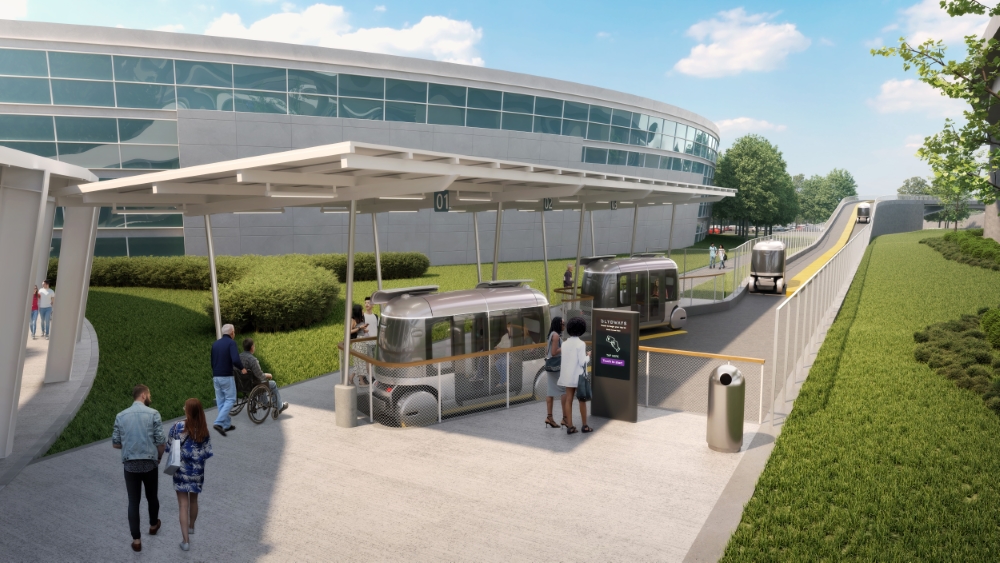
A half-mile demonstration pilot will utilize Glydways transit technology systems to power a suite of autonomous vehicles.
Rendering courtesy of Glydways
This transit system works by cultivating a dedicated guideway for these Glydcars to service. Much like MARTA rail, Glydcars operate on their own dedicated route away from roads and traffic. Although akin to rideshare services, these vehicles will operate on-demand as passengers request a ride and specific location. If it seems confusing, it’s just innovation at work.
“The PRT project is ours, so that allows us to run this project the same way MARTA runs a project,” says McDowell. “We will be able to investigate these mobility solutions to determine if they work, if they’re viable and if they’re feasible. If the pilot shows these solutions work, then we advocate to MARTA to plan to implement this in the future.”
Atlanta will be Glydways’ first commercial deployment, joining other competitive wins for projects in development with the City of San Jose and East Contra Costa County in California.
Other large-scale PRT systems are being tried out in places such as Noida International Airport in India.
Bringing these innovative systems to life takes time. It also takes a willing first mover.
“It’s easy to be the fifth in line, it’s harder to be the first,” says Glydways Senior Vice President, Growth-Americas Brian Gettinger. “Atlanta will be a big part of proving this technology.”
What’s Next?
In May 2025, the airport placed parking rate increases into effect for the first time in eight years.
Some changes included the hourly rate in both North and South lots increasing from $3 to $10 per hour, while the North and South daily lots moved from $3 per hour/ $19 max to a $30 flat rate. In comparison to other major airport hubs — in Denver, Chicago, Los Angeles and New York City — the updated costs to park at Hartsfield remain cheaper for hourly and daily parking, according to a rate comparison sheet released by the airport. The price hike will supplement new infrastructure investments guiding the airport’s evolution.
These changes make rideshares, park-and-ride and public transportation options more attractive, albeit while presenting new challenges for residents and travelers who do not have adequate access to these resources. Public transportation expansion — namely a push for new MARTA rail routes — has been a topic on conversation in Metro Atlanta for decades. McDowell says that, regardless of these conversations, the likelihood of expansions in south metro Atlanta would not take place for another 30 to 50 years.
“One of the biggest challenges in and around the airport is that investors are not as attracted to the south metro area [due to] a lack of mobility options,” says McDowell. “We’re finding solutions that can fill that void and unlock new development and investment from a global perspective.”
A location at the world’s busiest airport is the perfect way to introduce this technology to domestic and international travelers in a controlled environment, he says. It also unlocks a unique way for users to view the future of public transportation, especially those who would not normally use it.
“We look at projects globally, and I would argue that most major metros don’t have high functioning transit,” says Gettinger. “So, we see a huge opportunity — not only in the U.S. market — to service gaps in transit systems like Atlanta.”
Gettinger says the PRT pilot project is looking to officially break ground in February 2026, spanning upwards of seven months to construct the guideway. Once operational, the demonstration pilot will run eight hours a day for four days a week until early 2029.
“There will be five vehicles that will provide you 400-passengers-an-hour capacity. Now imagine if there were 50 or 500 in operation,” he says. “Its intent is to demonstrate functionality and collect feedback from users on how we can continue to improve the experience.”
Climb In
At the Atlanta Regional Commission’s 2025 State of the Region event held at the Georgia World Congress Center in October, Glydways was in attendance to showcase its transit solution. I had the opportunity to climb into the pod myself. Much like a MARTA or Plane Train passenger car, double doors open to welcome in riders. I entered the calmly lit pod and sat next to another attendee, while two others faced us across the way. Aside from fascination, one of my first observations was that there was plenty of leg room.
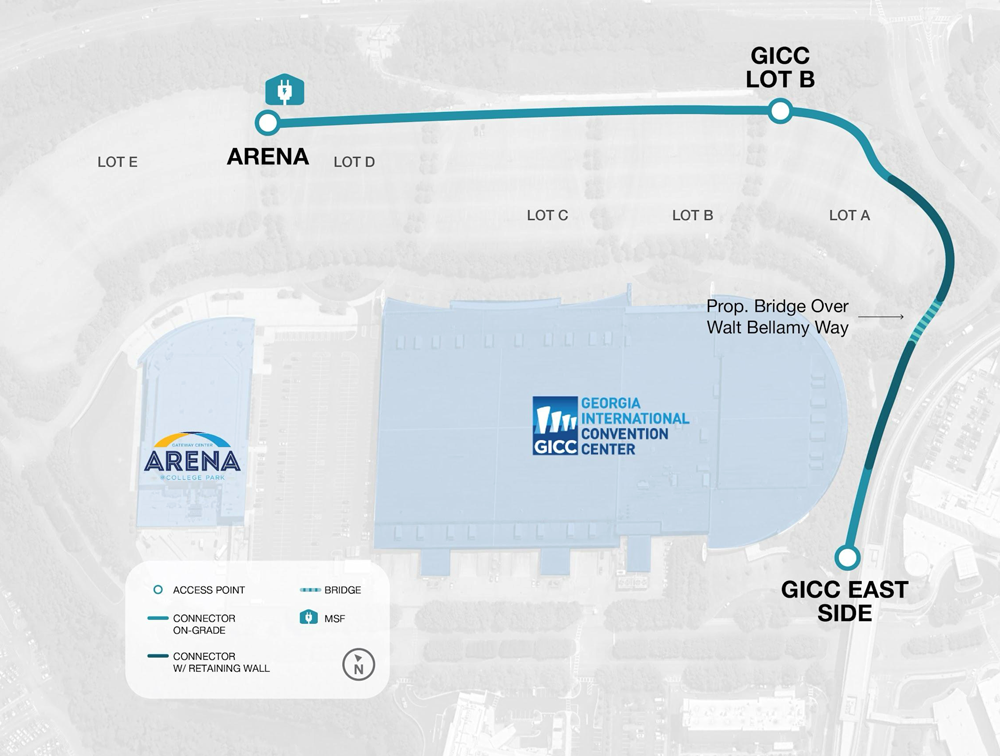
Construction of a dedicated transport guideway will begin early this year.
Map courtesy of Glydways
A few weeks later, I headed into the AACID’s offices in College Park to participate in a VR experience that placed me at the future PRT loading bay. I watched as Glydcars made their way into the station — capable of moving both forward and backward without turning around — and later push off down the guideway with ease. If operational, I would climb in and tap or scan my ticket to enter my destination and the Glydcar would take everything from there. The experience is customizable, whether one’s preference is for a private ride or shared with other passengers. The airport pilot will be a two-and-a-half-minute ride and run at no cost to users — although if later implemented full-time and expanded, it would run at a comparable rate to a MARTA fare.
The AI-enabled system powering these vehicles enables it to monitor a pod’s battery life, navigation, cameras and sensors in real-time. The data will be critical to advancing next steps for the project at the airport, in addition to providing context for MARTA or other entities to pursue an independent PRT feasibility study.
The project continues to move forward in a metro region that the 2025 Global Traffic Scorecard released in December by INRIX identified in the top 20 regions worldwide for hours lost to traffic congestion (75 hours annually), a figure that has increased by 23% in a mere two years.
“If there is anything we need more of in metro Atlanta it is for people to get out of their cars and start using public transportation,” says McDowell. “We just do not have a solution today that works. Most people driving cars cannot rely on public transportation to get them where they need to go faster. If you build a system that works for Atlanta, more people are going to ride, and I believe that’s PRT.”