It’s only right that the AI-driven, fully automated future of manufacturing is hatching in a former Fry’s Electronics store.
That’s where The Cannery, focused on engineering testing and prototype manufacturing, is located in Palo Alto, California. The Cannery is where Dynatomics, founded by Google co-founder and billionaire Larry Page to focus on AI-assisted manufacturing and design tools for advanced aircraft, has taken 73,000 sq. ft. of space even as Page official moved the three-year-old company’s HQ to Texas, ostensibly to avoid a potential billionaire tax in California.
Dynatomics is still in stealth mode, much like Prometheus, the company co-headed by former Google X leader Vik Bajaj and Amazon billionaire Jeff Bezos, who told Andrew Ross Sorkin on CNBC that the company is focused on creating an “artificial general engineer” to create tools to design physical objects. According to reporting by Bloomberg and GeekWire, Project Prometheus has hired around 120 already from major tech and AI firms and is operating out of space in San Francisco, London and Zurich.

The Cannery is located near “an established EV and advanced manufacturing cluster anchored by Tesla and Rivian” noted The Real Deal in January. Tesla in 2023 celebrated 20 years in the area by opening its global engineering HQ in the building originally occupied by Silicon Valley OG HP.
Wait: This is California, right? The state whose regulatory and tax policies are thought to repel business as surely as neoprene repels water. What’s up in Palo Alto other than the tech bro population and that population’s salaries? R&D space, for one.
As Douglas Sams reported in January in the San Francisco Business Times, “Across the Peninsula, life sciences leasing fell sharply toward the end of last year, but tech-driven R&D demand rose. Technology firms made up 44% of the largest deals. Peninsula developers are now repurposing buildings for AI and advanced-technology users, a shift reflected in recent leases by firms like Dynatomics.”
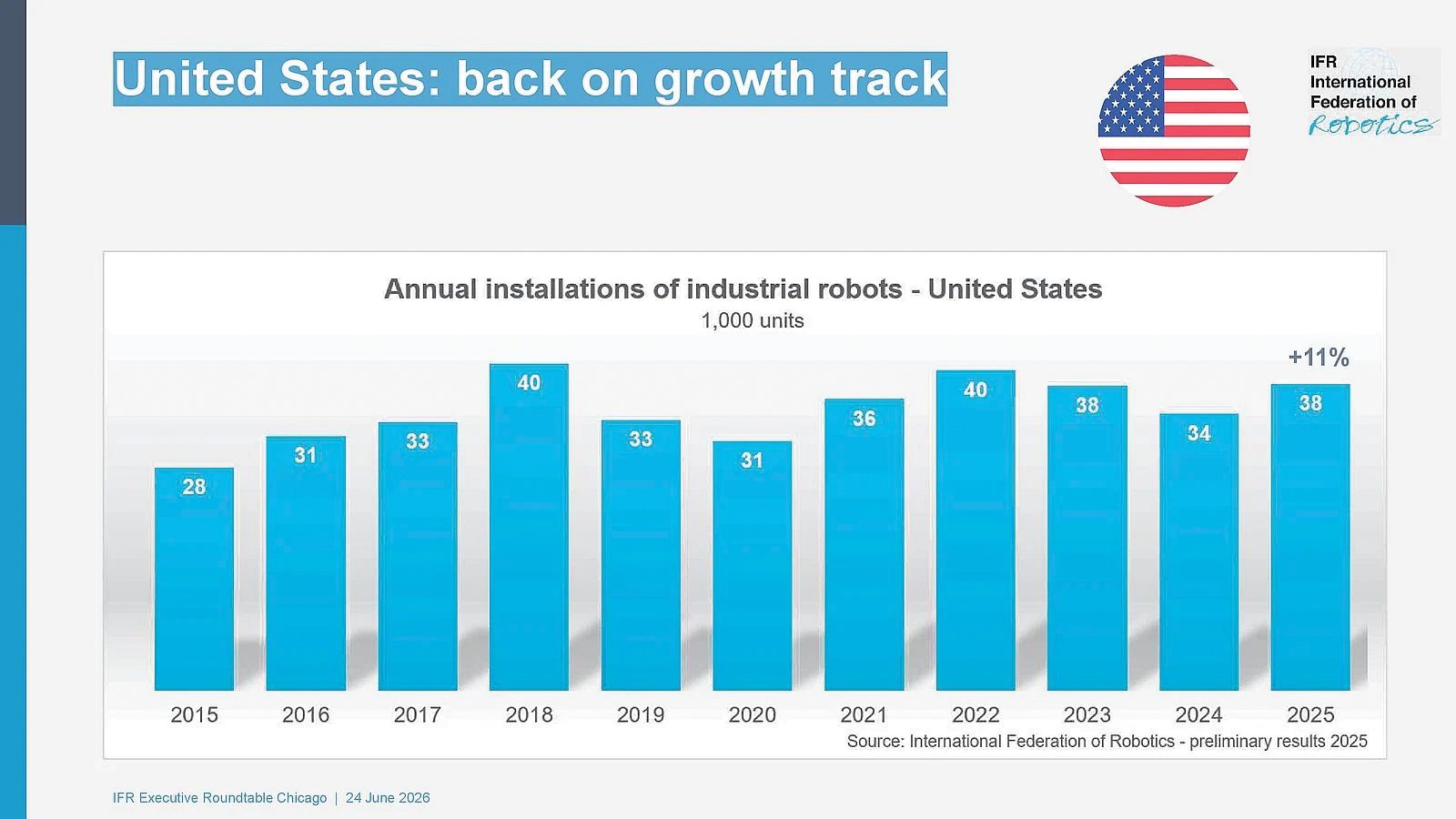
The United States is No. 8 in robot density (as measured by robots per 10,000 employees), with a rate around one-quarter of top automated country South Korea. But the country saw a rise in industrial robot installations in 2025 driven by a surge in the food industry and the continuing leadership of the automotive sector.
Graph courtesy of International Federation of Robotics
The Cannery, on track for LEED-Platinum certification and featuring an all-electric design with Net Zero Energy and Net Zero Carbon operations, was just completed in May by The Sobrato Organization (TSO), a Silicon Valley–based family-owned firm consisting of Sobrato Real Estate, Sobrato Philanthropies and Sobrato Capital. “For nearly 70 years, the Sobrato family has been developing commercial real estate for high-growth companies, building multi-family communities, investing in entrepreneurial enterprises and giving back to communities in the San Francisco Bay Area and around the world,” is how TSO describes itself, all operating under a common mission “to build a more equitable and sustainable world through business and philanthropic leadership.”
The Cannery is an adaptive reuse of the Bayside Cannery Company established nearly a century ago by Chinese immigrant and entrepreneur Thomas Foon Chew. Now the site is home to a 74,000-sq.-ft. Class A office building that features a commissioned mosaic honoring Chew, who in 1918 constructed the original cannery on four acres he’d purchased and then proceeded become the third-largest cannery of fruits and vegetables in the country, earning the nickname “Asparagus King.”
That property today is poised to cultivate the tech-enabled business kings of tomorrow.
“On behalf of the City of Palo Alto, we deeply appreciate Sobrato’s longstanding commitment to Palo Alto and pioneering leadership advancing economic development and vitality, historic preservation of the Cannery, and sustainability,” said Palo Alto Mayor Vicki Veenker at the completion celebration in May. “The City partnered with Sobrato to secure 3.25 acres of land for a new park, re-naturalized creek, future housing and affordable housing. We look forward to future celebrations as these critical community benefits are added to the Ventura Neighborhood.”
In a sense, then, advanced manufacturing as interpreted by TSO means a lot more than whiz-bang gadgetry or automation on steroids. It means advancing a community to the next level of prosperity. A significant portion of the plan is for TSO to bring 74 for-sale townhomes to the site through a future homebuilder partnership and contribute an additional 3.25 acres of land to the city for future affordable housing and a park, further activating the neighborhood for years to come. “Through this work, TSO helped expand the site’s affordable housing capacity from 15 units to over 100,” the organization announced, “and contributed $5 million to support an RFP process for future housing and park development.”
Taking Off in Greensboro
Nearly all the way to the opposite coast some 2,800 miles from Dynatomics’ digs, another advanced manufacturing operation focused on future aircraft has taken shape.
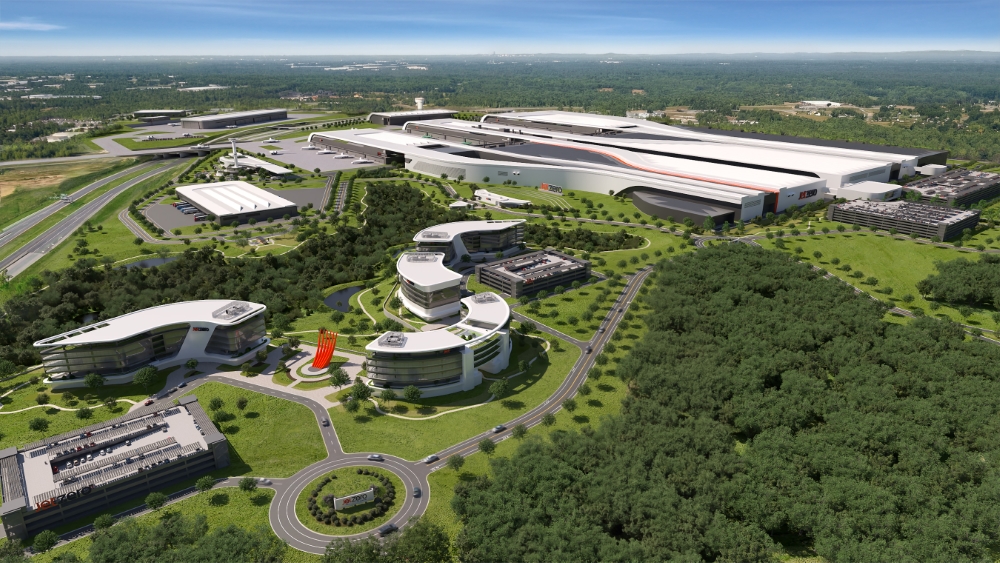
Blended-wing aircraft company JetZero in mid-June broke ground on a $4.7 billion, 8-million-sq.-ft. manufacturing and final assembly campus on more than 600 acres in Greensboro, North Carolina. The project, supported by the largest ever state-level incentive package for any startup of any industry, will be home to production of JetZero’s next-generation aircraft the Z4, creating 14,500 jobs over the next 10 years, the company announced.
With 250-passenger capacity and a range of up to 5,000 nautical miles, JetZero says the Z4 will be up to 50% more fuel-efficient with what it calls “an elevated passenger experience.” The company also is designing military variants of the Z4, including an aerial refueler and transport aircraft. “As a refueler, the all-wing design allows for twice the range or twice the payload to support U.S. air power,” JetZero stated.
As of January 2026, the company had raised more than $1 billion, counting government grants and incentives as well as investment from United Airlines Ventures, Northrop Grumman, 3M Ventures and RTX Ventures, the corporate venture capital arm of RTX.
But the design of the site might be just as cutting-edge as the design of the aircraft. That’s because it will be what JetZero calls a digital-first, AI-native smart factory, developed in collaboration with Siemens and Deloitte. “These platforms and tools allow engineers to build a complete digital twin of the factory before any concrete is poured — testing how machines, people, and materials will move through the building, and making changes on a screen rather than on a job site,” the company said. “That flexibility is rare in aerospace manufacturing and will make the Greensboro facility the most efficient and adaptable plant of its kind anywhere in the world.”
“Our partnership with JetZero demonstrates how cutting-edge industrial technology can help reindustrialize America,” said Siemens USA President and CEO Ann Fairchild. “Our digital twins help bring the next generation of manufacturing facilities to life faster and with greater confidence.”
“Our work with JetZero brings automation and AI together with data strategies informed by our experience at The Smart Factory by Deloitte @ Wichita — connecting design, the shop floor and the workforce,” said Deloitte Chief Client Officer Kelly Herod.
Wait, did somebody say, “Wichita”?
Getting Smarter
That Kansas city, pretty much smack dab at the midpoint between Palo Alto and Greensboro, is where Deloitte located “an experience center that helps organizations leverage advanced manufacturing techniques and the latest technologies to tackle problems, accelerate innovation and achieve end-to-end digital transformations” offering an immersive learning environment connecting digital, physical and experimental elements on a fully operational production line.
The facility opened on the Innovation Campus of Wichita State University (WSU) in 2022. (Deloitte also operates Smart Factories in Montreal, Quebec; Düsseldorf, Germany; and Tokyo, Japan.) Why there? Once again, aviation and aerospace are where advanced manufacturing takes flight, as Wichita at the time of Deloitte’s location decision delivered more than one-third of all general aviation planes built in the United States and was ranked No. 1 by the WSU-based National Institute of Aviation Research in manufacturing jobs and occupations involving STEM skills.
Among the initial companies affiliated with the Smart Factory as founders and as builders: AWS, Dragos, Infor, SAP, Siemens, Check Point, HPE, Tenable, ServiceNow, UiPath and Verizon. In October 2025, Oracle joined in order to bring to the facility’s clients Oracle Smart Operations capabilities for Manufacturing Execution.
“By bringing together Deloitte’s technology, industry and sector experience with Oracle’s AI solutions, we’re continuing to help manufacturers accelerate the adoption of AI and automation so they can address today’s most pressing operational challenges and unlock new opportunities for growth,” said Tim Gaus, Deloitte’s principal and Smart Manufacturing business leader.
Deloitte’s rival consultancy McKinsey in its spring 2026 report “Ramping up manufacturing in America?” makes mention of the various stealth ventures such as Dynatomics, Jeff Bezos’ $100 million “manufacturing transformation vehicle” fund and Tesla’s increased focus on factory-floor robotics. The report compares the scenario to the gold rushes of the past, when some chose not to mine and prospect for gold but to sell picks and shovels to those who did. Today’s enabling technologies are “modern picks and shovels,” the report suggests.
The gold in this case is the lofty goal of replacing imports with U.S. manufacturing. “The price tag to replace not only those imports but their components?” McKinsey Global Institute asks. “Around $2 trillion, or 6% of U.S. GDP.”