Corporate and infrastructure projects from top architecture, engineering and construction firms are leading indicators in multiple ways.
Chicago-based architecture firm Perkins&Will’s name has no spaces in it. But the work its people do — such as interiors at Acciona’s new headquarters in central Madrid (pictured) — creates memorable workspaces.
Recent rankings showed Perkins&Will ($720 million in revenue in 2024) to be No. 2 in the United States among architecture firms behind No. 1 Gensler ($1.86 billion), creators of the Gensler Transit-Oriented Development Opportunity Index chronicled in Site Selection last year.
This inaugural edition of a new feature spotlights selected corporate client and infrastructure work by some of the nation’s 10 highest-revenue firms across each of four categories of practice: architecture, engineering, architecture/engineering and construction, according to category rankings from Building Design + Construction. Here we present projects from the top two firms in each category.
These synopses and images, however, brief, offer sometimes stunning glimpses of corporate and community futures facilitated by robust collaboration, pioneering vision and precise execution.
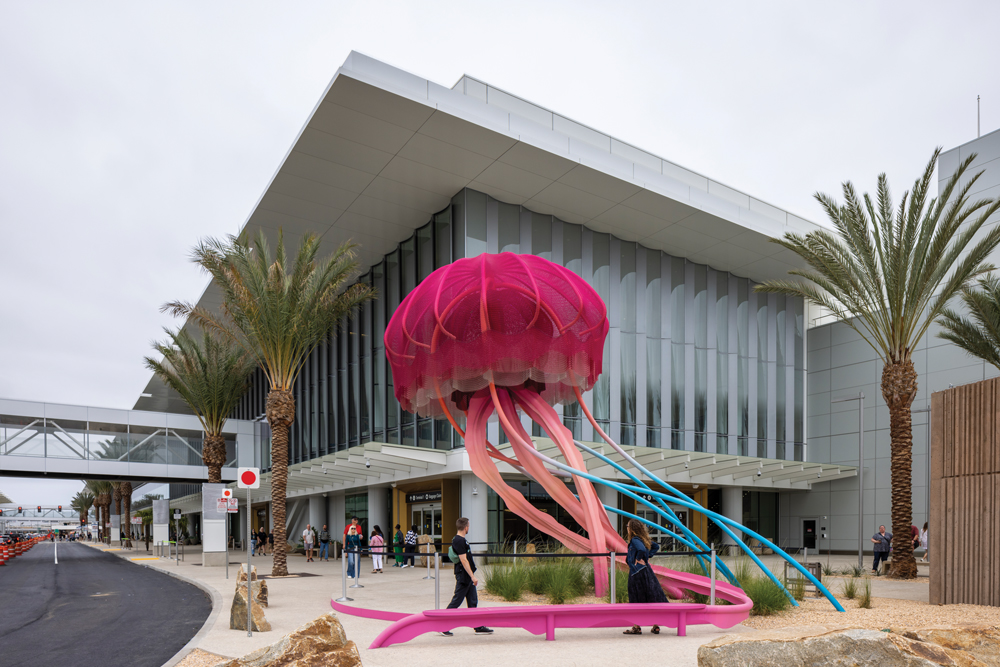
Photo courtesy of San Diego International Airport
Gensler: Terminal 1, San Diego International Airport
In partnership with Turner-Flatiron, Gensler led the $3.8 billion transformation of Terminal 1 at San Diego International Airport (SAN), “redefining the traveler experience at the nation’s busiest single-runway commercial airport,” the firm said. The new terminal has 19 gates and 17 new concessions, with a second phase scheduled for completion in early 2028 that will add 11 more gates.
“Airports are more than infrastructure; they are cultural front doors that reflect the identity of a city,” said Terence Young, principal and design director at Gensler. “Airports are no longer judged only by how many planes they move,” said Gensler Global Aviation Leader Ty Osbaugh, “but by how well they move people — through experiences that restore calm, through operations that cut carbon, and through connections that drive regional economies.”
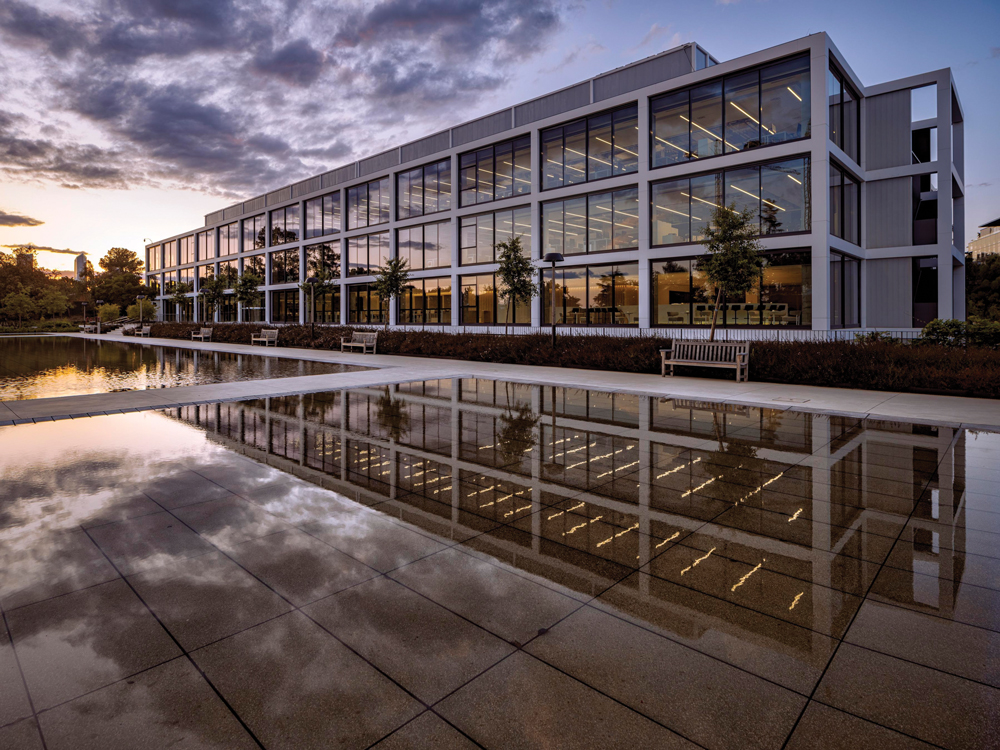
Photo courtesy of Perkins&Will and v2com newswire
Perkins&Will: Acciona Headquarters Campus, Madrid, Spain
Perkins&Will called Acciona’s new headquarters campus in central Madrid “a new global benchmark in people-focused workplace design.” The design repurposed a decades-old corporate campus site for the infrastructure and renewable energy giant’s 4,000 employees.
Completed last March, the 400,000-sq.-ft. campus on 25 acres has achieved LEED Platinum and WELL Platinum certifications while also aligning with EU Taxonomy, says Perkins&Will, which performed the interior work. The campus operates entirely on renewable electricity, with on-site solar PV, geothermal systems and heat recovery technologies.
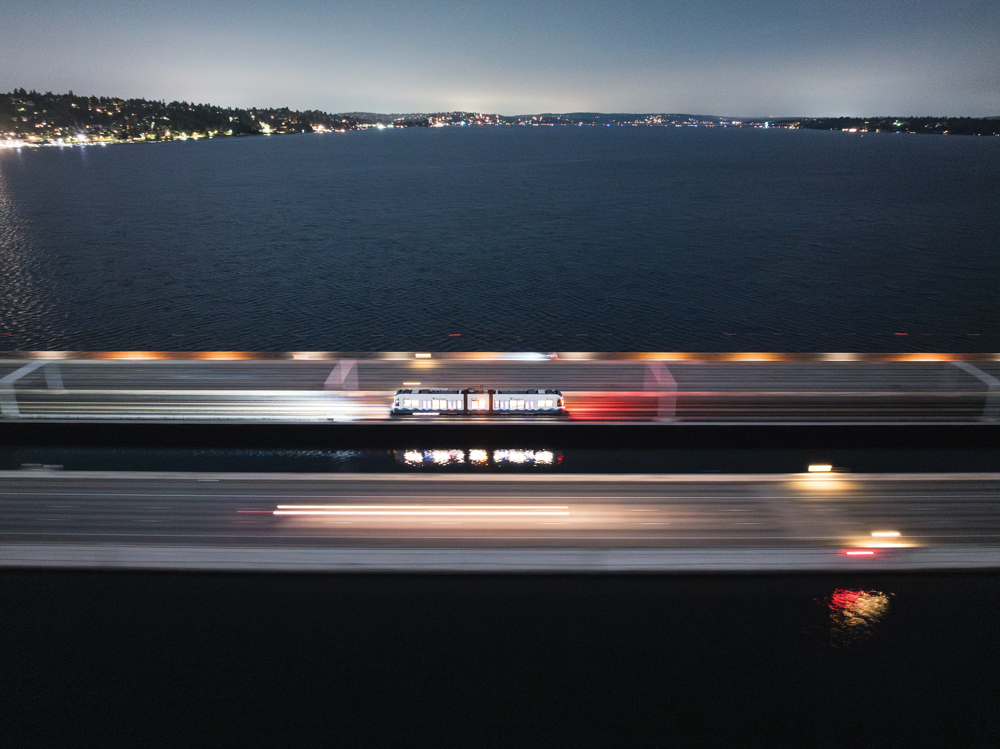
A light rail vehicle (LRV) crosses the Sound Transit floating bridge under its own power during the first night of Crosslake livewire testing in Seattle on September 8, 2025.
Photo by Peter Bohler courtesy of Sound Transit
WSP: Sound Transit Crosslake Connection, Seattle, Washington
The opening of the Crosslake Connection by Sound Transit and its regional partners in March 2026 completed the Link Light Rail 2 Line and marked the world’s first light rail service to operate across a floating bridge. WSP called the project “the latest investment to expand regional mobility, reduce congestion and support sustainable growth throughout the Puget Sound region.”
“Completing the Crosslake Connection is a defining moment for regional transit and a testament to years of collaboration and innovation,” said WSP Mountain Pacific Region Executive Karen Doherty.
WSP, which employs 83,000 “Visioneers” worldwide, served as the prime engineering consultant for the final design of the Crosslake Connection, focused on integrating light rail infrastructure with the existing I-90 corridor “while maintaining safety, performance and long‑term durability.” The 2 Line now operates continuously between Redmond and Lynnwood, while the combined 1 Line and 2 Line provide frequent service through the system’s busiest corridor. Trains will run approximately every eight minutes during peak periods at the new stations.
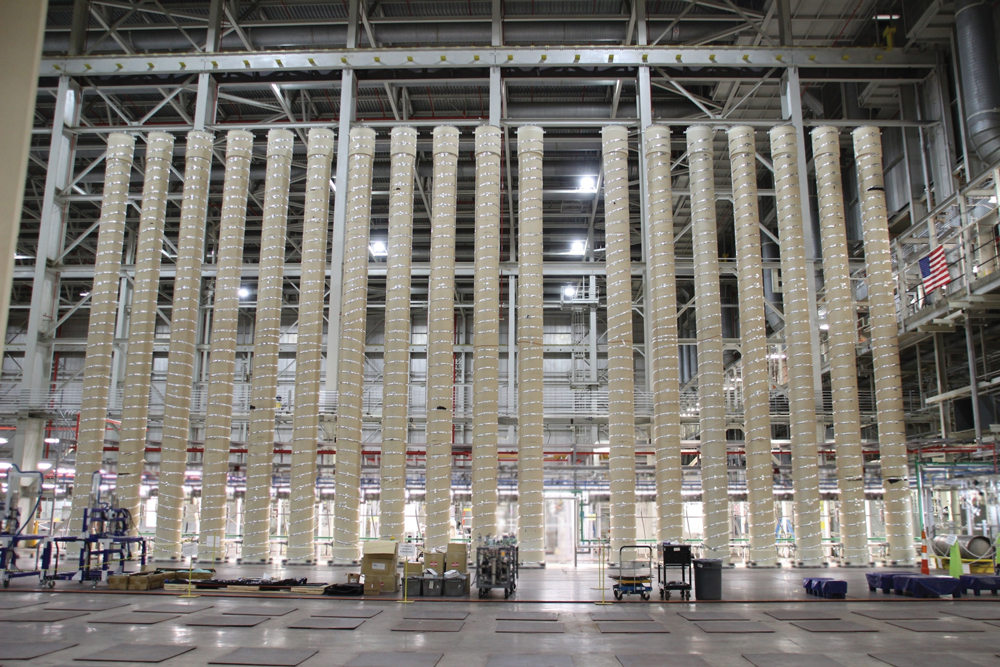
A contract with Fluor is part of a multi-billion-dollar public and private investment plan to add thousands of additional centrifuges to these HALEU cascade centrifuges at Centrus’ American Centrifuge Plant in Piketon, Ohio.
Photo courtesy of Fluor
Fluor Corporation: Centrus, Piketon, Ohio
In February, Fluor Corp. was awarded a multi-year contract by Centrus Energy’s subsidiary, American Centrifuge Operating, LLC, to serve as the integrated engineering, procurement and construction partner to expand its low-enriched uranium (LEU) and high-assay low-enriched uranium (HALEU) enrichment facility in Piketon, Ohio. The project is expected to create more than 1,300 Ohio jobs during construction and operation “This is another critical milestone for us as we begin our expansion in earnest,” said Centrus President and CEO Amir Vexler. “Fluor is a global leader with decades of experience managing complex nuclear construction projects and is an ideal partner as we transition to a large-scale deployment. With centrifuge manufacturing already underway, we are moving full speed ahead with our expansion.”
Fluor’s energy leadership doesn’t stop in Ohio. The firm announced in early April that it has been selected by America First Refining (AFR) to execute the front-end engineering and design (FEED) for their large-scale refining facility in Brownsville, Texas. The AFR facility is the first new refinery to be constructed in the United States in more than 50 years. “This collaboration reflects both companies’ commitment to advancing the nation’s refining infrastructure,” said Fluor’s Business Group President of Energy Solutions Pierre Bechelany.
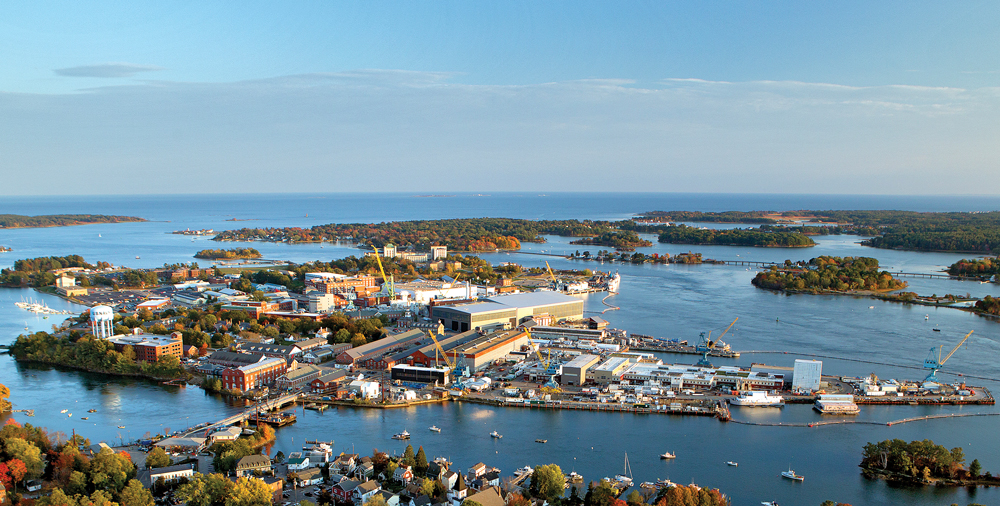
Stantec has supported infrastructure optimization at Portsmouth Naval Shipyard (pictured) in Kittery, Maine, as well as three other U.S. Navy shipyards.
Archive photo courtesy of Defense Logistics Agency Land and Maritime and DVIDS
Stantec, Portsmouth Naval Shipyard, Kittery, Maine
Edmonton, Alberta–based Stantec was selected with AECOM by Naval Facilities Engineering Systems Command (NAVFAC) to lead multidiscipline architect-engineer and consulting services as part of a five-year, $150 million to support the U.S. Navy’s Shipyard Infrastructure Optimization Program (SIOP) focusing on the modernization of Portsmouth Naval Shipyard (PNSY) in Kittery, Maine. SIOP is upgrading and modernizing the infrastructure at all four U.S. public naval shipyards: Pearl Harbor Naval Shipyard and Intermediate Maintenance Facility (PHNSY), Hawaii; Puget Sound Naval Shipyard and Intermediate Maintenance Facility (PSNS), Washington; Norfolk Naval Shipyard (NNSY), Virginia; and PNSY. Stantec has supported SIOP programs and projects at all four shipyards.
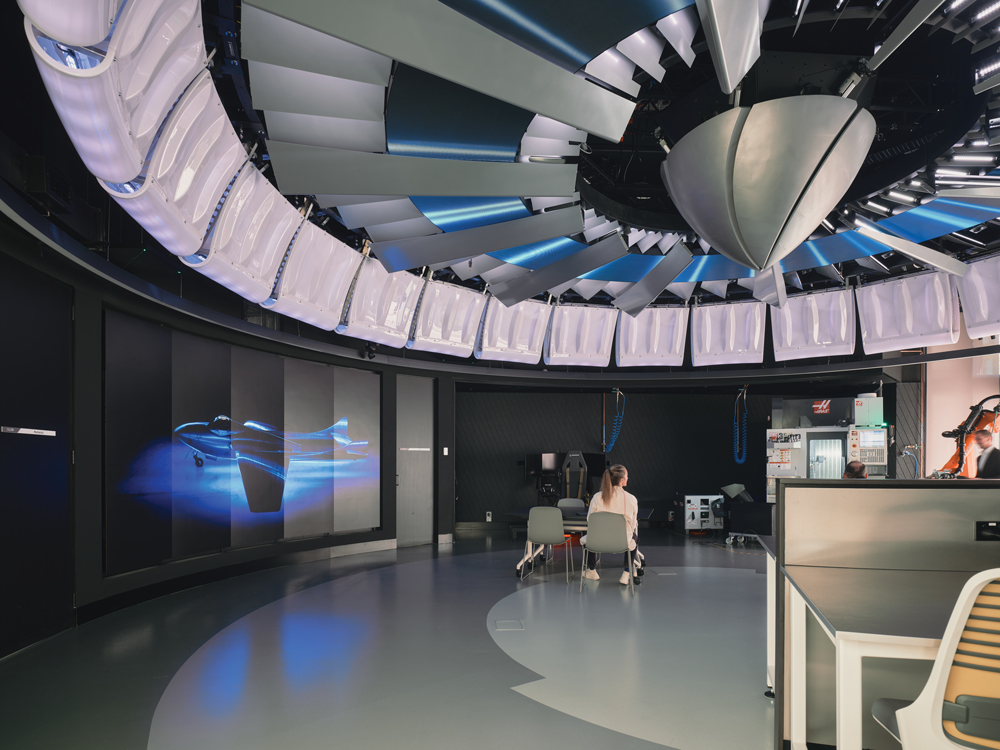
The Factory of the Future at Western Sydney University will specialize in “supporting businesses to transition to a smart manufacturing environment, whether they are upgrading an existing production facility or developing a new factory from the ground up.”
HDR and Western Sydney University
Factory of the Future, Western Sydney University, Australia
In March, Omaha-based HDR delivered to Western Sydney University’s Bankstown City Campus a new experiential learning and innovation environment called Factory of the Future. “The Factory of the Future is an immersive platform for invention, creativity and collaboration,” said Alex Wessling, associate principal at HDR. “We set out to design a space where innovation is visible and approachable — a place where students, researchers and the community can see, touch and engage with the ideas and processes shaping our future.
“Working within the constraints of an irregular floor plate and a vertical campus, HDR developed a circular spatial logic inspired by Bankstown’s industrial and aeronautical heritage.,” Wessling continued. “This strategy connects two levels and choreographs a clear learner journey to the project’s centerpiece: the Innovation Engine — an 8.6-meter kinetic, propeller-like installation fabricated locally. Its rotating turbine reveals mechanisms that draw students into fabrication, engineering and spatial learning.”
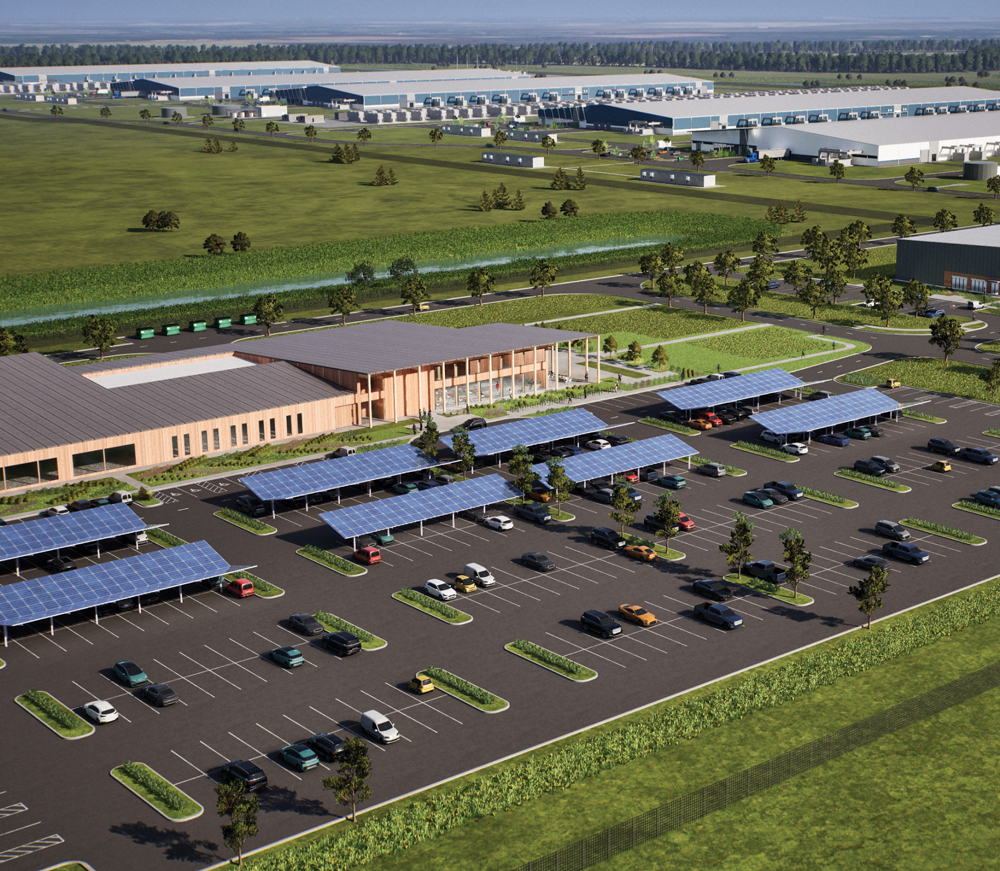
Once complete, Meta’s Lebanon Data Center will stand as one of the largest infrastructure investments in Indiana’s history.
Rendering courtesy of Meta
Turner Construction Company, Meta data center campus, Lebanon, Indiana
Turner was selected in February 2026 as one of the contractors for Meta’s $10 billion, 4-milloin-sq.-ft., 1-gigawatt data center campus in Lebanon, Boone County, Indiana. The site will support more than 4,000 construction jobs and 300 operational positions. “Meta will pay the full cost for energy used by the data center to ensure residents aren’t negatively impacted,” a Turner release noted. “In alignment with Meta’s energy and sustainability commitments, 100% of the facility’s energy use will be matched with clean and renewable energy. The data center will be built to achieve LEED Gold certification and will utilize a water-efficient, closed-loop liquid cooling system that recirculates water.”
“The scale of the Lebanon Data Center reflects the growing demand for high-performance infrastructure,” said Turner Construction Company Managing Director Ben Kaplan, “We look forward to working alongside Meta and applying our integrated services and deep mission-critical experience to deliver this data center safely, sustainably and efficiently while supporting the long-term growth of the Lebanon community.”
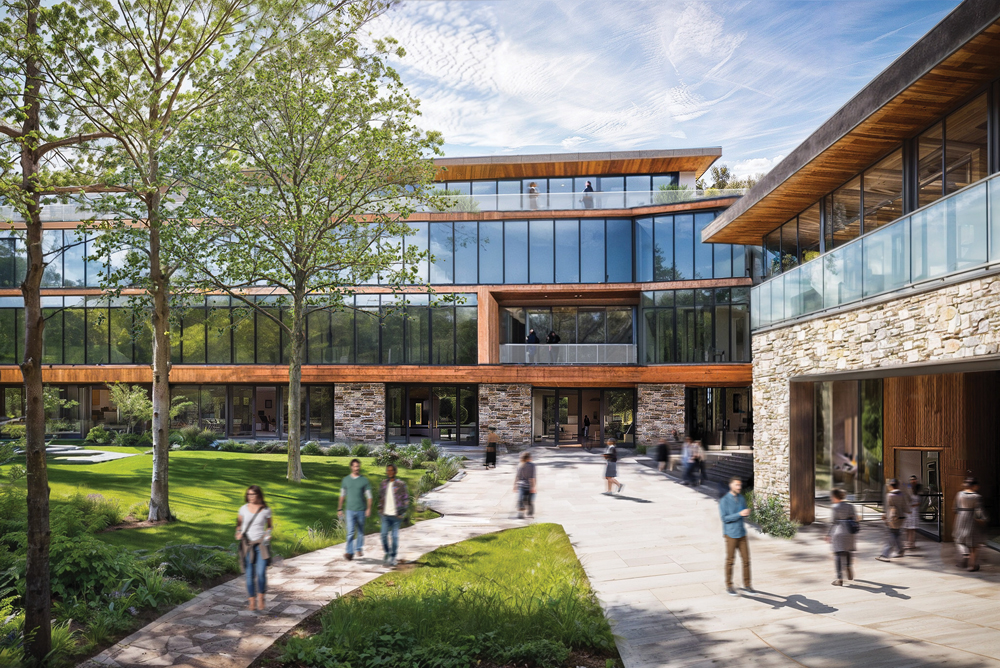
Goucher College President Kent Devereaux said the partnership behind Whiting-Turner’s plan to relocate its HQ to the college’s campus “takes an innovative approach to business development, education, and community engagement while opening the door to collaborative experiential learning opportunities and workforce pipelines for future generations.”
Rendering courtesy of Whiting-Turner
Whiting-Turner Contracting Company, Headquarters, Goucher College, Towson, Maryland
Sometimes the client is yourself. That’s the case with Whiting-Turner, which announced plans in February 2025 to relocate its corporate headquarters to a 150,000-sq.-ft. facility on the campus of Goucher College. “In addition to serving as the new home to Whiting-Turner’s local employees, the facility will also support state-of-the-art, safety-focused industry training and other community-focused initiatives,” the company said. “Goucher and Whiting-Turner are developing ways to use the new headquarters as a hub for introducing young people to career opportunities in today’s high-tech and innovative design and construction industries. Whiting-Turner and Goucher have signed a 50-year ground lease agreement, reinforcing their shared commitment to long-term growth and collaboration.”
Which firm did Whiting-Turner choose to lead the HQ’s design and development? Gensler.
Game recognize game.
Top 3 Architecture Firms
| Rank | Firm | Architecture Design Revenue (US$M) |
|---|---|---|
| 1 | Gensler | 1,863.07 |
| 2 | Perkins&Will | 719.54 |
| 3 | HKS | 661.98 |
Source: Building Design + Construction, Sept. 2025
Top 3 Engineering Firms
| Rank | Firm | Eng. Revenue *US$M) |
|---|---|---|
| 1 | WSP | 1,264 |
| 2 | Fluor | 764.96 |
| 3 | Salas O’Brien | 730.87 |
Top 3 Architecture Engineering
| Rank | Firm | A/E Design Revenue (US$M) |
|---|---|---|
| 1 | Stantec | 1,166 |
| 2 | HDR | 772.9 |
| 3 | HOK | 573.8 |
Top 3 Construction Firms
| Rank | Firm | Construction Revenue (US$M) |
|---|---|---|
| 1 | Turner Construction | 20,132 |
| 2 | The Whiting-Turner Contracting Co. | 13,190 |
| 3 | STO Building Group | 12,038 |