
Whisper Aero’s ultralight aircraft won’t take flight without rigorous testing and development under its wings. Institutions such as Tennessee Tech University and Oak Ridge National Laboratory (ORNL)—plus a state legacy of aircraft testing that goes back many decades—have provided the R&D lift and the runway to a new aviation era, not to mention a leaf blower revolution.
The company since early 2024 has operated in a growing facility in Crossville that Oak Ridge Leadership Computing Facility communications professional Coury Turczyn noted once was occupied by a publisher whose magazines included Trade-A-Plane, launched in 1937.
Whisper Aero uses ORNL’s Summit supercomputer to test concepts, but it is also engaged in real-world testing through facilities such as wind tunnels, which have a long history in Tennessee dating to the creation of the Propulsion Wind Tunnel at the Arnold Engineering Development Center on Arnold Air Force Base in Tullahoma in the 1950s.
“In the old pressroom where massive printing machinery once stood tall,” Turczyn wrote not long ago, “the disjointed sections of a 140-foot-long wind tunnel now await reassembly. A Minnesota bicycle company donated the wind tunnel to Tennessee Tech University, which now owns the building and is converting it into an advanced mobility business incubator, leasing 40,000 of the 130,000 square feet available to Whisper Aero.”

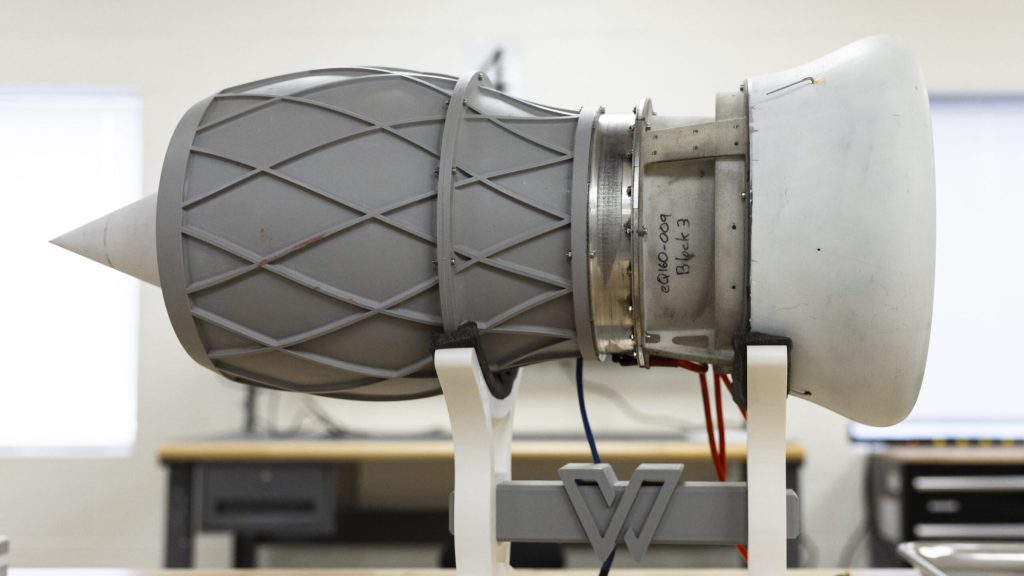
Whisper Aero’s quiet engine technology aims to serve flight first, followed by other potential uses that dial down the noise of air movement.
Rendering courtesy of Whisper Aero; photo by Carlos Jones courtesy of ORNL
In April 2025, Whisper Aero and Tennessee Tech were jointly awarded a $500,000 Transportation Network Growth Opportunity (TNGO) grant by Tennessee Department of Economic and Community Development (TNECD) to advance the development and testing of the Whisper Ultralight, a single-seat powered glider capable of UltraQuiet™ flights.
“This project will help position Tennessee as a leader in mobility innovation and highlights the power of state partnerships in advancing transformative technologies,” said Whisper Aero CEO Mark Moore. By bringing together industry, academia and government, it lays the groundwork for a future where regional flights aboard electrified aircraft are possible from more than 70 airports in the Volunteer State.
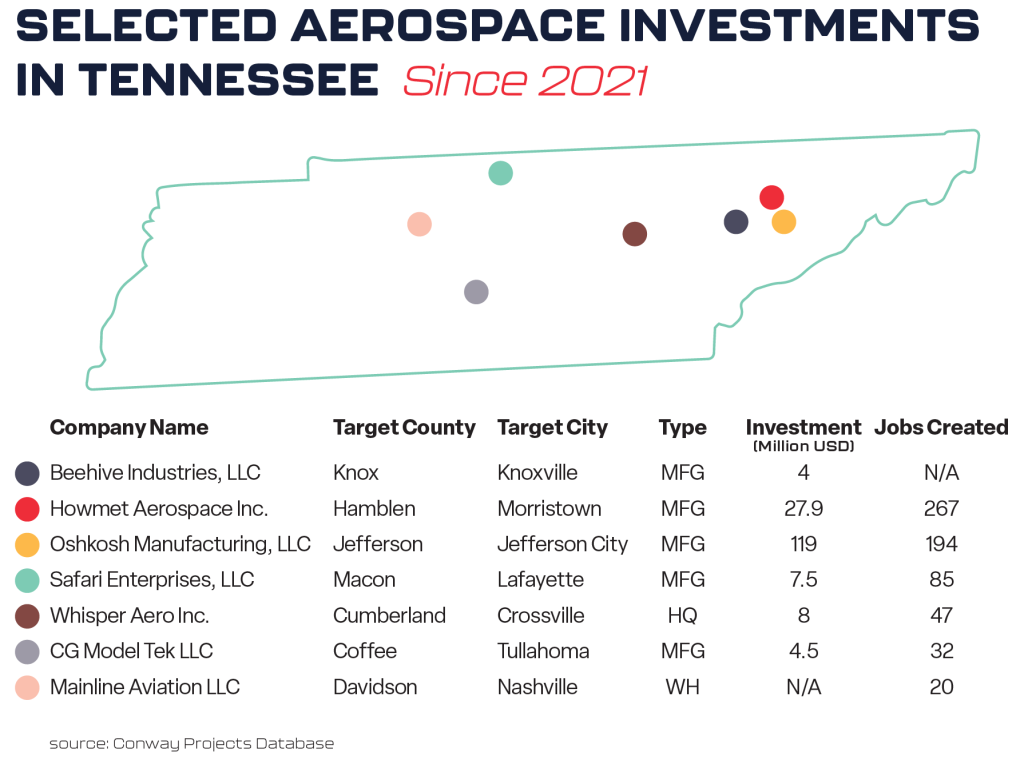
Whisper Aero’s successful partnerships with ORNL, Tennessee Tech and other organizations are emblematic of a successful aerospace/aviation ecosystem that has a long history in the state and is linked to an equally robust heritage in electrical power and propulsion as well as defense.
Since 2019, Tennessee has seen
40% job growth in aerospace and defense
and includes more than
160 companies.
Whisper Aero is partnering with Electric Power Systems (EPS) for battery modules that carry the powered glider as far as 109 miles, with a second battery iteration extending the range to 170 miles. “Two additional technologies that could be tested in subsequent flight test phases are a small micro-turbine that provides range extension to 400 miles or 10 hours of endurance, as well as an embedded propulsor that enables gliding or thermaling with no extra propulsion drag,” Whisper Aero announced last year.
As for military applications, the company was recently selected for Strategic Finance Increase (STRATFI) and Operational Energy Capabilities Improvement Fund (OECIF) funding awards with the support of Intelligence, Surveillance, Reconnaissance and Special Operations Forces Directorate (PEO ISR/SOF), AFLCMC Rapid Sustainment Office (RSO) and Air Force Research Lab (AFRL), among others.
Air Management Sets the Tone
It turns out what propels a retrofitted glider—the eQ160 electric ducted fan propulsor—effectively propels leaves off your driveway too, but with a lot less noisy fanfare.
Hence the spinoff of Tone, Whisper Aero’s outdoor equipment brand, whose T1 Handheld Leaf Blower, which made its debut at the Consumer Electronics Show in January 2026, is taking the world by storm.
The company announced in February a commercial operators’ pilot program for “organizations that require professional performance in environments where noise has a direct impact on the experience,” including resorts and hospitality properties, golf courses, HOAs, universities and professional landscaping teams.
Participants receive priority access to production units when shipments begin in September 2026 and also will be prioritized for initial delivery allocation of Tone’s future Backpack Battery System, designed for longer duty cycles on large properties and shipping in Q2 2027.
It’s not a stretch to predict there will be plenty of organizations in Tennessee ready to pilot Whisper Aero aircraft and blowers, not to mention potential other uses of the company’s engine such as warehouse drones, exhaust fans and cooling fans.
“Whisper Aero was founded on a passion to achieve a quieter world, in the air and on the ground,” said Mark Moore in February, noting that the T1 was the first product to use aerospace-grade technology derived from his years at NASA. “Help us make neighborhoods quieter now,” he told the world, “while we make aircraft quieter in the future.”
Meanwhile, the impact of the company continues to resound across Tennessee’s booming aerospace and defense economy.