Report shows which U.S. metros have the most AI-ready workers.
Artificial intelligence is no longer just the domain of science fiction. AI now permeates every business sector and virtually every facet of life. It knows and studies our eating habits, our TV viewing schedules and our shopping preferences.
But AI is also doing something far more substantive:
It is changing the way companies scour the field for talent.
Thanks to a timely report by The Brookings Institution, companies can know exactly which metro areas now offer the most AI-ready workers in North America. While many of the AI talent mainstays are familiar — places like Chicago, Boston and Silicon Valley — you may be surprised to learn that pockets of AI expertise can be found in unlikely places.
“Geography matters,” says Mark Muro, senior fellow at Brookings Metro. His study measures every U.S. metro on 14 metrics such as talent levels, innovation infrastructure and business adoption to determine the AI readiness of regional economies.

“There is significant dispersion of AI activity into new and different metros across the country. Our report allows for an important new look at where we are on AI.”
— Mark Muro, Senior Fellow, Brookings Metro
Only two places in the country earn the highest ranking: Superstar Metros. They are San Francisco and Silicon Valley. But 28 places earn the next highest status — Star Hubs — because they have uniformly strong AI ecosystems that balance top-tier talent, research and enterprise uptake. These are places like New York City; Boston; Los Angeles; Washington, D.C.; Chicago; Seattle; Austin; San Diego; Dallas-Fort Worth; Philadelphia; Ann Arbor; Houston; Greater Phoenix and Miami.
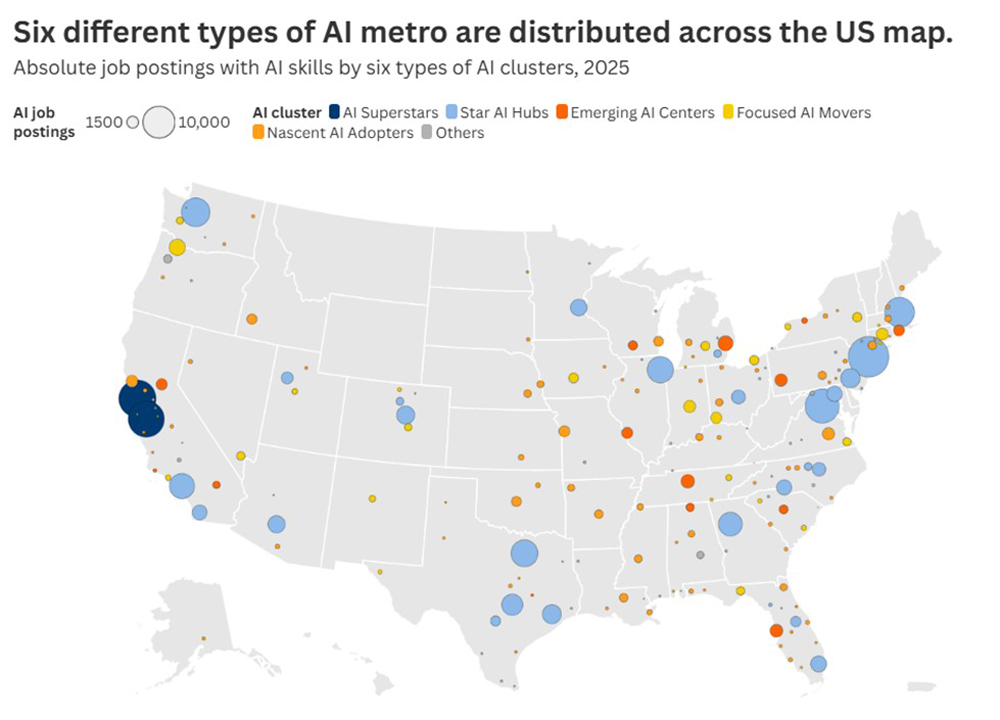
“Key metros in the Sunbelt and the Upper Midwest now matter in the artificial intelligence sector,” says Muro. One reason these cities make the cut is because they are among the earliest adapters to the digital infrastructure needed to power the AI hyperscale computing of the future. Cities like Chicago; Madison, Wisconsin; and Cedar Rapids, Iowa, lead the way. Chicago, for example, ranks as the ninth-largest data center market in the world — and Google recently announced plans to develop a $2 billion data center cluster in Fort Wayne in Allen County, Indiana.
Microsoft is investing more than $3 billion to build out a giant data center complex north of Milwaukee in southeast Wisconsin; and Amazon Web Services just committed to invest $15 billion in northwest Indiana around the small town of Hobart in Lake County along the south shore of Lake Michigan.
Welcome to the AI Surge
What’s driving this surge — and why are so many AI-centric companies suddenly choosing to spend billions in these locations? “There is significant dispersion of AI activity into new and different metros across the country,” notes Muro. “Our report allows for an important new look at where we are on AI.”
While the usual suspects stand out — metros in Northern California and the Eastern Seaboard — Brookings Metro also finds large AI-ready labor pools in Nevada, Utah, Arizona, Colorado, Florida, northern Alabama and southern Wisconsin.
“Artificial intelligence is rapidly transforming the U.S. economy,” the report states. “However, regional capacities for AI talent development, research and enterprise adoption differ dramatically across the country, and policymakers have little insight on where these gaps are emerging. The nation’s readiness to benefit from AI is critical because the technology is going to play a significant role in economic development given its potential to drive innovation and productivity in every industry, both in general and within regions.”
Among other key observations, the report finds:
- A rapidly growing but nascent AI market: Between 2010 and 2025, AI-related job postings grew annually at 28.5%. However, today they comprise just 2.5% of all job openings in the country.
- Extreme concentration: The Bay Area accounts for 13% of all national job postings for positions requiring AI skills. The top 30 metros in the country account for 67% of all AI job listings.
- Signs of geographic diffusion: Several non-coastal metros — Pittsburgh, Detroit, Madison and Huntsville — now rank among the top quartile of cities on at least two pillars, indicating that emerging AI hubs are starting to branch out far from the established tech hubs of North America.
- Persistent opportunity gaps: More than half of all U.S. metros remain in the bottom two readiness tiers, revealing significant shortfalls in their talent pipelines, research infrastructure and enterprise adoption.
Who Has the AI Talent?
Much of this is corroborated by a new Lightcast study titled “AI Places: How to Benchmark and Boost Your Region’s AI Competitiveness.” The state of Washington (4.6%) and metro Washington, D.C. (4.3%), lead the country in share of workers with AI skills, followed by Massachusetts (3.6%). In sheer numbers, California leads the way with over 600,000 workers possessing AI skills. New York ranks No. 2 with over 300,000. Texas is third with 280,000. But many places lag behind.
“For policymakers and workforce agencies, benchmarking against peers is essential to understand your relative strengths and gaps, and to decide which levers to pull to boost local competitiveness,” the Lightcast report states.