
by BRENDAN SULLIVAN, GLOBAL HEAD OF CARGO, INTERNATIONAL AIR TRANSPORT ASSOCIATION
In a world trade picture where the only certainty is everyone’s continuing uncertainty, the ability to use air cargo continues to be a priority for global companies. By special arrangement, Site Selection presents this commentary by International Air Transport Association Global Head of Cargo Brendan Sullivan. The IATA represents some 360 airlines comprising over 80% of global air traffic. — Ed.
When we think of aviation, it’s tempting to picture bustling terminals, and holidaymakers and business travelers jetting off in passenger aircraft that connect cities across continents. Yet, beneath this visible layer, a quieter but equally vital engine powers the global economy: air cargo.
Its influence is felt not only in commerce but also in how goods move, industries adapt and societies respond to crises. But while air cargo matters more than ever to our modern way of life, it is increasingly at the back of the queue for airport slot coordination.
Air cargo is a cornerstone of world trade. Just 1% of global trade by volume travels by air, but it accounts for 35% of the total value. In monetary terms, air cargo moves goods worth around $8 trillion annually — an amount almost twice the GDP of Japan. From aircraft components to medical supplies, semiconductors and luxury items, industries depend on the speed, safety and reliability of air freight to meet tight margins and critical deadlines.
The rise of e-commerce has turbocharged the demand for air cargo. Today’s businesses — whether global conglomerates or small exporters — rely on just-in-time air freight to minimize storage costs and ensure swift market entry. This reliability enables even the smallest players to compete alongside industry giants.

“In monetary terms, air cargo moves goods worth around $8 trillion annually — an amount almost twice the GDP of Japan.”
— Brendan Sullivan, Global Head of Cargo, International Air Transport Association
There’s a vast ecosystem working behind the scenes to orchestrate this rapid movement of high-value goods. These networks ensure that products arrive where and when they’re needed, often under immense time pressure. Moreover, the role of air cargo extends beyond economics; it is also a social lifeline. During disasters, air cargo delivers urgent aid, medical supplies and essentials, underscoring its significance to society.
Airport Slot Coordination: Getting Cargo Its Fair Share
Despite its economic and social contributions, air cargo often faces significant hurdles in airport slot allocation. Many airports, including Bogotá and Dubai, restrict cargo carriers to temporary ad hoc slots rather than granting historic allocations. In China, cargo flights are confined to midnight–6 a.m. operations. Major UK airports like Heathrow and Gatwick also deny historic slots to cargo, limiting their operational flexibility.
Parking restrictions compound the problem. Cargo operators may be limited to shorter parking durations than passenger flights — such as 10 hours versus 12 in Hong Kong — making scheduling more complex. Local regulations, committee voting procedures (which often favor passenger airlines) and additional operational barriers like curfews, separation windows and even outright bans in cities such as Mexico City or Mumbai further hinder cargo access.
Stakeholder influence is arguably the main reason cargo is sidelined in slot allocation decisions, rather than a lack of awareness about its economic value. Passenger airlines, with their frequent schedules and greater visibility, can exert more sway in coordination committees. Infrastructure limitations and local rules also play a role, creating a labyrinthine environment that cargo operators must navigate.
These disparities stem from local regulations, not global guidelines. The IATA Worldwide Airport Slot Guidelines (WASG) calls for fair, non-discriminatory and transparent slot allocation, regardless of the type of operation being flown. Regulators, airport operators and slot coordinators should review and align local rules with WASG principles. Ring-fencing slots for cargo is not the solution — it can lead to inefficiencies and unintended consequences. The focus should be on maximizing airport capacity for all users.
As global commerce evolves and the demand for rapid delivery intensifies, the value of air cargo will only continue to grow. Ensuring that cargo operators have fair access to airport slots is not just about economic efficiency; it’s about meeting the needs of a changing world.
The next time you receive a next-day delivery or see emergency aid arriving in a distant country, remember the quiet giant that makes it possible. Air cargo is more than a backstage player — it’s a driver of opportunity, progress, and global connection.
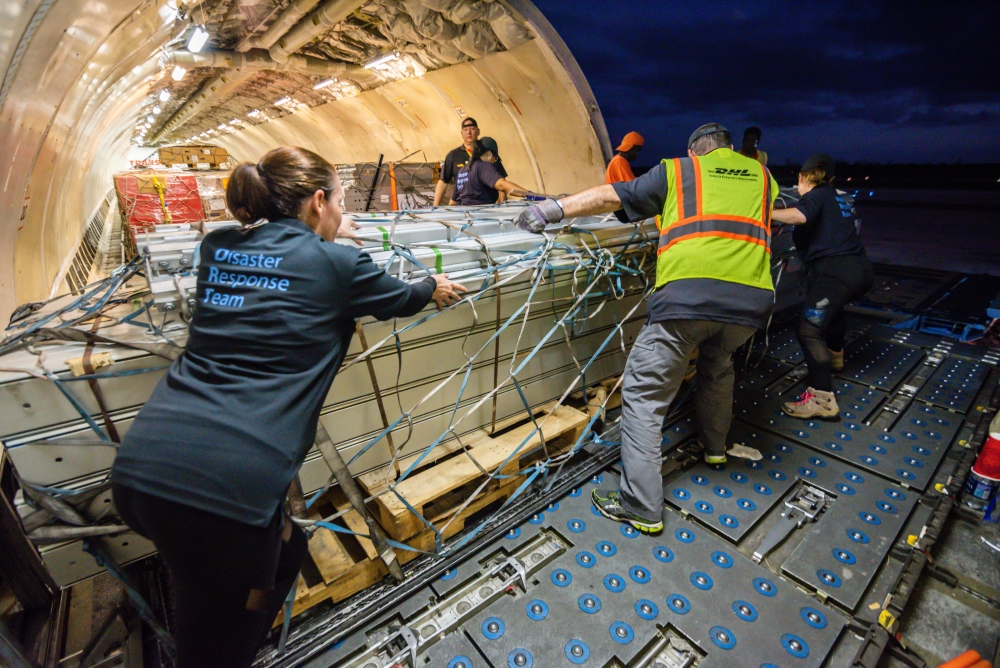
Over 20 years, the DHL GoHelp humanitarian logistics initiative has responded to 77 disasters, moving around 70,000 tons of life-saving aid to places such as this airport in the Bahamas in August 2025.
Photo courtesy of DHL Group
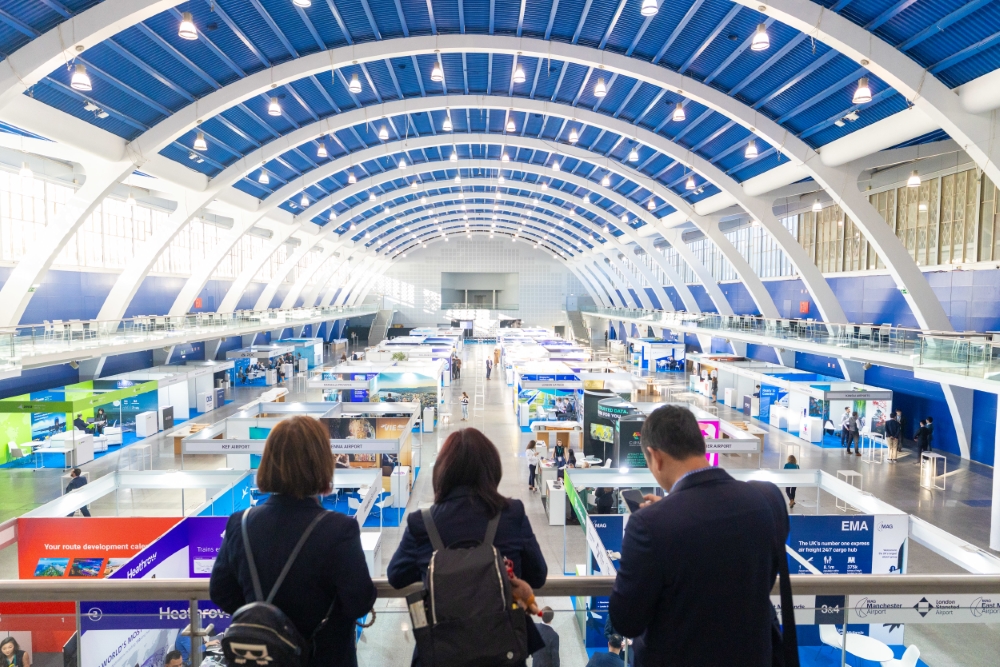
Attendees look over the floor of the International Air Transport Association’s 157th IATA Slots Conference held in Lisbon, Portugal, in November 2025.
Photo courtesy of IATA
SLOTS: ONE QUESTION, ONE ANSWER
Site Selection: Brendan Sullivan’s commentary lists a number of airports with restrictions or hurdles. Walk me through examples of regions where particular manufacturers, airports and business ecosystems have developed workable solutions for slot allocation that are contributing to that region’s economic development.
John Middleton, Head, Worldwide Airport Slots, IATA: Slot allocation is a process for allocating arrival and departure slots at congested airports. The process works through a capacity declaration from the airport which informs the airlines and the independent slot coordinator of which take-off and landing slots are available. The coordinator will then work with the airlines in a transparent and independent process to allocate the slots to airlines based on their preferences as far as possible.
The rules for slot allocation, such as “grandfather rights” and how to fairly allocate new capacity, are set down in the Worldwide Airport Slot Guidelines (WASG). We urge governments to follow the WASG rules so that the process is as globally harmonized as possible.
From a regional perspective, the common WASG framework has allowed regional practices to support growth, competition and economic development:
- Europe has some of the most mature slot allocation systems, all operating under the WASG aligned EU Regulation 95/93. The combination of independent slot coordinators, transparent data processes and consistent use of historic precedence has enabled stable growth in hub development and strong intra regional connectivity. This model has contributed significantly to the economic performance of major hubs such as London Heathrow, Amsterdam, Frankfurt and Madrid.
- Asian States, such as Singapore, Japan, Hong Kong and Australia, apply WASG-based processes that allow coordinated airports to handle rapid traffic growth.
- The Middle East is a good example of Gulf hub (e.g. Dubai, Doha, Abu Dhabi) implementation of the WASG allocation methods to manage very high-intensity operations. This predictability has supported major investments in aircraft fleets, airport infrastructure and related ecosystem development. The region’s success illustrates how a consistent global framework allows airlines, airports and manufacturers to plan long term capacity expansion with confidence.
Occasionally we have some countries that deviate from the WASG rules. This is what has caused problems at Schiphol airport [in Greater Amsterdam] for example, where a decision to suddenly reduce capacity at night disproportionately affected cargo operators as well as some airlines. The decision was challenged in court, and the government restored the capacity, though a threat to capacity at Schiphol remains, which we are actively opposing.
This matters because the stability of the rules on slot capacity — particularly on grandfather rights — are crucial for airlines continuing to invest in new routes and frequencies, which bring the economic benefits of air connectivity. In short, following WASG rules creates the “workable solution” you refer to in your question. It is a fair process to manage limited capacity and balance the interests of established operators — who need the certainty of access to continue to invest — with the needs of new operators to have access and offer competition. — Adam Bruns
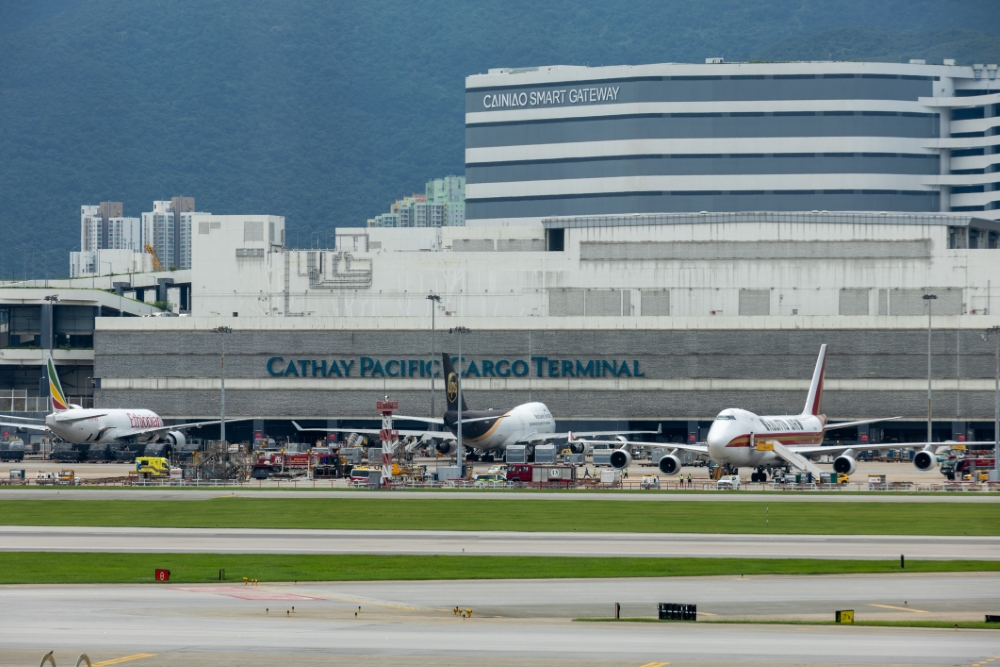
Hong Kong International Airport in February reported that cargo throughput had grown by 2.8% to 5.09 million metric tons on a 12-month rolling basis through January.
Photo by winhorse: Getty Images
CARGO: DATA SHOW ASIA ASCENDING
Full year 2025 data released in January by the International Air Transport Association (IATA) showed global air cargo demand, measured in cargo tonne-kilometers (CTK), achieved a record volume last year, growing by 3.4% over 2024 and 4.2% for international operations.
“2025 trade lane data shows a clear shift in global air cargo flows from Asia–North America to Asia–Europe,” the IATA stated. “Driven by tariff pressures and the removal of the U.S. de minimis exemption. The Within Asia and the Middle East–Asia corridor also recorded strong growth.” The disparity? While North America-Asia air cargo demand fell by 0.8%, Europe-Asia air cargo demand grew by 10.3% while internal Asia demand grew by 10%.
Regional highlights:
- Asia-Pacific airlines saw 8.4% year-on-year demand growth for air cargo in 2025, the strongest among the regions. Capacity increased by 7.4% year-on-year.
- North American carriers saw a 1.3% year-on-year decline in demand growth for air cargo in 2025, the only regional decline and the weakest performance globally. Capacity decreased by 1.1% year-on-year.
- European carriers saw 2.9% year-on-year demand growth for air cargo in 2025. Capacity increased by 3.1% year-on-year.
- Middle Eastern carriers saw 0.3% year-on-year demand growth for air cargo in 2025. Capacity increased by 4.5% year-on-year.
- Latin American and Caribbean carriers saw 2.3% year-on-year demand growth for air cargo in 2025. Capacity increased by 4.5% year-on-year.
- African airlines saw 6% year-on-year demand growth for air cargo in 2025. Capacity increased by 7.8% year-on-year.
There is some parallel with passenger statistics. The World Airport Traffic Report released by Airports Council International (ACI) in September 2025 found that while North America was forecasted to reach 2.1 billion passengers in 2025, Europe was expected to grow by 3.6% to 2.5 billion passengers while the Asia Pacific was projected to grow by 5.6% to 3.6 billion passengers. ACI estimates U.S. commercial service airports will require nearly $175 billion in investment by 2029 to modernize aging facilities, address capacity constraints and keep pace with rising demand.
“Global e-commerce strength drove volumes, even as trading relationships with the U.S. faced rising tariffs, the removal of de minimis tariff exemptions and continuing policy uncertainty,” said IATA Director General Willie Walsh. “Air cargo rose to the occasion. It adapted quickly to support global businesses and supply chains as they front-loaded product deliveries ahead of tariff impositions and adjusted to rising demand within Asia and between Asia and Europe as U.S.-Asia trade stagnated.”
While growth is expected to moderate to 2.4% in 2026, said Walsh, “We can expect that demand will continue to be shaped by trade and geopolitical developments. Whatever trading patterns emerge, we can be confident that reliance on air cargo to keep global supply chains running will remain, with carriers responding to the challenge by deploying capacity and designing their networks for optimum flexibility.” — Adam Bruns

Western Sydney International Airport is slated to open in New South Wales, Australia, by fall 2026.
Terminal photo by Brett Boardman
AEROTROPOLIS: CARGO ON THE HORIZON
OF SYDNEY’S THIRD CITY
From the perspective of the Greater Sydney Commission, most historical infrastructure investment and economic growth has occurred in two distinct areas: the Eastern Harbour City focused on the Sydney CBD and Central River City focused on Parramatta. So, they reason, backed by investment by the commonwealth government in a new airport and aerotropolis concept, it’s time for a third: the Western Parkland City.
“The Aerotropolis will create an innovation precinct and a home for technology, science and creative industries,” the Commission says, “ensuring the Western Parkland City has:
- world class jobs that will sustain prosperity within the region, creating more than 100,000 new job opportunities across the Aerotropolis Core, Badgerys Creek, Northern Gateway and Agribusiness Precincts by 2056 — the biggest jobs boom in NSW’s history
- excellent access and connectivity, provided through public infrastructure
- excellent liveability, where a ‘beyond business as usual’ approach will focus on creating a cooler and greener city.”
Anchored by the new Western Sydney International (Nancy-Bird Walton) Airport, the aerotropolis is envisioned to become “a high-skill jobs hub across aerospace and defense, manufacturing, health care, freight and logistics, agribusiness, education and research,” says the Commission.
The Base Farm Greendale Master Plan proposes up to 1.4 million square meters (15 million sq. ft.) of gross floor area including large-scale warehouse and industrial buildings, the Commission states, “intended to boost supply chain industries to support agribusiness as well as freight movements within the nearby cargo precinct of the new airport.”
That new airport is scheduled to open in October 2026. The cargo precinct, already 90% leased, opens three months earlier. With up to 75,000 sq. m. (more than 807,000 sq. ft.) of warehousing space and backed by AU$805 million in infrastructure investment, the airport says the cargo precinct “will support more than 19,000 supply chain jobs each year.” — Adam Bruns
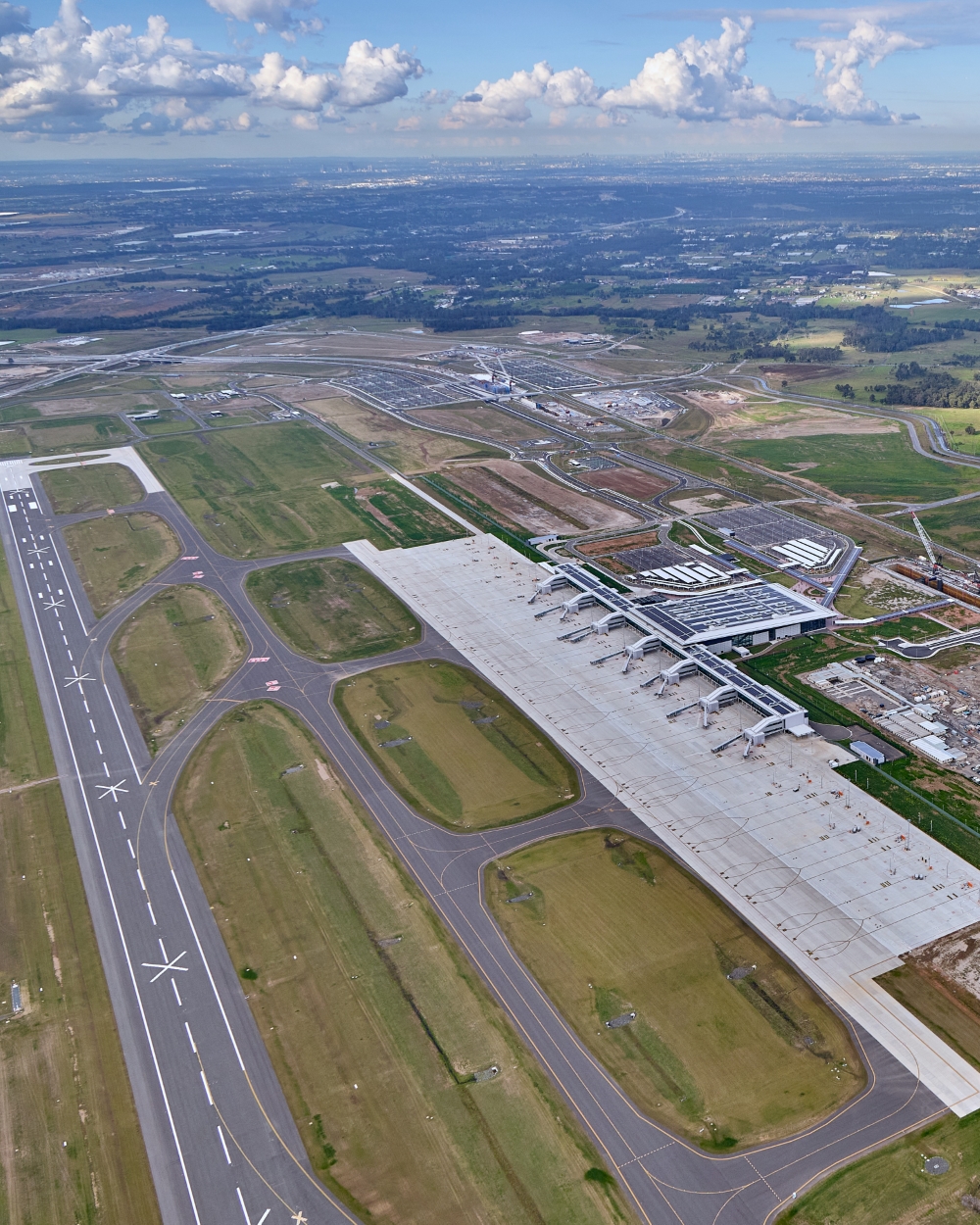
Photo courtesy of Western Sydney International Airpor