

by Arunrat Chumroentaweesup and Kay Khaing Htun, Tractus
In a 2022 Site Selection Magazine article, Tractus observed a major shift from “nice to have” to “critical location factor” in two key elements of capital-intensive projects: access to renewable energy and compliant wastewater treatment. This change reflects more than shifting preferences; it signals a structural shift in the industrial investment screening process.
Across capital-intensive sectors, sustainability is no longer adjacent to competitiveness — it is embedded within it. According to the World Bank’s State and Trends of Carbon Pricing 2023 report, carbon pricing instruments now cover approximately 23% of global greenhouse gas emissions. While most emissions remain outside formal pricing systems, coverage has more than tripled over the past decade.
The World Bank’s carbon pricing report also shows that governments collected about US$53 billion in carbon tax and emissions trading fees in 2020, rising to US$104 billion in 2023 — an increase of roughly 96% in three years. In Europe, the EU’s Carbon Border Adjustment Mechanism (CBAM), which directly links emissions intensity to trade exposure for selected energy-intensive goods, will be fully implemented in 2026. Carbon intensity is becoming a trade variable; thus carbon taxing and trading has finally become a reality rather than a theoretical policy option.
For manufacturers making long-term location decisions, geography has always shaped risk. What’s changed is that carbon pricing, disclosure expectations and climate volatility are making location-based exposures more visible and costly over the life of an investment.
As a result, ESG does not merely influence site selection; it increasingly determines the order of site elimination.
Why ESG Is Now a Business Imperative
The shift in ESG’s importance is reinforced by disclosure requirements. In 2023, the International Financial Reporting Standards (IFRS) Foundation established the International Sustainability Standards Board (ISSB). The ISSB issued its first two standards in 2023. IFRS S1 (General Requirements) covers general requirements for disclosing sustainability-related financial information. IFRS S2 (Climate Related Disclosures) sets specific requirements for climate-related risks and opportunities. These standards establish a global baseline for sustainability- and climate-related financial disclosures.
Under IFRS S2, companies must disclose climate-related transition risks (such as carbon pricing exposure) and physical risks (such as flooding or extreme weather). Because these risks vary by geography, capital markets are paying closer attention to the risk exposure of physical assets. Grid carbon intensity, flood exposure, permitting volatility and regulatory enforcement can differ significantly from one location to another.
For capital-intensive investments, geography therefore influences the climate and regulatory risks that may later need to be disclosed to investors. ESG disclosure standards and carbon pricing mechanisms make those geographic differences more financially visible and reportable than ever.
Southeast Asia is moving in the same direction. Malaysia’s National Sustainability Reporting Framework (NSRF) will phase in ISSB-aligned reporting beginning in 2025. Thailand’s Securities and Exchange Commission has initiated alignment consultations, and Vietnam’s Decree as of June 2022 establishes a greenhouse gas governance framework that lays groundwork for a domestic carbon market.
With the expansion of carbon pricing, converging disclosure standards and intensified climate volatility, an investment’s geography increasingly determines its long-term risk profile.
Investor expectations are evolving in parallel. PwC’s Global Investor Survey 2024 reports that 71% of respondents agree sustainability should be embedded directly into corporate strategy, and 72% agree that management of sustainability-related risks and opportunities influences investment decisions.
Capital markets are increasingly focused on the long-term location-based risks embedded in physical assets, not just ESG commitments. For industrial investors, few decisions lock in long-term carbon, regulatory and climate exposure as permanently as location choice.
Climate, Carbon, and the Geography of Risk
Decarbonization and resource efficiency are no longer abstract commitments. They are
determined by a site’s fundamentals: the grid’s carbon intensity, infrastructure readiness and renewable procurement routes (such as green tariffs, power purchase agreements [PPAs] and renewable energy certificates [RECs]). These characteristics all shape whether a facility supports net-zero goals or carries higher carbon cost exposure as pricing expands.
In many site searches, ESG criteria are treated as Important Location Factors (ILFs) rather than outright deal breakers. Depending on the project’s risk profile and corporate commitments, ESG criteria may function either as Critical Location Factors (CLFs) eliminating non-compliant sites early, or as Important Location Factors (ILFs) that differentiate among technically feasible options. Typical screening questions now include whether a site can credibly support renewable energy targets, what the greenhouse gas
intensity risk profile of the grid looks like, whether there is sufficient wastewater treatment capacity for expansion or meeting local air emission standards, and how exposed a location is to climate risk.
When ESG is addressed early — as a design constraint rather than a compliance checklist
— companies can reduce the likelihood of late-stage redesigns, permitting delays and costly compromises around energy, water, and emissions control. The shift becomes evident when viewed through the lens of real expansion projects.
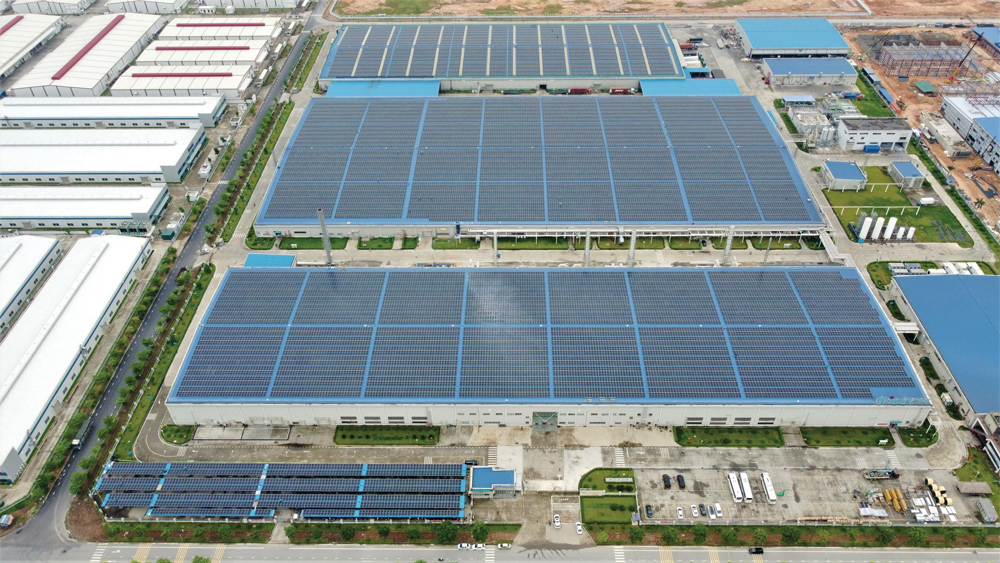
Vietnam’s ESG goals (phase out coal-fired power generation by 2025 and increase solar power and energy storage) influence corporate facility location choice when it comes to climate risk — including choices related to business development opportunities, such as this Trina Solar wafer, cell and module plant in northern Vietnam.
Photo courtesy of Trina Solar
Case Study 1: Renewable Integration as a Critical Location Factor in Vietnam
A global consumer manufacturer evaluated Vietnam for a phased production facility, requiring approximately 56 hectares (138 acres) of contiguous land and long-term expansion capability. The defining ESG constraint was renewable integration; corporate commitments required the site to support large-scale rooftops and ground-mounted solar photovoltaic installations across phased buildouts.
Renewable readiness functioned as a Critical Location Factor. Sites unable to accommodate the required solar footprint, structural load capacity or grid integration flexibility were all eliminated prior to cost modeling.
Flood resilience was evaluated in parallel — certain industrial zones required elevation adjustments to mitigate projected 50-year riverine flood exposure, introducing capital and schedule implications.
ESG requirements were treated as CLFs during screening, eliminating non-viable sites before proceeding with detailed financial comparison.
Case Study 2: Emissions integration and industrial ecosystem depth (Southeast Asia)
A multinational manufacturer in a carbon-intensive segment evaluated more than 1,100 potential industrial zones across multiple Southeast Asian countries for a new production facility. In this case, the defining ESG factor was off-gas management processing. Without viable downstream industrial users, excess gas requires flaring, increasing emissions exposure and potential regulatory risk as environmental standards evolve.
Early-stage screening therefore evaluated the density and technical capacity of
surrounding industrial clusters. Locations with established petrochemical ecosystems and credible downstream users offered integration pathways that reduced long-term emissions volatility.
Evaluation also incorporated regulatory clarity around air emissions, flood exposure within coastal industrial estates, electricity supply redundancy, and provincial enforcement stability.
In this project, ESG operated as a hybrid: Off-taker availability functioned as a CLF during early screening. Emissions exposure and commercial risk were weighted ILFs during detailed comparison.
Risk adjustment did not materially alter the preferred site, confirming emissions integration and regulatory predictability as core operating constraints.
Case Study 3: Energy Pathways, By-Product Utilization, and ESG Risk in a 6-Country Search
An advanced materials producer evaluated six countries — Indonesia, Malaysia, Thailand, Vietnam, Japan and South Korea — for a large-scale industrial processing investment valued at $1 billion. The operating profile involved significant energy consumption, substantial water use and major industrial inputs such as sulfuric acid and caustic soda.
Due to environmental footprint and export orientation, ESG considerations entered the evaluation process during detailed due diligence as weighted Important Location Factors (ILFs). These included renewable energy availability, greenhouse gas intensity exposure, community grievance risk, environmental governance track record, human rights indicators and local ecosystem capacity for absorption and utilization of industrial by-products.
Permitting predictability varied significantly across jurisdictions. In some countries, regulators confirmed compatibility with existing industrial estate environmental approvals. In others, extended Environmental Impact Assessment processes introduced schedule uncertainty. Industrial symbiosis — particularly the ability to identify credible by-product utilizers — further differentiated countries.
In this case, ESG did not eliminate countries outright. Instead, it functioned as a structured, weighted component of the site evaluation model, influencing risk-adjusted rankings and long-term regulatory durability.
Locations with predictable permitting environments and strong industrial ecosystems — particularly those with the ability to utilize by-products — ranked higher after risk adjustment. In contrast, locations with less developed industrial integration or high regulatory uncertainty ranked lower despite comparable cost structures.
As a result, the shortlist reflected not just cost competitiveness, but also capabilities to manage environmental exposure and maintain operational continuity over time.
These projects illustrate how ESG is increasingly shaping country elimination and site differentiation decisions before final investment models are completed.
Regional ESG Comparison for Site Selection
ESG exposure is not uniform across Southeast Asia. Structural variations across disclosure alignment, carbon market development, industrial governance and climate vulnerability all result in varied risk profiles.
| Structural ESG Variable | Thailand | Vietnam | Malaysia |
|---|---|---|---|
| Alignment with ISSB-style disclosure | Roadmap progressing toward alignment | Evolving disclosure framework | NSRF adopts ISSB (IFRS S1/S2) baseline from 2025 |
| Carbon market development | Voluntary carbon market (T-VER); ongoing policy discussions | GHG framework under Decree 06/2022; advancing roadmap | Bursa Carbon Exchange operational; 2026 carbon tax announced |
| Industrial zone governance maturity | Structured in promoted corridors; site-specific variation | Varies by province and developer | Concentrated in established industrial regions |
| Physical climate exposure | Moderate; relative risk lower than Vietnam | Higher flood and typhoon exposure | Moderate exposure |
| Renewable procurement flexibility | Expanding within regulated framework | DPPA mechanism introduced; maturing implementation | Structured corporate renewable options available |
Source: Tractus analysis based on publicly available data from IFRS Foundation, World Bank, Securities Commission Malaysia, Government of Vietnam, and Thailand SEC
For investors comparing markets, these structural variables increasingly influence country elimination and long-term feasibility — not only operational cost.
The Future of ESG in Site Selection
ESG is shifting away from broad commitments and toward measurable, comparable and location-specific realities. With the expansion of carbon pricing, converging disclosure standards and intensified climate volatility, an investment’s geography increasingly determines its long-term risk profile — from energy and water to permitting predictability and climate resilience.
In earlier decades, companies selected sites based solely on cost and managed environmental exposure internally. Today, the question of location has become one of the most powerful sustainability choices an organization makes. Once a facility is built, it inherits the grid’s carbon intensity and renewable procurement options, the locality’s wastewater treatment capacity and regulatory standards, the country’s sustainability disclosure regime and the region’s geographic climate risk. Those attributes are embedded in place.
As more jurisdictions continue to expand carbon pricing and climate disclosure enforcement over the next decade, geographic exposure only becomes more pertinent. For leaders planning new investments, the question is no longer whether ESG matters; it is whether ESG has been embedded in the country screening process prior to locking in capital allocation decisions. The most resilient investments will not be those that simply comply — they will be those that remove long-term exposure at the outset.
Arunrat Chumroentaweesup is the Thailand Consulting Manager and Kay Khaing Htun is a Consultant at Tractus (www.tractus-asia.com), a leading Pan-Asia global site selection firm. Together, they bring more than 17 years of site selection experience across Asia.
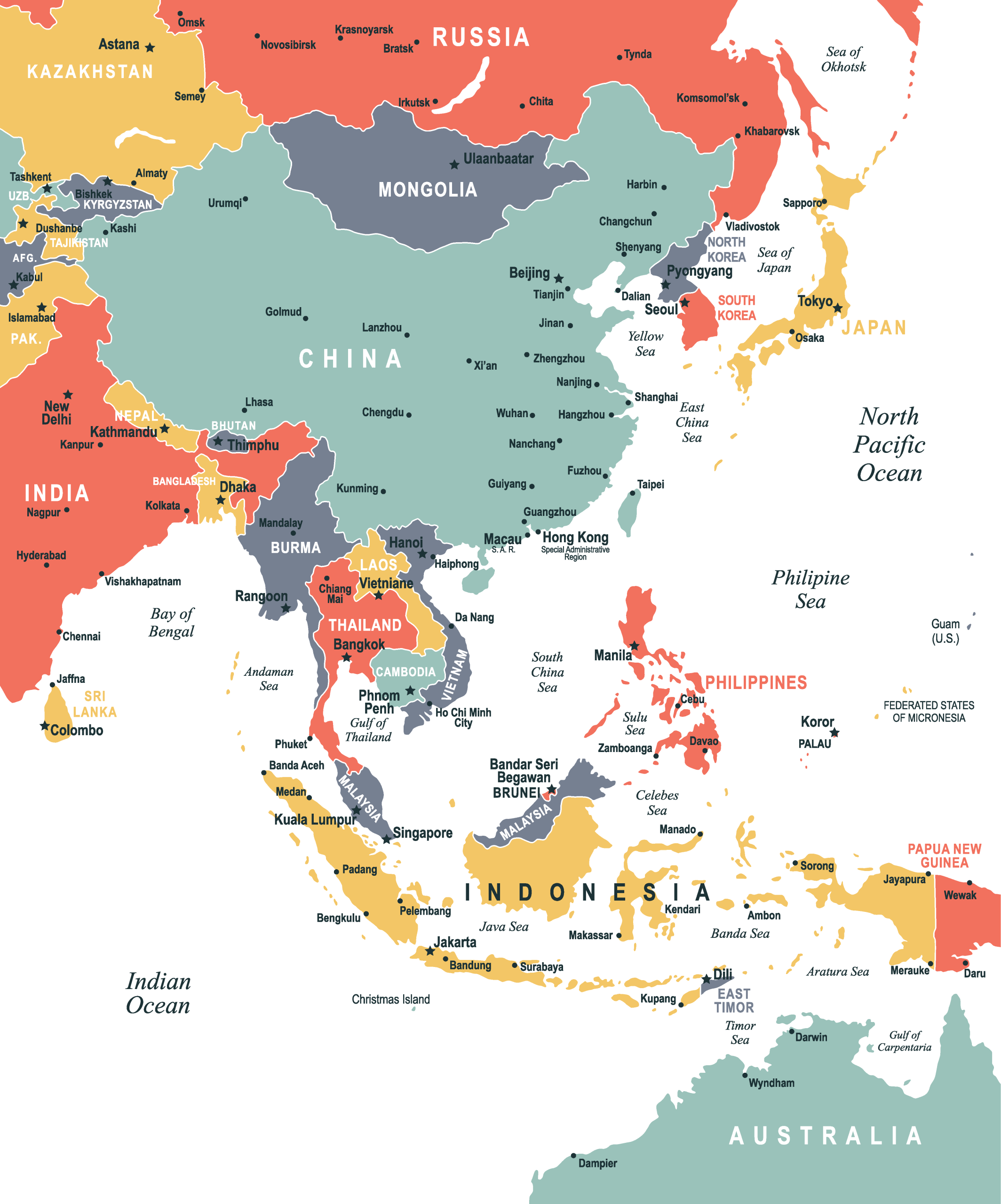
In a recent site selection for a $1 billion project, ESG considerations such as greenhouse gas intensity, community grievance risk and local capacity for absorption and utilization of industrial by-products entered the evaluation process during detailed due diligence as weighted Important Location Factors (ILFs).
Map by pop_jop: Getty Images