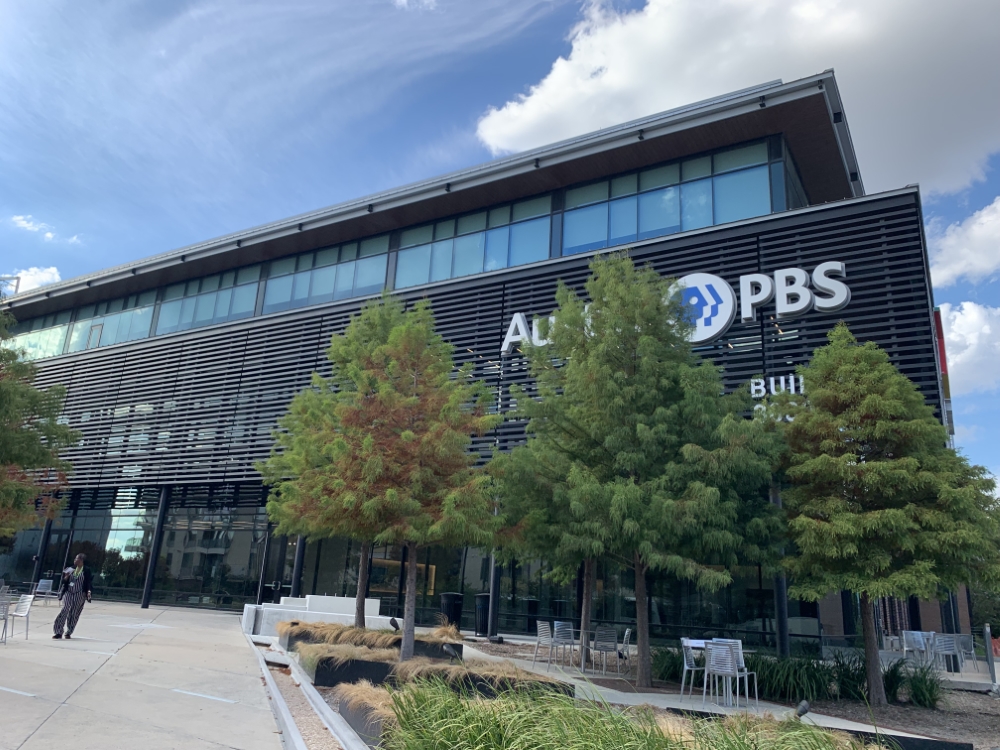
Craving industry engagement with scale? Look no further than Austin Community College.
As malls across the United States face repurposing, redevelopment or outright demolition, Austin, Texas, offers a not-so-academic case study in transforming property from obsolete shops to cutting-edge workforce development that changes lives.
A visit to the Highland Campus of Austin Community College (ACC) in October 2025 revealed a place and a community every bit as impressive as many a university on a parcel that was Highland Mall, Austin’s first indoor shopping mall, until 2015. An official campus grand opening took place in 2022.
In remarks to a group of career and technical education fellows supported by the ECMC Foundation, Dr. Chris Cervini, vice chancellor of community and government affairs for ACC, said, “We took a mall and turned it into 810,000 square feet of educational space.” But that’s only recent history. The other important thing about Highland, he said, was that the land used to be part of the St. John’s African American community.
“Over the years, that land was sold off. When the African American community owned this land, it was the first trade school for orphaned African American students. We met with the St. John’s Regular Baptist Association as we were purchasing the land … we’re proud to return this property to its original educational purpose.”
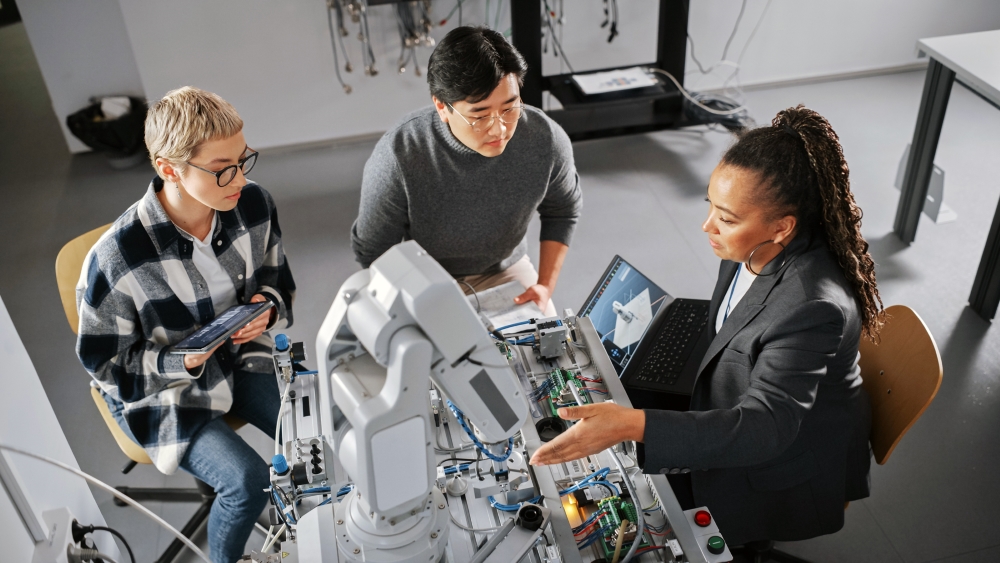
Photo courtesy of NXP
The growth of metro Austin is reflected in the growth of ACC, which serves a 7,000-square-mile area. Enrollment is up by 23% over the past two years. A bond passed in 2022 means the institution will grow from 11 to 13 campuses. “We made tuition free for all high school graduates starting in 2024,” said Cervini, “in an effort to increase student persistence and the intensity of credits they take.”
The north star goal, he said, is to see completion move from 47% today to 70%, based on values of “courage, compassion, joy and ‘yes.’ ”
“We are redesigning and transforming the entire institution,” Cervini said, based on the idea of starting strong, enrolling full time, meeting basic needs of students and offering a culture of belonging and connection. The redesigning comes from front-line staff — no chancellors or vice chancellors involved — because that’s where the best ideas come from, he said.
Programs and Partners
The sense of connection extends to area employers, including Tesla. An advanced manufacturing program initially geared toward high school students has evolved toward entry-level candidates. Offered at two campuses, the program had around 735 students in fall 2025, but the intention is to grow to as many as 2,000 in 2026.
A separate panel on workforce development partnerships held at the Y Texas Summit in College Station in December featured panelists from ACC, NXP and Tesla. “We partner with over 25 school districts at the high school level,” said Karla Mediate, who carries out manufacturing programs recruiting at Tesla. “As we hire for production in these early career roles, we are working with the community college, letting students know we will pay for their certificates in manufacturing.”
A partnership with the U.S. Army began five years ago, specifically with the former Army Futures Command, now reorganized as the Transformation and Training Command
“We call it the Software Factory,” said Laura Lucas, ACC’s senior director of strategic initiatives, at the October presentation. “It started with third-party partners teaching classes. We brought them in house. There are three classes. They learn to build apps. They work in teams and support active-duty soldiers in real time. It’s a unique model and opportunity.”
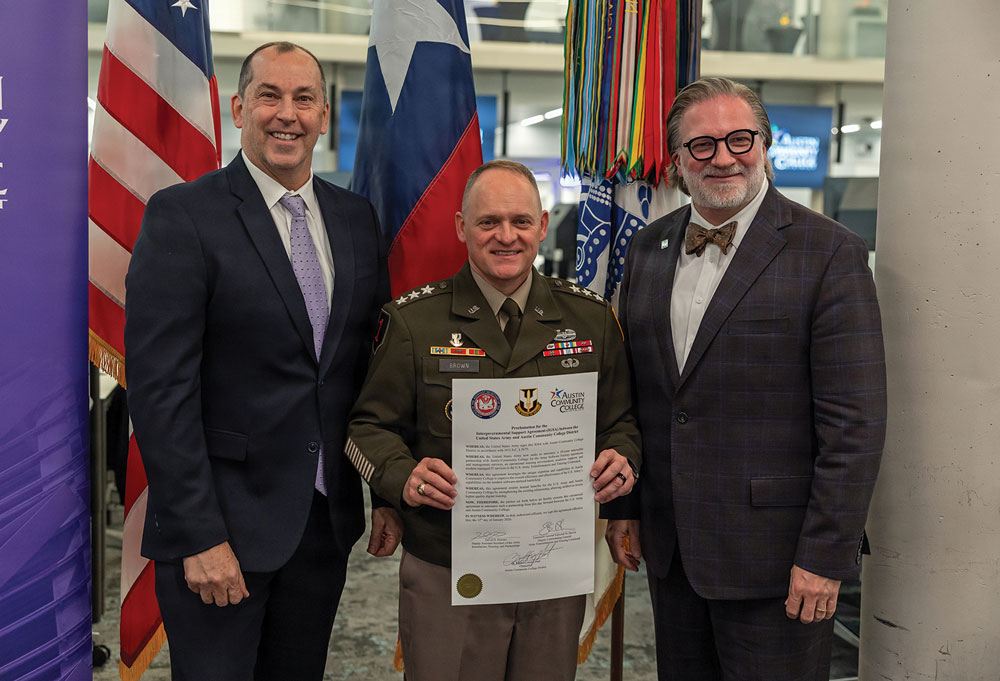
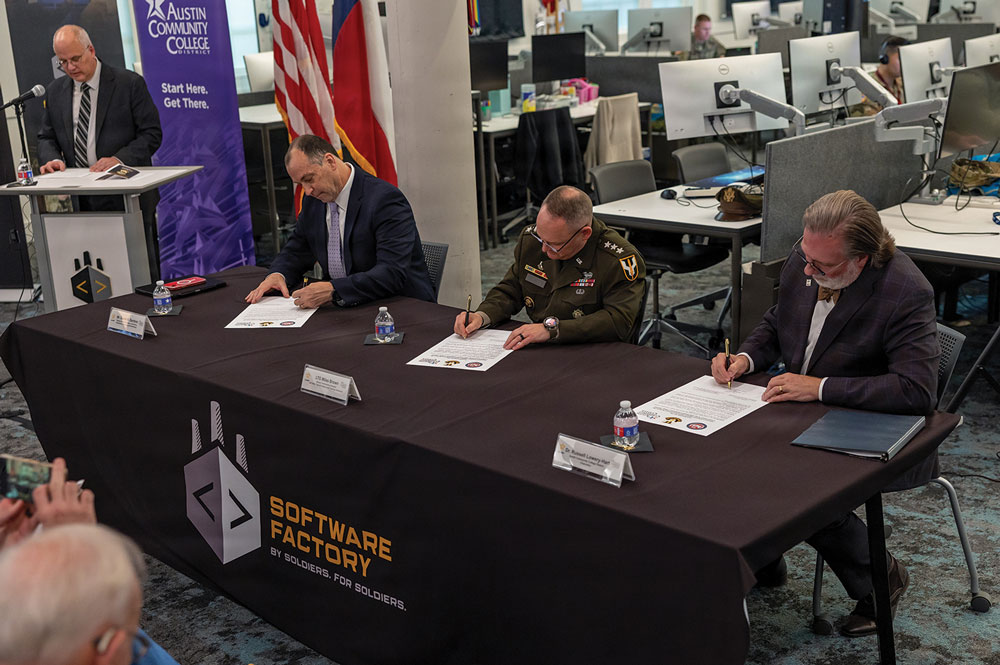
In January 2026 that partnership grew even more solid, as the Army signed a 10-year academic partnership with Austin Community College District, directly fueling what an Army release called “the innovation engine that is the Army Software Factory. This collaboration is more than an agreement; it’s a fusion of academic excellence and military operational necessity. By embedding expertise, the ability to deliver the cutting-edge software soldiers require to dominate the modern battlefield is accelerated.”
Area employers also include semiconductor giants NXP, Samsung, Applied Materials, Sylvania and Tokyo Electron. ACC continues to listen and respond to their needs.
“They had lots of incumbent workers with a skills gap,” Lucas said. “We developed a 4-week program that moves incumbent workers into a technician level. Wages and tuition are paid.” Support comes in part from the Texas Workforce Commission’s Skills Development Fund. The industry, fueled by a federal government focus on boosting domestic chip expertise and manufacturing, is on a high-growth trajectory, including a huge plant being constructed by Samsung in Taylor, Texas. Lucas said the ACC program is well defined, vetted by partners and can ramp up as needed.
“This is a program we recently taught for a cohort of University of Texas undergrad STEM students interested in the semiconductor industry,” she said. “They now layer it onto their undergrad degree at UT-Austin. We are looking for opportunities to scale some of these programs nationally … for other areas that need entry-level manufacturing.”
That’s already happening. Johnnie Cain, operations manager at NXP Semiconductors, told the audience at the panel in College Station that developing the Semiconductor Technician Advanced Rapid Start (STARS) program with ACC, fellow semiconductor companies in the area and the Austin Regional Manufacturing Association (ARMA) was “a foundational game-changer for us,” so much so that as the company has invested in Arizona, it’s brought ACC staff to that state to do the training.
ACC is also a partner, along with Workforce Solutions Capital Area, in the City of Austin’s Infrastructure Academy, readying students in such areas as construction, HVAC, automotive technology, fleet maintenance and repair, and other fields as the booming region has some $25 billion in infrastructure projects on the docket. The institution just graduated the first cohort in that program’s mobility and infrastructure core.
Lucas said lessons learned include being prepared to flex as hiring needs ebb and wane and supporting basic needs. “Anytime we can get students paid, we do it,” she said. Other lessons include the idea of co-creating curriculum with industry partners and what she called “innovate to integrate,” meaning integrating the best of the best non-credit programs into credit programs. Stackability of credentials is fundamental too, she said. “In advanced manufacturing, for example, a student can start with non-credit and finish with the bachelor’s program and now this year we introduced the ability to get into the master’s program at UT-Austin.”
The Student Perspective
A panel of students who spoke included Faiza Hussein, a 30-year marketing and PR veteran who came to the United States in 2024 for work and whose son was enrolled at ACC. “Food has always been my passion,” she said. “I used to dream about the Culinary Arts Institute.” When scouting ACC for her son’s enrollment she saw the school’s impressive culinary arts department, which she called “an amazing setup.” Now she’s working toward a degree in culinary arts with a focus on baking and pastry and is also working in the department.
Automotive tech student Brian Kostman was a high school dropout who decided to write his own comeback story and is almost finished earning his credential. “An associate degree is a step toward your future in case you don’t want to turn wrenches anymore,” he said. “I grew up with less, so giving back is another thing I always wanted to do. I know ACC is starting an EV program. Hopefully I’ll take a year off and come back to that EV program.”
David Hernandez, whose focus is advanced manufacturing, earned his associate degree in spring 2025, is now enrolled in a bachelor’s degree program and works for Tesla and for NXP. “It was that Tesla job, entry level, that really sparked my interest,” he said. “I was amazed at the robotics. Now I’m a part-time hourly employee and tutor in my own department.”
Hernandez initially wanted to go straight into the workforce but is now motivated to pursue an advanced degree. “After becoming an employee of ACC, I started thinking about a master’s and possibly coming back to teach. I can’t see myself leaving ACC. I love it so much. I’m supported here. I love Highland. I was born and raised in Austin … I used to shop here as a child.”
You Can Make It Here
Among the assets on the ACC Highland campus is the Make It Center, a hands-on career exploration experience that welcomes a constant stream of tours even as real work gets done in labs there at the same time. “We’ve put a lot of effort these past few years into more engagement with middle and high schools,” said ACC Dean of Advanced Manufacturing & Engineering Technology Dr. Laura Marmolejo at the Y Texas event. “One of our techs in the lab initially asked, ‘Why are all these middle schools here?’ You need to plant the seed.”
She noted that ACC has two parallel tracks: one academic pathway that moves into a certificate, then applied technology and a move up to the bachelor’s level. It’s a pathway for technicians who want to become leads and managers. The second track is a fast track meant for the working adult that covers fundamentals of terminology of all manufacturing systems and exposes students to electronics.
“We’ve created a mid-skill upskilling curriculum, and we now have high-level technician training,” she explained. “It’s short, broken into chunks and we can support a working adult. It’s a great way to support not just the traditional student. We’re now in partnership with UT to create a center of excellence in semiconductors. We’re working with a couple of colleges in Korea who want to send students to train.
“The future,” she said, “is being open to these new ways of supporting industry and creating pipelines to support these students.”
Leaders from the U.S. Army Transformation and Training Command and Austin Community College District in January signed a 10-year academic partnership that the Army said directly fueled “the innovation engine that is the Army Software Factory.”
U.S. Army photos by Patrick Hunter courtesy of DVIDS