Local leaders in Holly Springs, North Carolina, made the conscious decision 26 years ago to position the community as a home for biotechnology and life sciences. Over two decades later — propelled by billions of dollars in capital project investment — the town has remained true to its vision.
Protection of suitable industrial land, transportation infrastructure, sustained investment into water and sewer capacity and enhanced quality-of-life amenities were among the comprehensive plans and actions that enabled Holly Springs to prepare for future market success. While those preparations were made at the local level, support began to come from county and state leadership to ensure the community was ready for new industry opportunities. Proximity to five Tier-1 research universities didn’t hurt.
That long-term commitment resulted in Holly Springs becoming the nation’s No. 1 biomanufacturing hub in 2025, according to JLL. Today, 840 life sciences companies and a network of 2,500 suppliers have settled into the region, powered by a workforce of over 75,000. In the past five years alone, Holly Springs has announced more than $7 billion in new industry investment, creating 3,500 new jobs with an average salary of $110,000.
“What is often described as an ‘overnight success’ is really the result of more than two decades of disciplined vision and execution,” says Holly Springs Economic Development Director Irena Krstanovic. “By consistently targeting life sciences as a priority industry, we were able to align land-use planning, infrastructure investments and economic development strategies toward a common goal.”
San Francisco-based biotech company Genentech has been constructing a new drug manufacturing plant in town since August 2025. After a national site search, the project marked the company’s first East Coast facility and soon became a significant investment worth doubling down on. In January 2026, Genentech announced an additional $1 billion toward the initial $700 million project, noting the company’s confidence in the community, its workforce, educational institutions and potential long-term growth alongside other top life sciences companies.
“Companies tell us they choose to expand on their initial investments here are because of the confidence built through our working relationships. The Town of Holly Springs works with these companies every week, schedules are discussed up front and when these expansions come, they are not a surprise to us,” says Krstanovic. “We know we deliver what we say we’re going to deliver.”

“This expansion reflects our long-term commitment to the United States and communities like Holly Springs that offer the kind of world-class biotech talent, top research institutions and strong infrastructure that make innovation possible.”
— Ashley Magargee, CEO, Genentech
The fresh funds fall in line with Roche and Genentech’s $50 billion commitment to U.S. manufacturing, expanding upon the duo’s 13 manufacturing sites and 15 R&D sites across 24 states. Genentech’s funding influx allows for additional production capacity and will increase facility output for treatments for metabolic conditions, such as obesity. This expansion creates 100 new jobs to join the previously announced 500 direct roles at the site. Construction will continue until completion in 2029.
Doubling down on operations in Holly Springs is far from uncommon within the life sciences industry, as Genentech follows expansion activity from Johnson & Johnson and Amgen. FUJIFILM’s presence in the region led Johnson & Johnson to invest $2 billion to establish a biopharmaceutical manufacturing facility at the FUJIFILM site in order to expand its domestic manufacturing capacity. Meanwhile, Amgen announced a $1 billion, 370-job expansion of its Holly Springs biologics site in December 2024, citing the role the state’s skilled workforce and forward-looking business climate play in delivering vital medicines.
“What makes Holly Springs truly remarkable is its proven track record as a premier destination for innovation,” says Krstanovic. “The presence of world-class leaders such as CSL Seqirus, Fujifilm Biotechnologies, Amgen and now Genentech is a testament to our town’s infrastructure, talent and unwavering commitment to the life sciences industry.”
Facilities Designed for the Future
Over a month before Eli Lilly and Company completed the rollout of its four new U.S. manufacturing sites the pharmaceutical company initially announced in February 2025, a $6 billion investment landed in Huntsville, Alabama.
It was the final synthetic medicine active pharmaceutical ingredient (API) plant to arrive in the mix in December 2025, as Lilly’s first two API manufacturing facilities went to Richmond, Virginia, and Houston, Texas. (The fourth Lilly project, a $3.5 billion investment, landed in Lehigh Valley, Pennsylvania, in January: See p. 233 of this issue.)
Lilly chose to locate in Huntsville’s Greenbrier South industrial park, partly due to the presence of the HudsonAlpha Institute for Biotechnology in the city. The Institute’s focus on genomics-based research proved to be an attractive asset due to its ability to support research activity and regional workforce training.
“Huntsville was selected from more than 300 applications from over 40 states based on several criteria, including but not limited to workforce potential in the region, local incentives, ready access to utilities and transportation, favorable zoning and environmental factors,” a Lilly spokesperson tells Site Selection.
Construction will begin during the second half of 2026, until facility completion in 2032. Lilly’s strategy to approaching a new facility investment is based on consistent analysis of demand, allowing the company to adjust production to ensure availability of medicines.
The Alabama site will integrate machine learning, artificial intelligence, digitally integrated monitoring systems and advanced data analytics that provide what the company called “right-first-time” execution.
“Our Huntsville site will be a next-generation facility focused on manufacturing APIs for small molecule synthetic and peptide medicines, including orforglipron, reshoring critical capabilities of small molecule chemical synthesis and further strengthening Lilly’s supply chain across therapeutic areas, including cardiometabolic health, oncology, immunology and neuroscience,” says the spokesperson.
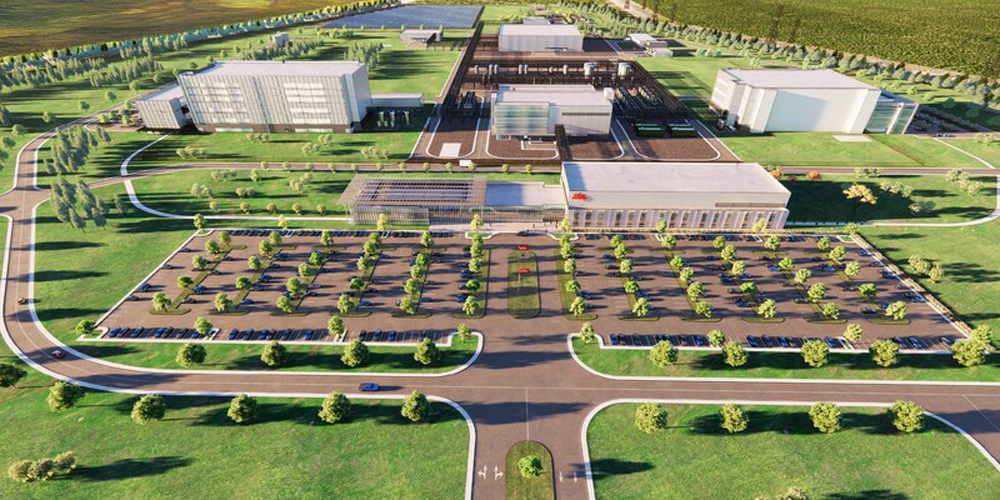
The Huntsville site in Alabama was the final active pharmaceutical ingredient production facility to be announced as part of Lilly’s U.S. expansion.
Rendering courtesy of Eli Lilly and Company
A few weeks after the arrival of the Huntsville investment, Eli Lilly and NVIDIA unveiled they would launch a first-of-its-kind AI Co-Innovation Lab this year in San Francisco. The partnership was cultivated to attempt to address leading challenges currently faced by the pharmaceutical industry, utilizing AI to accelerate future medicine development.
Lilly’s spokesperson says the idea for the collaboration began with direct exchanges between Eli Lilly & Company CEO David Ricks and NVIDIA CEO Jensen Huang, who share the same enthusiasm for AI’s potential in life sciences. These conversations led to a combined $1 billion investment to establish a space to explore robotics and physical AI in the Bay Area.
“The initial goal of the coinnovation lab is to bring together massive compute with dedicated scientific and technical talent to generate novel data, train advanced AI models and apply those models to some of the most complex challenges in drug discovery,” they said.
The decision to locate in the Bay Area was driven by the region’s unmatched convergence of biotech, AI engineering and research talent. It will provide the ideal ecosystem of AI researchers, startups and educational institutions to enable rapid iteration and collaboration, while scaling development of advanced AI models, simulations and physical AI capabilities.
This work will also aid Lilly in scaling future manufacturing capacity and strengthening its supply chain reliability through its AI factory, which deployed at NVIDIA’s Washington, D.C., site last year.
“What is often described as an ‘overnight success’ is really the result of more than two decades of disciplined vision and execution.”
— Irena Krstanovic, Holly Springs Economic Development Director
The co-innovation lab with NVIDIA is unique, according to Lilly’s representative. Several industry forces are converging to make the initiative possible today:
The industry now possesses elite global model-building talent enabled by AI models that didn’t exist a few years ago. AI capabilities have reached an inflection point, with multimodal foundation models, agentic AI, embodied or physical AI and advanced robotics creating new experimental paradigms. And biological discovery increasingly depends on closing the loop between computation and experimentation — something Lilly is well positioned to execute at scale.
Lilly domain experts in biology, science and medicine will co-locate with NVIDIA’s AI model builders and engineers, using NVIDIA’s BioNeMo™ as the critical platform for this work. Lilly will also bring its AI and machine learning platform, Lilly TuneLab, to provide biotech companies with access to select the company’s models for drug discovery. Lilly’s platform is hosted on federated learning infrastructure, enabling the company and its TuneLab partners to use the model to contribute model-enhancing training data without risking the exposure of proprietary data.
“Through this coinnovation effort,” the spokesperson says, “Lilly and NVIDIA aim to generate next-generation foundation models and scientific insights that can be hosted on TuneLab and made available to participating biotechs.”