
The 89th Texas Legislature passed multiple bills aimed at improving the state’s overall business climate by making it easier to do business and grow a business in Texas.
Gov. Greg Abbott championed these measures when he signed them into law at the Texas Capitol. Among them was Senate Bill 29, which codifies the business judgment rule in Texas and reforms derivative claims processes. It also creates a mechanism to pre-assess corporate director independence.
Abbott said the bill “provides business decision-makers the certainty that sound business judgments made in the best interest of shareholders will not be second-guessed by courts. Business decisions are to be made by the elected officers and shareholders, not by unelected judges. These laws will solidify our status as the best state for doing business for many years to come.”
Abbott also signed into law several bills designed to reduce barriers for small businesses. The new laws included House Bill 346, which allows the Texas Secretary of State’s Office to offer expedited business filings so that Texas small businesses can establish themselves quickly. The law also makes the new-veteran-owned business franchise tax exemption and business filing waiver permanent.

“Expanding the R&D tax credit through
SB 2206, both by permanently extending
it and by raising the amount of the credit,
will help Texas compete for emerging
and high-value industries in technology,
semiconductors and biotech.”
— Ray Perryman, President & CEO, The Perryman Group
Other acts included House Bill 2464, which prevents cities from imposing regulations on certain home-based businesses, and Senate Bill 2206, which increases the research and development franchise tax credit up to 11% for qualified research expenses and creates a refundable franchise tax credit.
Ray Perryman, president and CEO of The Perryman Group, an economic research and analysis firm based in Waco, said that many of the bills passed by the Texas Legislature in 2025 have notable implications for economic development in the state. For example, he said, “expanding the R&D tax credit through SB 2206, both by permanently extending it and by raising the amount of the credit, will help Texas compete for emerging and high-value industries in technology, semiconductors and biotech. By offering greater long-term certainty of the credit, the state is in a better position to attract these mobile industries.”

Gov. Greg Abbott holds up a small business bill he signed into law in Fort Worth in 2025.
He adds that “the returns on investments in R&D can be very high, leading to commercialization and spillover benefits across the economy. In essence, the multipliers are high, and Texas is doing very well.”
Reducing Tax Imbalances
Perryman also noted that several bills passed last year aim to reduce tax imbalances. “Texas is heavily reliant on property taxes, and voters approved constitution prohibitions on certain taxes,” he said. “Exempting stock exchanges from certain franchise taxes (SB 1058) will help keep up the state’s momentum in the industry, which has been growing faster in Texas than other states. The new Texas Stock Exchange (TXSE) and major locations by the NYSE and NASDAQ have solidified Texas as a leader in investment banking, and other aspects of financial services are also expanding rapidly. Continuing to emerge as a center for finance will lead to the creation of jobs and business activity and is also an important aspect of continued expansion in business and professional services.”
Senate Bill 7 and House Joint Resolution 7, meanwhile, invest in Texas water infrastructure to ensure the state can meet growing needs for businesses and residents. HJR 7 is a constitutional amendment to dedicate $1 billion annually of the state’s sales and use taxes to the Texas Water Fund and allows the allocation and use of the revenue.
“The importance of adequate supplies of fresh water can hardly be overstated, from both a business and individual perspective,” says Perryman. “Setting aside funds to support water projects ranging from new sources of supply to conservation is fundamentally crucial to future economic growth, not to mention quality of life. Even $20 billion over 20 years [assuming fiscal milestones are met] is not close to sufficient to resolve water issues [one credible estimate is $152 billion], but it helps to support private initiatives and serve as a catalyst for addressing the situation.”
Perryman gave the Legislature high marks for its efforts. “On the whole, the Texas Legislature made notable strides in helping the state to maintain its undisputed position as the leader for major corporate locations and expansions. New activity is key to ongoing economic expansion, generating opportunities for individuals and businesses alike. Much like other states, growth has recently slowed temporarily, but Texas has the resources and advantages to secure long-term prosperity. Water, power, infrastructure and education investment will be required to support ongoing expansion, along with an effective business climate. The recent Legislative Session brought positive strides on multiple fronts.”
HJR 1/HB 9 increases
the business personal property
tax exemption from $2,500 to
$125,000, an almost 5,000%
increase.
Ensuring Judicial Fair Treatment
The Texas Legislature also passed House Bill 40, which expands the jurisdictional and operational framework of the Texas Business Courts, which Perryman says have been doing yeoman’s work. “The Texas Business Courts are a notable advance, offering a time- and cost-effective mechanism to resolve business disputes,” he says. “By reducing the burden of certain types of torts, businesses can invest in more productive ways. I was an expert witness in one of the first trials, and the process was very efficient.”
Creating more avenues for regulatory efficiency was a theme throughout the 2025 Texas Legislative Session. Senate Bill 14 created the Texas Regulatory Efficiency Office to find and eliminate unnecessary regulations in state agencies and to create best practices for reducing regulatory strains on Texans and Texas businesses.
Another recurring theme was alleviating the overall tax burden on both individuals and companies in Texas. House Joint Resolution 1/House Bill 9 increased the business personal property tax exemption from $2,500 to $125,000, an almost 5,000% increase, while House Joint Resolution 4 approved a constitutional amendment to permanently ban two types of taxes in Texas: a tax on financial transactions, such as stock trades, and a general occupation tax imposed on individuals for working in a licensed profession.
Jay Garner, founder and president of Atlanta-based Garner Economics and chair of the Site Selectors Guild, said of the new bills that “they appear to be great. Texas continues to set the bar in state competitiveness and this legislative summary confirms just that.”
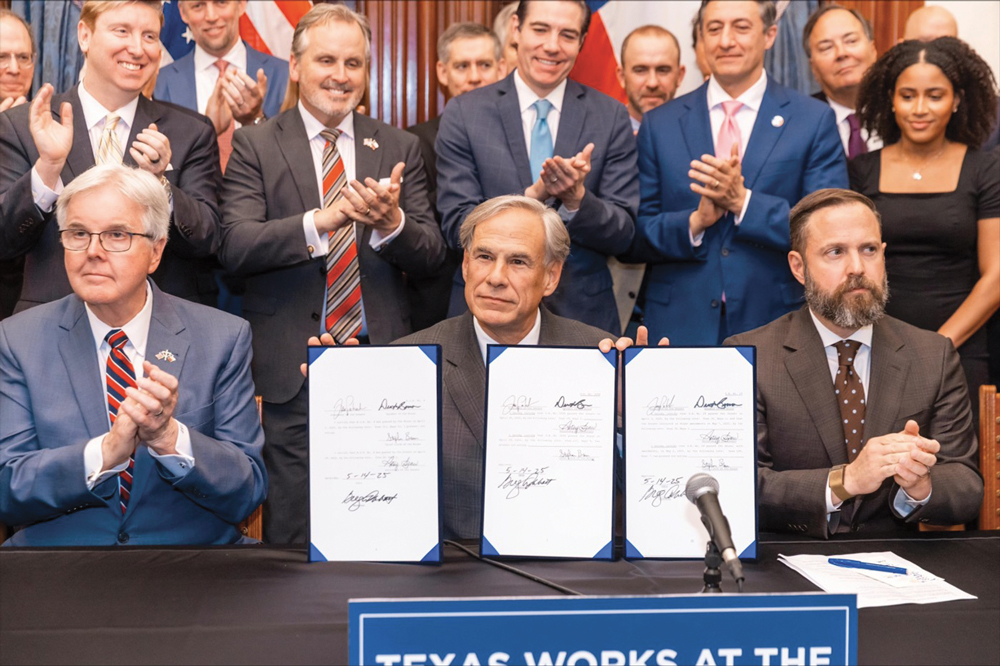
Gov. Greg Abbott holds up three pro-business bills that he signed into law at the Texas State Capitol.