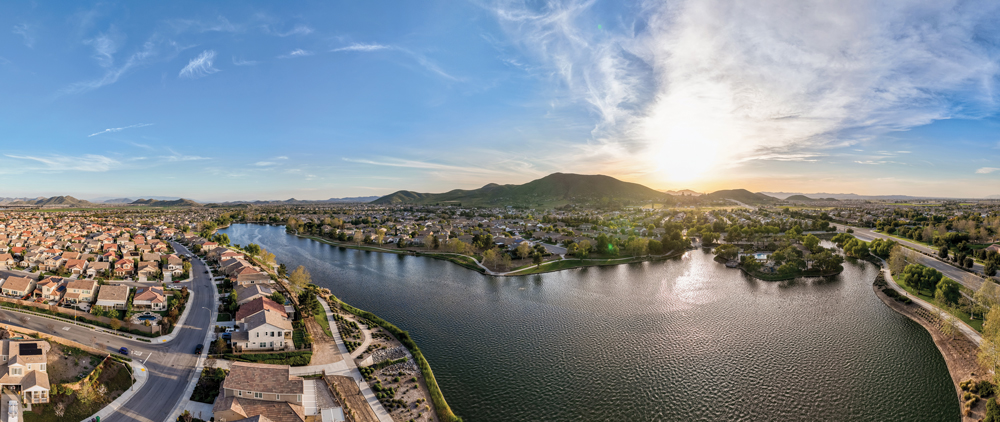
As coastal prices skyrocket, inland communities cash in their golden ticket: affordability.
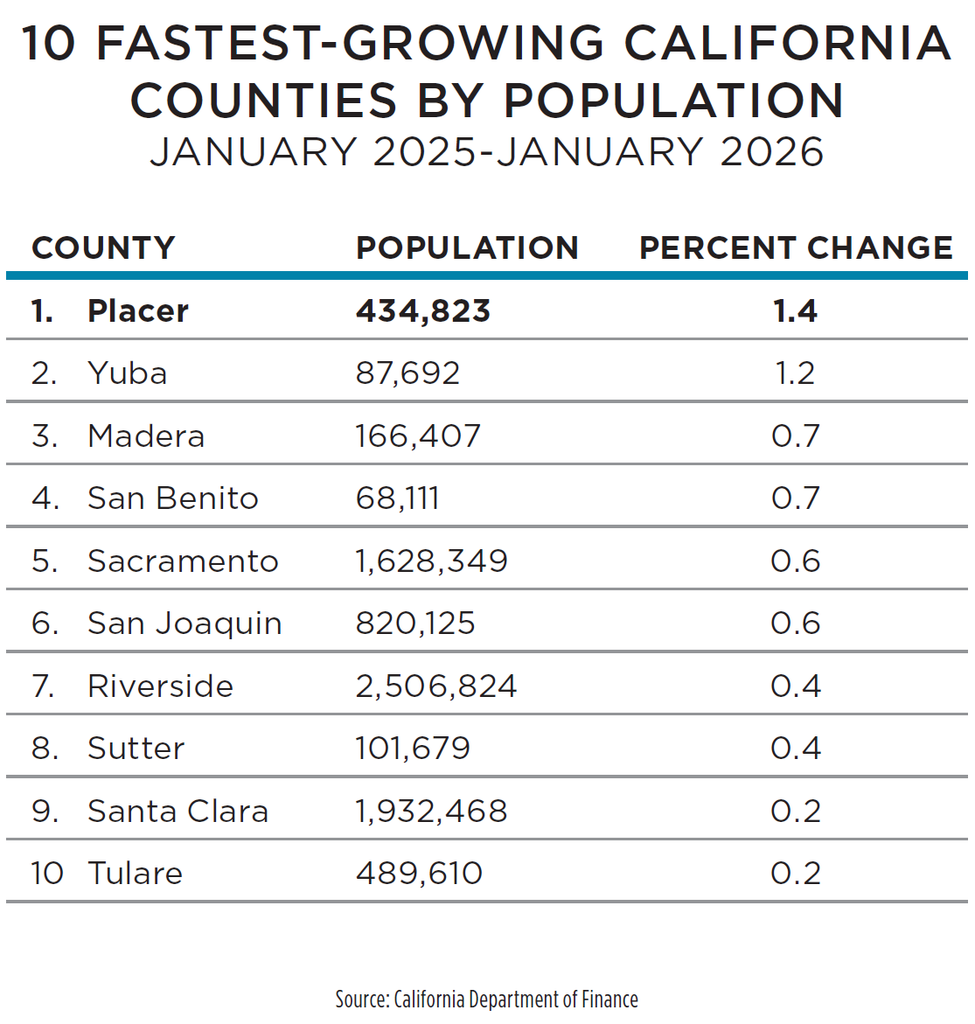
Looking for the next California boomtown? We’ve already found it. It’s anywhere not on the coast. According to the latest figures from the California Department of Finance, the state’s 10 fastest-growing counties are located in inland areas; and this eastward migration is set to continue for some time.
Led by Placer County’s 1.4% population growth from January 2025 to January 2026, inland counties in Northern and Central California lead the charge. Right behind Placer are Yuba County at 1.2% and Madera County at 0.7%.
These findings mirror a recent report by SmartAsset showing four California cities ranking among the Top 75 Boomtowns in America: Menifee (65), Rancho Cordova (70), Santa Clara (72) and Sunnyvale (75). Cities were scored across three growth metrics: 5-year labor force change; 5-year housing unit change; and county-level compound annual real GDP growth.
“Over the past decade, one of the most prominent demographic trends nationally has been the increase in the number of people leaving larger, high-cost metro areas,” says senior demographic researcher Hamilton Lombard of the Weldon Cooper Center for Public Service at the University of Virginia. “This trend has been particularly notable in Los Angeles, San Diego and San Francisco.”
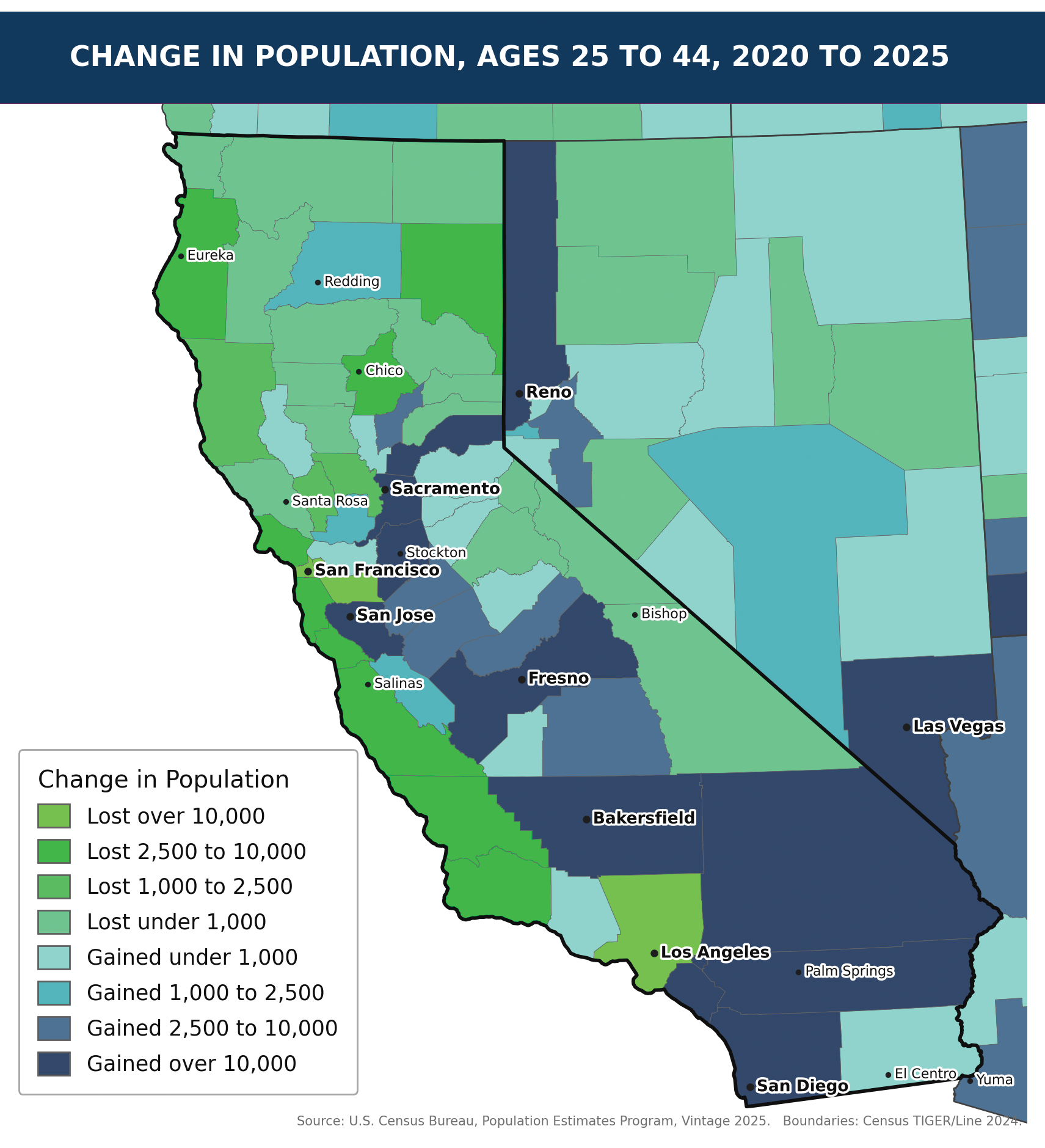
This map shows where 25-to-44-year-olds are increasing in the greatest numbers in California. Counties in dark blue are growing the fastest among this cohort.
Source: Weldon Cooper Center for Public Service, University of Virginia
These three metro areas have lost nearly 700,000 residents since 2020, says Lombard. “The residents leaving these metro areas were disproportionately older adults moving to lower-cost parts of the country,” he notes. “Over three-fifths of residents that California lost due to migration were over age 50.”
A report just published by the nonpartisan California Policy Lab (CPL) at UC Berkeley reveals why: Homeowners and renters are getting priced out of coastal communities.
“The Bay Area continues to offer tremendous economic opportunity, but it’s also the most expensive metro in the country,” says co-author Evan White, executive director of the CPL. “Our research shows many residents are achieving affordable homeownership elsewhere, but often at the cost of lower incomes, lower-performing schools or greater climate risk.”
The study’s key finding: Those who left the Bay Area moved to areas with home values that are 50% lower and rents that are 33% lower, on average.
Cashing in Chips in Roseville
However, as with most demographic shifts, where there are losers, there are winners. Inland California cities such as Elk Grove, Lathrop, Menifee, Mountain House, Roseville, Sacramento and Stockton aren’t just gaining people. They’re cleaning up.
As California residents vote with their pocketbooks and moving vans to shelter in these rapidly growing, more affordable inland areas, this migration sends a clarion call to employers to follow suit — and boy, are they doing just that.
Santa Clara, San Bernardino and Sacramento counties now rank as top 10 locations for corporate facility projects in California. Over the past 18 months, these three counties accounted for 136 new or expanded corporate real estate investments, per the Conway Projects Database of Site Selection magazine and Conway Data, Inc. That amounts to 22% of the 625 projects tallied statewide.
Riverside County tallied 15 projects while San Joaquin County landed 14. Both rank in the top 15 counties in the state for projects. So does Fresno County with eight.
One of California’s biggest wins of 2026 came on July 13 when Bosch, the world’s largest automotive supplier, announced it would proceed with its planned $2 billion investment to transform its site in Roseville in Placer County for the mass production of silicon carbide semiconductors because it was approved for a large CHIPS Fund grant.
“We are now the big dog in town. We are now the largest city in the region; and all of this has happened very quickly.”
— Kayla Charters, Economic Development Director, City of Menifee
Melissa Anguiano, economic development director for Roseville, calls the deal by the German conglomerate a game-changer for her city of 165,455 people. “This deal was dependent on Bosch securing a $225 million agreement with the U.S. Department of Commerce for CHIPS funding and another $25 million in California Competes Tax Credits,” she says. “They were working on that for the last couple of years. For Roseville, this is a tremendous boost to our economy. Bosch retained 250 jobs when they acquired this site from TSI three years ago. With this expansion, they will increase employment. This is a significant investment in our city and will be a catalyst for attracting other businesses.”
Asked what enabled Roseville to beat out other locations, Anguiano says, “Having the facility already built and a workforce on site made this location desirable from a timeline and cost standpoint. When you couple that with a full-service city that owns and operates all utilities and offers very competitive rates, Roseville checked every box.”
No direct city or county incentives were awarded to Bosch, she adds. “We did do a GF5 electric utility rate, which is an economic development rate that we offer to all large power users,” she says. “That assumes they meet a certain load factor. We are already known as an affordable utility provider. We charge 40% below the Pacific Gas & Electric Company rate in California.”
Located 20 miles north of Sacramento on Interstate 80, Roseville is at the midpoint between San Francisco and Lake Tahoe. With reasonable commute times to UC Davis, UC Berkeley, Stanford and Palo Alto, Roseville sits in the sweet spot for industrial users.
Sacramento Nabs Peak Approval
So does Sacramento, the state capital and fastest-growing large city in California. In early July, Peak Energy selected 538,753-resident Sacramento for the firm’s first U.S. manufacturing plant for grid-scale, sodium-ion energy storage systems. The $71 million capital investment into an existing 183,000-sq.-ft. facility is expected to produce up to 4 GWh of battery systems per year — enough to power 4 million homes — and generate 239 new jobs paying an average annual wage of more than $90,000.
Edward McGlone, vice president of government affairs for Peak, says grid batteries are being driven by demand for power from AI and data centers. “It is a lot like traffic congestion,” he tells Site Selection. “We are focused on a sodium-ion battery chemistry to lower costs and increase efficiency. It looks similar to lithium, but sodium is more stable and has less supply-chain risk. It enables a significant advancement in energy storage.”
McGlone says California’s commitment to renewable energy drives corporate site selection in this field today. “This is one of the fastest-growing battery markets,” he says. “We have the talent to grow the business and the market to embrace it.”
He says the new plant became necessary when Peak outgrew its existing facility at its headquarters in Burlingame across the bay in San Mateo County. “We needed to invest directly in manufacturing and that led us to Sacramento,” he says. “We wanted the ability to stay close to home, which meant being able to have our engineers drive to the production line and back the same day. That’s critically important in the first phase of manufacturing. Locating in Sacramento enables us to get up and running in 18 months or less.”
Beyond that, says McGlone, Peak needs to hire a highly skilled workforce. “We met with the Greater Sacramento Economic Council very early on,” he says. “We did intense site selection work for over a year. Having state policymakers on our front door is a plus. With outstanding community colleges for worker training and an outstanding workforce in the region, we found the perfect home in Sacramento.”
McGlone says Peak visited at least five other sites before choosing Sacramento’s Metro Air Park just off I-5. “We looked at sites in the Southeast U.S., but we wanted to be close to home,” he says. “Shipping is expensive, and our two largest markets are California and Texas. It came down to Texas and California. We chose California.”
GSEC worked overtime to seal the deal, he adds. “ ‘Committed’ is the word I would use to describe them,” he says of GSEC. “[President and CEO] Barry Broome and his team were in constant communication with us.”
McGlone also credits a case manager at the California Governor’s Office of Business and Economic Development (GO-Biz) with assisting Peak in securing a $10.5 million California Competes Tax Credit earlier this year. Partnerships with General Motors and the Sacramento Municipal Utility District also aided in getting the deal done.
Production at the new Peak facility in Sacramento is expected to begin in early 2027. According to the International Energy Agency, global battery energy storage system (BESS) installations increased more than 20-fold in storage capacity over the past five years. Polaris Market Research reports that the global BESS market size was valued at $103.8 billion in 2025 and is projected to grow at a CAGR of 26.8% from 2026 to 2034.
Menifee: The Boom Is Just Beginning
Perhaps no city in California better exemplifies what it means to be a boomtown than Menifee in southwestern Riverside County. Located about an hour north of San Diego on the edge of Southern California wine country, Menifee is rewriting the rules of development for mid-sized cities in a region known for sun, sand and sprawl.
Menifee has grown from 102,527 people in 2020 to 121,943 today — a 19% rise. Menifee made the SmartAsset list of Top 75 Boomtowns because of three factors: a 29% increase in housing units over five years; a 45% surge in the local workforce; and compound annual real GDP growth of 2.4%.
“We are now the big dog in town,” says Kayla Charters, Economic Development Director for the City of Menifee. “We have passed Temecula and Murrieta in population. We are now the largest city in the region; and all of this has happened very quickly.”
Multiple factors drive residents and companies to Menifee. “We have this perfect recipe for high quality of life,” says Charters. “A lot of our community is brand-new with perfectly manicured landscaping. Our housing prices are still relatively attainable. Average home prices here are in the mid-500s. We were also recognized recently as one of the Top 20 Safest Cities in California for the third year in a row.”
With 25 new housing tracts underway and 7.8% population growth projected by 2028, Menifee now ranks No. 2 in the state for high-income growth. The number of families earning over $200,000 per year in Menifee has grown by over 85% in the past year.
Because of this growth, industrial users and not just retail outlets are chasing the numbers.
Gordon Mize, senior vice president and managing partner of Lee & Associates in Murrieta, says growth in the Inland Empire is trending east to Palm Springs and south to Menifee.
“It’s been coming here for many years,” he says. “The I-215 cuts right through Menifee from San Diego. They have more available land in Menifee than what you’ll find in many cities in Southern California. Temecula and Murrieta are incredible cities, but they don’t have large tracts of available land. Lake Elsinore doesn’t have a lot of land available either in this part of southwestern Riverside County.”
Mize adds that “Menifee provides a great base for blue-collar workers. People can move here, find a good job and buy a nice house. The value of land is much less than in Orange County. It is a value-add to buy land and build here.”
Mize says he’s seeing industrial tenants looking for spaces under 50,000 sq. ft. in Menifee while searching for larger big-box facilities in Perris to the north. “We have some absorption that we need to finalize,” he says. “There will be another 12 to 18 months of absorption before we can focus on new product and get back to market rates.”
He says the hot industrial markets in the Inland Empire are Fontana, Ontario and Hesperia to the north in San Bernardino County. “I see a lot of companies going north from San Diego and moving south from Corona. Pricing for space is much higher in both of those markets. Better lease rates and sale prices can be had in the Inland Empire. You can also buy a reasonable house and not have a bad commute here.”
Charters concurs. “We have 1.3 million square feet of new commercial real estate development in the pipeline in Menifee right now,” she says. “If you’re going to move from San Diego or Orange County, we’re right off the 215 Freeway. At 46 square miles, we are a fairly large city. We have the space.”
Lathrop: Central Valley’s Hot Market
So does Lathrop, located 10 miles south of Stockton in San Joaquin County. According to the California Department of Finance, Lathrop ranks No. 2 in growth in the state. Growing at 5.6% in population from 2025 to 2026, Lathrop now has 40,942 people and trails only Mountain House in growth in California.
“I’ve been in south San Joaquin County for a long time,” says Barbara Harb, economic development administrator for the City of Lathrop. “The cities of Lathrop, Tracy and Mountain House are the value opportunity for people in the East Bay Area. They can create a better quality of life more affordably here. We offer amenities, open space and a great ecosystem for growth.”
Effective planning enabled Lathrop to position itself for industrial growth, says Harb. “We prioritize all core infrastructure elements. Lathrop has available land in the Central Valley. We did a really good job of master planning. If you meet the planning requirements here, you can get your project approved. It can be that easy.”
For example, a 5,000-acre development known as River Islands will eventually have 15,000 homes in Lathrop, says Harb. “They have lakes, amenities and thousands of acres,” she says. “It is just stunning.”
Lathrop’s claim to fame is the Tesla Megapack Factory, one of the largest utility-scale battery factories in the world. It produces 200 megapacks a week and is so profitable that Tesla built a similar plant in Texas.
Tesla’s Lathrop installation is so vast that it is seeking its own Foreign Trade Zone status. Covering more than 1 million sq. ft., the plant employs more than 1,000 workers.
Lathrop has one of the highest concentrations of manufacturing employment in the state, as 11.8% of the city’s workforce is employed in manufacturing, second only to transportation and warehousing (12.4%).
Lathrop’s population has grown by 52.5% since 2020, yet the city still has ample available land for development, says Harb. “Lathrop has ranked among the three fastest-growing cities in California for the past five years; and we’re also growing in productivity,” she notes. “With Interstate 5 running north and south through the city and Highway 120 running east to Yosemite, everything runs through Lathrop.”