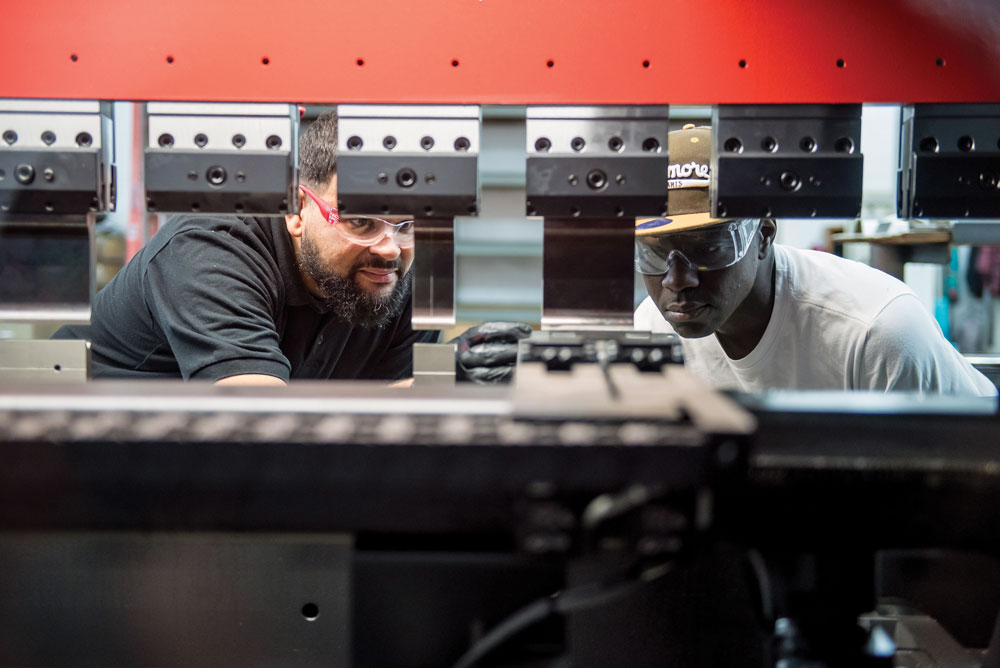
Outdoor lighting design and manufacturing firm Penn Globe, based in New Haven, Connecticut, since the 1870s, has provided light for places as diverse as Harvard, corporate campuses and Main Street at Disney, living by the motto “Lighting for the Greater Good.” Nothing embodies that mission more than the company’s pioneering Manufacturing and Technical Community Hub (MATCH), a bilingual, inclusive, nonprofit training program in a repurposed warehouse in Fair Haven that helps light the way to a future.
MATCH manufactures its own branded LED industrial task lights and offers contract manufacturing services. Its aim is to create a skilled work force that knows how to make things — whether for Penn Globe or other fortunate employers. Along the way it has the potential to not only boost livelihoods but transform lives. Talking to Penn Globe CEO and MATCH Board Chair Marcia LaFemina, her husband David Feinberg (executive director of MATCH) or individuals who have gone through the program is, in a word, illuminating.
“We have taken a common-sense approach to workforce development which has turned out to be both unique and effective,” says LaFemina.
Penn Globe says MATCH provides contract manufacturing services as a vehicle for commercially relevant manufacturing job training and paid manufacturing experience. “As an inclusive and predominantly self-funded public-private non-profit manufacturing facility, MATCH coordinates comprehensive training, mentorship, wrap-around support and jobs to the New Haven community,” the company says. “Operating as a revenue-driven contract manufacturer to support other local manufacturing companies, students and team members learn relevant manufacturing skills, machinery and concepts while also being exposed to business and entrepreneurial opportunities. Re-invested proceeds from contract manufactured items as well as sales of finished goods to national firms provides revenue to support the diversity of the community, to offer flex-schedule training, job placement and community support services.”
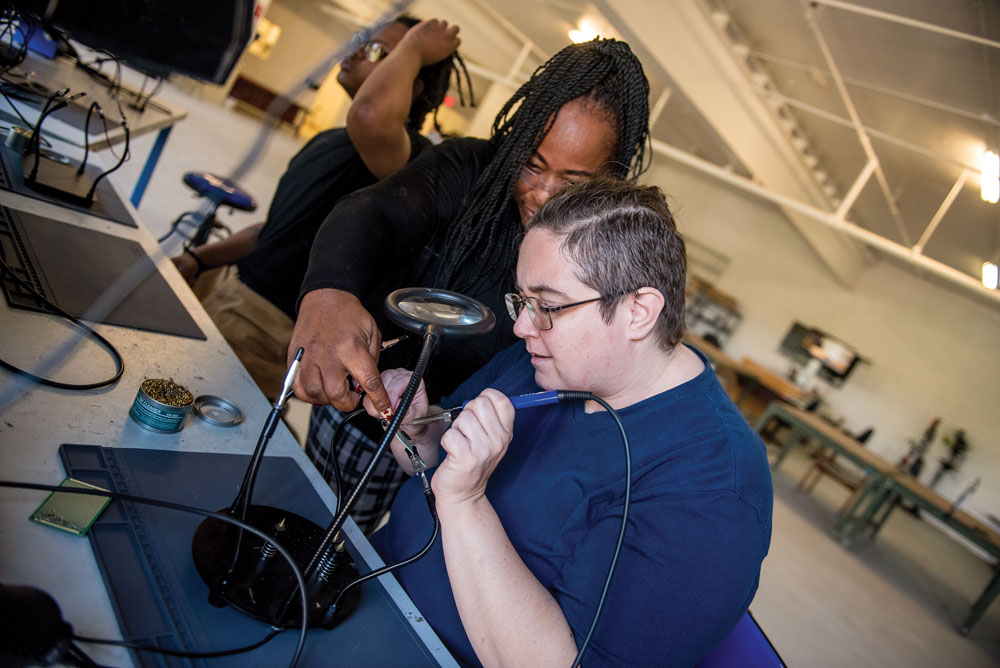
The MATCH program launched by Penn Globe seeks to manufacture a future for trainees and for the New Haven region. Here Nicole Zabski learns soldering techniques under the guidance of Shirell Bolding.
It’s working for Edwyn Rooks, 32, who grew up in New Haven and attended Eli Whitney Technical High School in Hamden, the Connecticut Technical Education and Career System school named for the inventor whose work gave birth to New Haven industry. Rooks focused on carpentry but had a lingering interest in manufacturing, thanks to the school model that had students spend 30 days apiece in each shop. Rooks says he has a few good friends in New Haven from his days at Eli Whitney, where a high percentage of graduates go on to work in their chosen technical specialty: “One is working in manufacturing and also owns a tree cutting business. Another is a plumber. Another is an electrician who works on solar panels.”
Caring for family members in other parts of the country took him as far away as south Florida and Houston in his 20s, but “New Haven was the place that kept calling me back. I just love the culture of the city,” he says. It was familiar ground, plus he loves the city’s legendary pizza — “It’s the home of the pizza, in my opinion. I like Modern Pizza, one of my favorite places to go.”
Rooks found out about MATCH, interviewed and was accepted, beginning a couple months of training in October 2025 that’s seen him learn about welding, soldering and painting as well as earn certificates in OSHA compliance and forklift work and an upcoming pre-apprenticeship certificate upon completion. MATCH is recognized by the state as a pre-apprenticeship facility in a number of areas, including welding, MIG welding, soldering, forklift operation and blueprint reading. It’s also the first program in the state to offer that pre-apprenticeship certificate that’s not discipline-specific. Feinberg says the official from the Connecticut Department of Labor who made the determination was “a wonderful man, but quite critical. He came in, looked at the program, saw what was happening and said, ‘I don’t care what it takes, but we’re going to do this. Nobody can deny that this works.’ ” Feinberg calls that the proudest of many proud moments at MATCH.
There’s more than pride involved, however. There’s money. Participants get a $100 weekly stipend for the first two weeks and are paid minimum wage after that.
At MATCH, Rooks says, “you’re able to get all the tools and essentials that you need to really succeed in the manufacturing world.” Asked what he plans to do next, he says, “The job board they have here at MATCH is phenomenal. I have plenty of interviews lined up and even have received job offers. My qualifications through MATCH make it easier to pick my choice. I’ve been able to negotiate things.” By January he planned to have a job lined up with starting pay somewhere close to $25 an hour.
Long History, But Thinking of Tomorrow
Community and service is part and parcel of Penn Globe’s business. Six years ago the company launched Lighting for the Greater Good, whereby, on placement of an order, Penn Globe sends a significant donation to a food pantry in the customer’s metro area.
How has a company that goes back to 1877 and has 100-plus years of molds and patterns on hand that it still uses today remained relevant? “To stay competitive, we introduced data collection, wifi and cameras discreetly into our outdoor lighting products,” says Marcia LaFemina. “A big part of our business is renovation work.” A recent project for Harvard Business School involved the school sending 300 fixtures that were refurbished and given new LED bulbs. Another project involves new LED packages and new globes for fixtures at a New Jersey Transit station.
“We try to do everything we can within the United States,” she says. “We are a custom manufacturer at a competitive price. I’ve been working here since I was 16. The business is Main Street Disney, Harvard University, lots of places with low volume and high margin. Instead of stocking 6,000 Chinese things on the floor, we’re actually making things here.” One recent order was for a new attraction at Disneyland themed around “Finding Nemo” that called for a light fixture that looks like a diver’s mask. “You can’t do that with stuff stocked on a floor in China waiting to come over on a barge,” LaFemina says.
Penn Globe itself has 10 people on the payroll and does anywhere from $2.5 million to $3 million in business annually. Staff work 36 hours a week, LaFemina pays everyone’s medical benefits, and “just about everybody here owns a house,” she says. Meanwhile, five full-time staff work at MATCH, generating a lot of work in a 26,000-sq.-ft. factory, “and we don’t have enough room,” she says. “Inside of a year we’ll be out of space. The goal is to have Penn Globe and MATCH collocate and have more room. Part of our model was to be self-sufficient. That means taking on contract manufacturing, and it’s here. So we need space.”
LaFemina gives credit to AdvanceCT and the Connecticut Department of Economic and Community Development (DECD) for support. “I used to say I was the poster child for everything and anything the state had to offer to support manufacturers in the way of training, funding and opportunities,” she says.
That includes a five-figure grant for cybersecurity compliance training last year from DECD’s Manufacturing Innovation Fund’s Cybersecurity Adoption Program at Connecticut Center for Advanced Technology (CCAT), as well as incumbent worker training dollars. LaFemina is also proud to be a part of the Connecticut Manufacturers’ Collaborative, composed of over 1,200 manufacturers in the state, which drove momentum for Connecticut to become the only state in the country to appoint a chief manufacturing officer, a post held since September 2025 by former Eppendorf Manufacturing Corp. President Kirti Patel.
At the same time, the state also created its Office of Workforce Strategy, where Patel’s counterpart is Chief Workforce Officer Kelli-Marie Vallieres. The office led the effort to successfully win a nearly $24 million Good Jobs Challenge grant from the EDA in August 2022 for its Strengthening Sectoral Partnerships Initiative, a manufacturing, health care, IT and biomedical workforce training program. Connecticut currently has 14 Regional Sector Partnerships, with 500+ employers participating, in manufacturing, health care, IT, bioscience and more.
Some of those EDA funds have supported the work at MATCH, which launched that same year. “We’re doing great stuff with it,” LaFemina says, noting that, historically, New Haven is a “forgotten stepchild” compared to Hartford or New London. “We’re kind of reviving it at the I-91/I-95 corridor,” she says. “We have a lot of people who need jobs. That’s the basic premise of MATCH.”
“It gave us the right vehicle to cut our teeth on,” says David Feinberg of the EDA grant. “We were going to do MATCH with or without the Good Jobs Challenge. It accelerated us to where we are now.”
“We have a lot of people who need jobs. That’s the basic premise of MATCH.”
— Marcia LaFemina, Penn Globe CEO & MATCH Board Chair
How It Got Started
LaFemina has been increasingly devoted to workforce development ever since Connecticut Congresswoman Rosa DeLauro visited Penn Globe a decade ago with former Speaker of the House Nancy Pelosi in tow. “The Secret Service was here. If you were a woman in the state, you were here. All of a sudden people in the state knew who we were,” she says. “That opened up an opportunity for me personally to get involved in places where workforce things were happening. I kept on learning and learning, putting two and two together.”
She and Feinberg kept discussing how to connect people needing jobs with manufacturers needing people. “It was frustrating to have all these good-intentioned people wasting money, only bringing people so far with training, but they weren’t making the connection with the employer. We take it from the beginning to the end. Knowing other manufacturers, we speak their language, we know what they need. We teach the shop math for a whole host of reasons. They can build on that and do precision measurements. They don’t have to do algebra and trigonometry.”
“We watched a lot of programs out there that quite frankly were being taught by academia,” Feinberg says. A mechanic in his youth, he brings to the MATCH program his blue-collar, gearhead nature combined with business acumen acquired from 25 years in corporate America running retail stores for Verizon Wireless.
Around half of the program participants are people re-entering the job market after “life happened” to them, Feinberg says. Matriculating at nearby Housatonic College is not a good fit. “In a short period of time, we’re able to take people who otherwise would put their heads down and beg for a job and send them credentialed into a job interview with their head high and saying, ‘Here’s how I can add value to your organization.’
“When one of our people graduates and fulfills the course curriculum, they have the foundation for what pretty much any employer is looking for.”
— David Feinberg, Executive Director, MATCH
“When one of our people graduates and fulfills the course curriculum, they have the foundation for what pretty much any employer is looking for. Mostly, they don’t have the bad habits. We have employers who have hired their third or fourth individual and they cite that — ‘they learn quickly and they don’t have bad habits.’ ”
High school engagement is important, too. In November, all of the high school guidance counselors from the City of New Haven were scheduled to visit MATCH for their in-service day “so we can grab those young folks who didn’t know if they wanted to go to college before we lose them to the wind,” says LaFemina. “We let them know we have a spot for them, 12 weeks, we don’t test for math, we don’t wait for cohorts and we pay minimum wage. There’s value in earning. A young person can’t live on 28 hours at minimum wage, but they can do something. You punch in, you get paid. It also allows us to say to employers, ‘Yes, they show up.’ And if they don’t have a car, ‘this is their plan to get to work.’ ”
Real Needs
Sometimes that learning curve is steep and the need for wrap-around services is high. In addition to career-building services, MATCH provides financial literacy guidance on banking, retirement savings, budgeting and fiscal preparedness, and offers assistance with housing and energy. Then there are the skills themselves.
“We were shocked last year,” LaFemina says. “My dad and grandfather had a workshop in the basement. I’m not sure people do that stuff anymore. These kids wouldn’t have known the difference between a Philips head screwdriver and a flathead screwdriver. We should assume nothing. We just have to keep moving fast.”
The team’s problem-solving mentality was evident when it was apparent a lot of people in the program didn’t have vehicles. “We got a van in a matter of two hours on Facebook Marketplace,” LaFemina says, “a $5,700 van, to make sure everyone didn’t have to get on three buses and walk through the soaking rain to a job interview — we take everybody to their job interviews.”
MATCH has a 77% placement rate. “We’ll be tracking to make sure they still have those jobs 12 months in,” says Feinberg.
A consultant has helped refine the MATCH program to now focus on people between the ages of 18 and 40, with “a huge focus on younger folks before we lose them,” says LaFemina. “We’re intervening before we’re trying to rectify living in their cars.”
Feinberg recalls how his eyes opened to real needs that come along with needing a job.
“When I was appointed, I took a regular approach: ‘I’ll go put learning into people’s heads.’ On the third day I was doing this, I came home with a bag of groceries, Marcia asked, ‘What’s that for?’ and I said, ‘Our students are hungry. But they’re also proud.’ We had to create the segue. I told them, ‘Listen, I learn better on a full stomach.’ Then I stood up and said, ‘Clearly I’m an intelligent man because I’m a big boy.’ ”
One bright student possesses a lot of promise but not a nice pair of pants and shoes for a job interview. A state program can help reimburse such purchases in 90 days, but that’s a long time. “That person and I are going to Walmart today to get pants and shoes,” Feinberg says. “I thought it was going to be 80% training and 20% helping them get where they need to be. I couldn’t have been more wrong.”
“We don’t say we remove barriers,” LaFemina adds. “We’re helping people navigate those barriers.”
Penn Globe has been making lighting products for 148 years. But that pales in comparison to lighting up lives, one worthy human at a time. Which explains the MATCH motto: “Manufacture our future, together.”
An adaptation of this story appeared in the January 2026 issue of Site Selection magazine.