
Would you trade in a one-hour commute for a four-minute drive? Investors are banking on it.
The relatively new world of distributed work is changing not only the systemic demand for office space, but also the structural nature of corporate site selection, worker mobility and economic development.
Whether you call it remote work, distributed work, flex/hybrid or long-distance work, the end result is the same: Corporate America is never going back to a static site selection model that favors a handful of large cities.
This sea change has dramatic implications for the economic fortunes of metro areas of every size; and increasingly, the big winners of the future will be places that adapt to this new workplace model the fastest.
Top 10 Largest U.S. Coworking Markets
| Market | 2026 Locations | 2025 Locations | Total 2026 SF |
|---|---|---|---|
| 1. Los Angeles | 343 | 293 | 7.6 MSF |
| 2. Chicago | 333 | 269 | 9.1 MSF |
| 3. Dallas-Fort Worth | 329 | 284 | 6.7 MSF |
| 4. Washington DC | 307 | 279 | 7.3 MSF |
| 5. Manhattan, NY | 306 | 275 | 12.6 MSF |
| 6. Atlanta | 291 | 244 | 5.6 MSF |
| 7. Boston | 263 | 211 | 6.0 MSF |
| 8. Denver | 260 | 236 | 4.1 MSF |
| 9. Houston | 254 | 232 | 5.0 MSF |
| 10. New Jersey | 254 | 186 | 3.6 MSF |
Source: CoworkingCafe/Yardi Kube
Three new studies from ADP, Coworking Café/Yardi and WeWork confirm this. Their reports quantify the impacts of shifting patterns of office space utilization and reveal how quickly corporate site selection is adapting.
But additional research was even more revealing: my first-person experience at a local coworking facility.
My conclusion: Adoption of this new model of coworking is still in its infancy but growing faster than most realize. Here are key takeaways from the studies:
- Nationwide, coworking space locations grew by 15% from 2025 to 2026, increasing by 1,197 net new locations and adding over 22.5 million sq. ft. (MSF) of new coworking space to the market, per Yardi Kube and Coworking News.
- “Moving vans didn’t revamp U.S. employment. The organizational chart did,” reports ADP Research. “Even at the height of the pandemic, the expansion of long-distance work — arrangements in which employees and their managers work in different metropolitan areas — owed far more to changing employer practices than to where incumbent employees chose to live.”
- The U.S. coworking market continues to climb at around 3% per quarter. National inventory rose 2.7% in Q2 2026 from Q1, per CoworkingCafé/Yardi, taking total inventory to 9,384 coworking facilities.
- Total national square footage climbed 1.5% from Q1 to 166.36 million sq. ft. by the end of Q2. “This represents just 2.34% of total office space, suggesting there’s room to grow,” states CoworkingCafé.
- The coworking markets growing the fastest are Indianapolis, up 10.3% in sq. ft. in one quarter, and Philadelphia, up 8.2%. Year-over-year, Jacksonville, Florida, and Richmond, Virginia, added the most new inventory.
- The top five operators in the country are Regus (1,285 spaces, up 3.9%); HQ (388 spaces, up 4.9%); Industrious (191 spaces, up 3.8%); Spaces (171 spaces, down 1.2%); and WeWork (149 spaces, flat Q-o-Q).
- One in four global Fortune 500 companies now use WeWork, and their footprints are growing, according to a WeWork analysis. “Flexible space has become an essential part of how some of the world’s largest companies use real estate globally,” the report states. “Total Fortune Global 500 seats grew 24.3% year-over-year in North America, more than four times the average global growth rate of 5.6%.”
- The average coworking footprint per company is up 33.5% Y-o-Y, from 589 to 787 spaces, as three in four F500 members either maintained or expanded their footprint in North America, per WeWork.
- “Companies in North America move the fastest, averaging less than 80 days from inquiry to move-in,” WeWork reports.
Moving the Workplace Closer to the Talent
Adelina Nicoara, one of the authors of the CoworkingCafe/Yardi study, says several factors influence the location decisions of employers when they’re deciding where to place employees in coworking spaces:
- Where the workforce lives
- Cost per seat and flexible terms
- Talent access
- The building itself
“In a hybrid setup, the whole point of coworking is putting space within an easy commute of employees instead of forcing everyone into one central office,” Nicoara tells Site Selection. “That’s why suburban and secondary markets like New Jersey have held demand even as some downtowns softened.”

“In a hybrid setup, the whole point of coworking is putting space within an easy commute of employees instead of forcing everyone into one central office. That’s why suburban and secondary markets like New Jersey have held demand even as some downtowns softened.”
— Adelina Nicoara, Junior Creative Writer, CoworkingCafe/Yardi
End-users value maintaining maximum flexibility. “Companies pick flex over a traditional lease to avoid a long, fixed commitment,” she adds. “This means that the cost per desk, the ability to scale up or down, and short contract lengths often matter as much as the location itself. This is especially true for satellite offices or testing a new market.”
The facility and where it’s located are huge selling points. “Companies look at where they can hire. A metro with a strong, growing talent pool makes a location a recruiting advantage,” says Nicoara. “Once the area is set, the specific space still has to be worth leaving home for. Transit, parking, amenities and quality all decide whether a location actually gets used.”
The biggest geographic shift, says Peter Kolaczynski, director at Yardi Research, is the move to the suburbs. “Population growth and the proliferation of growth in the suburbs over the last handful of years” are pulling coworking adoption to attractive, fast-growing suburbs around Atlanta, Austin, Dallas-Fort Worth, Houston, Nashville and Phoenix, he says. “We saw the push of coworking bringing the office to the employee and expansion outside of traditional downtowns. This movement has boosted the South’s numbers.”

Peter Kolaczynski, Director, Yardi Research
Alpharetta, Georgia, a northern metro Atlanta suburb of 67,200 people in North Fulton County, now ranks as one of the top 25 coworking locations in the country, per Yardi, which earlier this year named Alpharetta the No. 1 small city in the U.S. for career opportunities. Other up-and-coming coworking locations around metro Atlanta, per Thrive Coworking, are Milton, Suwanee, Cumming, Sandy Springs/Perimeter and Marietta.
The U.S. coworking market is growing
at around 3% per quarter. National inventory rose 2.7%
in Q2 2026 from Q1, taking total inventory to 9,384 coworking facilities.
Source: CoworkingCafe/Yardi
Marietta, a city of 64,152 residents in Cobb County about 20 miles north of downtown Atlanta, is seen by Thrive as one of the emerging locations on the north side of a sprawling MSA that’s now home to over 6 million people.
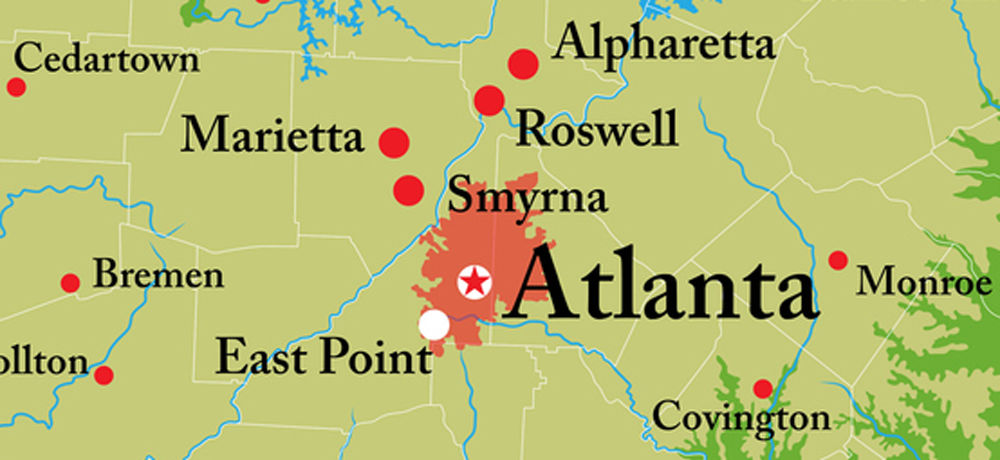
Crop of Georgia map by bogdanserban: Getty Images
Creative Marketers Build a Hub for Entrepreneurs
FireWorks Coworking on Roselane Street became the first dedicated coworking center in Marietta when it opened in 2019. Co-founded by creative marketing entrepreneurs Sonny Goodall and Rob Chaput, FireWorks is a 10,000-sq.-ft. coworking center located in the redeveloped McLaren Mill Office Park near Wellstar Kennestone Regional Medical Center in the old industrial rail part of Marietta. It’s also just a mile from the historic Marietta Square.
Founders describe FireWorks as “Marietta’s first coworking space and community for entrepreneurs, solopreneurs, freelancers and creative thinkers — for those that want to connect and collaborate but don’t want the endless commute to downtown or the distractions of working from home.”
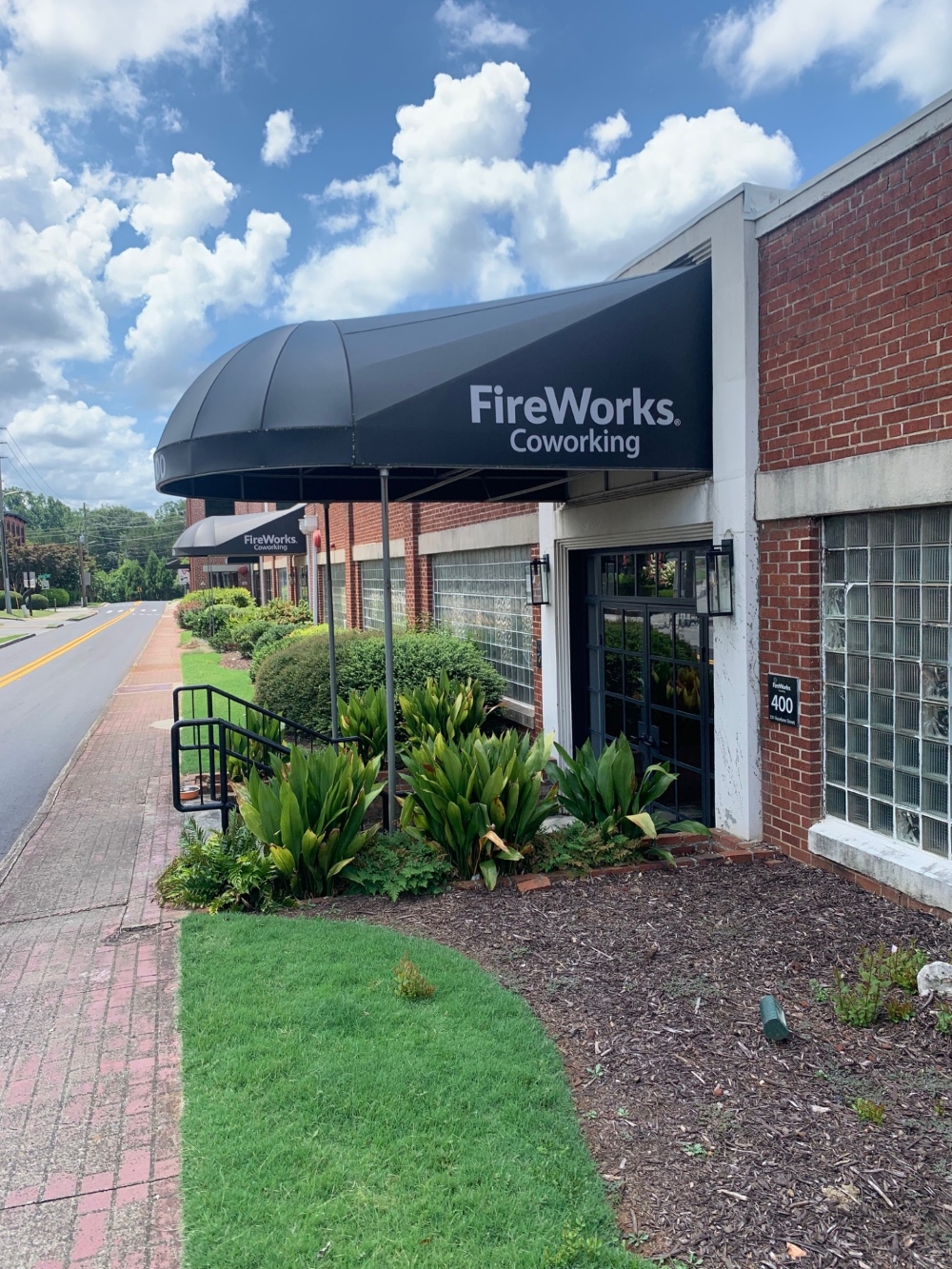
FireWorks Coworking in Marietta, Georgia
Photo by Ron Starner
“Entrepreneurs are our language,” says Goodall, who along with Chaput owns and runs Lighthouse Marketing at FireWorks. “Our trademarked tagline for this place is ‘Work close to home, not at home.’ ”
At 10,000 sq. ft., FireWorks is smaller than the average U.S. coworking space of 17,728 sq. ft., but Goodall says purpose outweighs space. “Space is about location. We wanted this to be a community space,” he says. “We have very cool space. It was designed to create energy and foster creativity.”
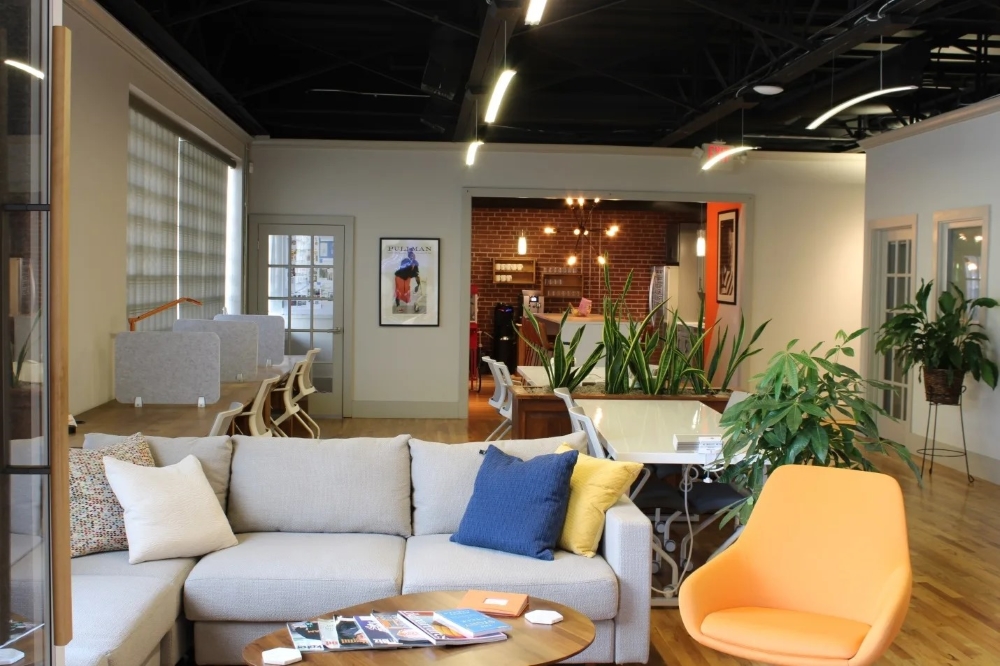
The interior spaces of FireWorks Coworking are designed to create energy and foster creativity and collaboration, say the owners of the facility.
Photo courtesy of FireWorks Coworking

Photo by Ron Starner
FireWorks offers 29 dedicated offices plus 25 open seats, three conference rooms, two kitchens, a podcasting studio and generous portions of open communal space. Goodall says the offices have about 95% occupancy and the center can host group meetings of 60 people or more.
Chaput says two factors motivated him and Goodall: “We intentionally overbought real estate with the intent to grow our business; and we knew that if we built coworking space here, it would help the agency,” he says. “It did both.”
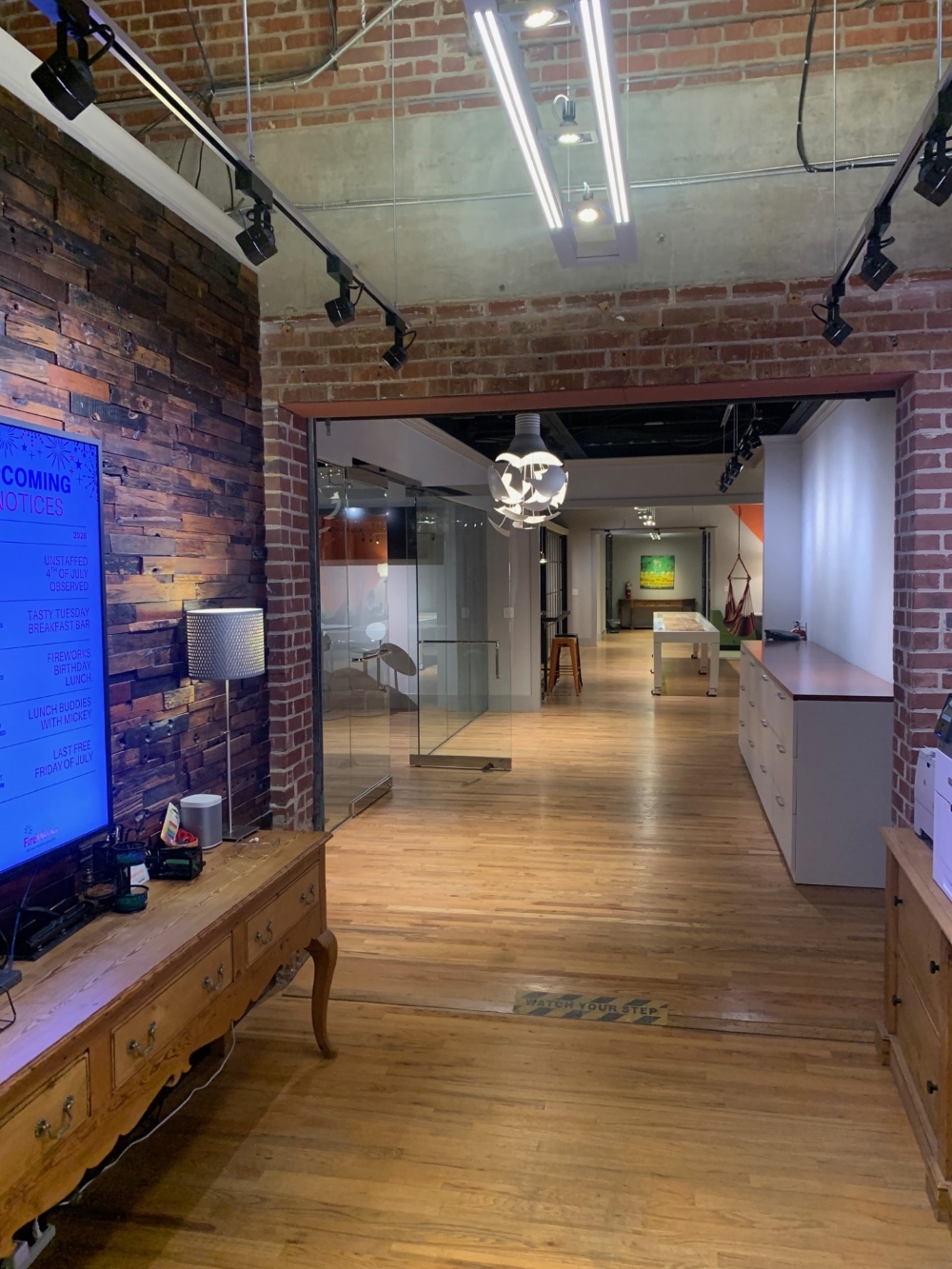
Photo by Ron Starner
Some of the earliest adopters were independent contractors employed by Lighthouse for creative marketing projects. “We were pleasantly surprised that they started coming to work here,” says Goodall. “Everybody here is an entrepreneur.”
“Shortly after we opened our doors in 2019, suburban coworking became the fastest-growing segment in this office market. We really saw the value in this business model post-COVID.”
— Rob Chaput, Co-founder and Co-owner, FireWorks Coworking in Marietta, Georgia
Chaput notes that “suburban coworking is our market. We were one of the very first suburban coworking centers in metro Atlanta. Shortly after we opened our doors in 2019, suburban coworking became the fastest-growing segment in this office market. We really saw the value in this business model post-COVID.”
‘We’re Not Trying to be WeWork’
While noting that they are “not trying to be the WeWork of Marietta,” Chaput and Goodall say they could envision growing their space to around 15,000 sq. ft. “We feel like that would be the sweet spot,” says Chaput.
He stresses that community-building trumps numbers. “We always wanted this to be a place where we could build an internal community where each member helps each other,” he says. “We called it a divine experiment. It happened.”
As hybrid and remote work continue to normalize and proliferate nationwide, the number of smaller to mid-sized coworking centers is increasing with it. Entrepreneurs, small businesses and Corporate America have bought in.
The next logical phase, say Goodall and Chaput, will be growth in secondary and suburban markets. “We have the space suited for the coworking world,” says Goodall. “Generally, we have always been profitable, but our primary goal was not to see how much money we could make. The success happened organically.”
Chaput adds, “We could optimize our space more, but we’re happy where we are.”
As someone who tried out this space because it’s just two miles from my home instead of the 30 that I normally drive to the office, I can see why.