

by LISA A. BASTIAN
As American supply chains are increasingly reshored and strategically redesigned, geography is reasserting itself as a defining force in corporate site selection. More than ever, where a company operates is just as critical as how it operates.
But geography alone is not enough. What matters just as much is how efficiently goods and resources move through it.
Oklahoma stands out as a state where central location and integrated connectivity systems combine to create a measurable competitive advantage across industries. For site selectors, this translates into clear benefits including lower freight and last-mile costs, more efficient supply-chain networks and reduced transit times aligned with today’s demand for speed.
Central Location With National Reach
Oklahoma’s central “sweet spot” allows trucks to reach nearby regional markets such as Dallas, Kansas City and St. Louis (representing up to 40% of the U.S. population) within a one-day drive. Major metros including Chicago, Atlanta, Denver and New Orleans are accessible within two days.
Bottom line: Trucks departing Oklahoma can reach up to 70% of the U.S. population within 48 hours. This is a substantial advantage that coastal states, constrained by geography, cannot match.
Oklahoma’s transportation advantage is not defined by any single mode, but by how seamlessly its systems work together. A three-corridor Interstate network forms the backbone of truck movement, enabling fast, multi-directional access to major U.S. markets.
Interstate 35 serves as the primary north–south spine, placing Oklahoma along one of North America’s most critical trade routes linking Mexico to the Midwest. As U.S.–Mexico trade continues to expand, this corridor has become increasingly important for cross-border freight movement, much of which moves by truck.
Interstate 40 provides critical east–west connectivity, linking Oklahoma to major population centers and coastal port networks. It supports both domestic distribution and global trade flows.
And Interstate 44 functions as a regional connector between Oklahoma City and Tulsa, bolstering in-state distribution and last-mile activities. It also extends the reach of companies into key Midwest and Southern markets.
While often overlooked, Oklahoma’s relatively low highway congestion is another location advantage. Compared to larger U.S. metros and coastal regions, fewer bottlenecks here enable more predictable transit times and lower transportation costs — all important benefits for time-sensitive supply chains.
Rail connectivity adds another layer of strength. The state is served by Class I railroads, including BNSF Railway and Union Pacific, providing long-haul freight capabilities and direct connections to national markets and West Coast port networks. Complementing these carriers is a network of regional and short-line railroads servicing industrial sites and rural production areas.
Together, all these systems create a highly integrated freight environment where trucks handle speed and flexibility, while rail delivers cost-efficient, long-distance transport.
Locations Powered by Reliable Energy
Oklahoma’s central location also makes it a critical corridor for energy transportation. The state serves as a natural crossroads for energy movement due to its positioning between Gulf Coast refining and export hubs, as well as major production regions in Texas, Kansas and New Mexico.
Pipelines across Oklahoma carry crude oil, refined petroleum products and natural gas products linking upstream production areas to storage hubs before they’re moved forward to refineries and export terminals. Notably, the city of Cushing — nicknamed the “Pipeline Crossroads of the World” — functions as one of America’s major convergence points for crude oil storage and distribution.
Geography has built a growing renewable energy sector, too. Located within the Great Plains, known for strong, consistent winds, Oklahoma benefits from wind resources that have made it a national leader in wind energy production. In recent years, wind has accounted for more than 40% of the state’s electricity generation.
Together, these energy systems provide reliable, cost-effective power and strengthen supply chain stability. As a result, Oklahoma continues to attract and retain operations in manufacturing, logistics, data centers, distribution and aerospace.
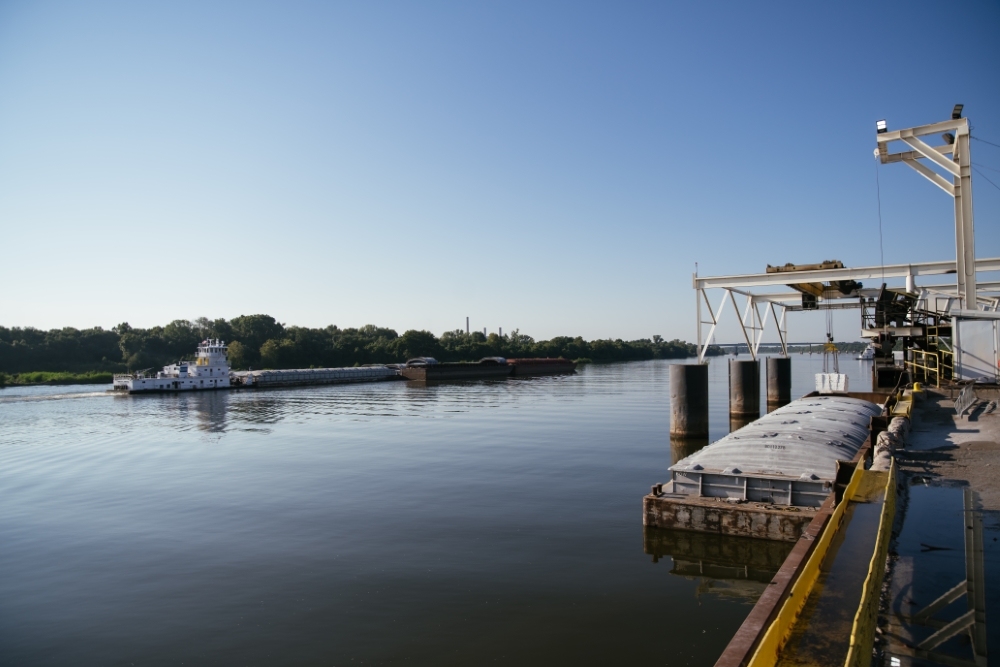
Waterways and inland ports are vital links in Oklahoma’s transportation network.
Photo courtesy of Oklahoma Commerce
Building a Pro-Business State On Location Assets
Of Oklahoma’s roughly 4.15 million residents, about 1.5 million live in the Oklahoma City metro area and about 1 million live in the Tulsa region. Their combined population of more than 2.5 million people anchors the state’s economic activity and labor force. Both cities amplify Oklahoma’s geographic advantages through coordinated investments in infrastructure, workforce development and pro-business policies.
Bustling Oklahoma City offers an expansive land area, growing population and significant room for industrial expansion. It attracts major new construction projects with multiple industrial parks, and pre-zoned, “shovel-ready” sites designed to eliminate months of costly pre-development work.
Tulsa is a more compact, industrially focused environment, offering strong multimodal capabilities. A key resource here is the Tulsa Port of Catoosa, one of the country’s largest inland river ports, giving Tulsa companies integrated logistics options beyond traditional trucking.
Both cities offer distinct yet complementary strengths. As Oklahoma’s primary economic anchors, they play a central role in attracting investment and accelerating growth. But they are far from being the state’s only engines of progress.
Across Oklahoma, a network of strategically positioned communities amplifies the state’s many site selection advantages shaped by location. Future-focused yet grounded in operational best practices, these regions deliver the speed, certainty and scalability that companies prioritize when evaluating long-term growth opportunities.
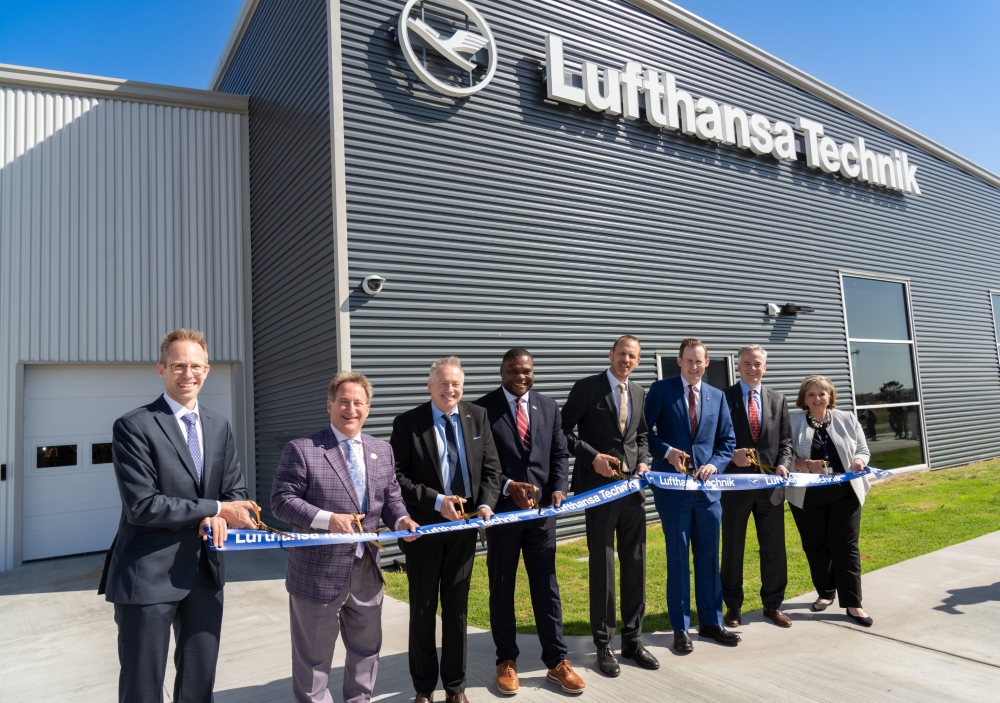
Officials cut the ribbon to officially open the new Lufthansa Technik facility at Tulsa International Airport.
Photo courtesy of Fly Tulsa and Lufthansa Technik
Lufthansa Technik Lands New Facility at Tulsa Airport
The rapidly growing aviation/MRO sector in Tulsa keeps growing. The latest news came last month when Lufthansa Technik Component Services celebrated the grand opening of their newest facility at Tulsa International Airport.
The 25,000-sq.-ft. building marks the first milestone in a larger expansion of their Tulsa campus and will support continued growth in aircraft component maintenance and repair.
“This expansion represents more than a new building. It creates new opportunities for skilled aviation professionals in our community and strengthens Tulsa’s reputation for world-class aviation services,” said Alexis Higgins, CEO at Tulsa Airports Improvement Trust.