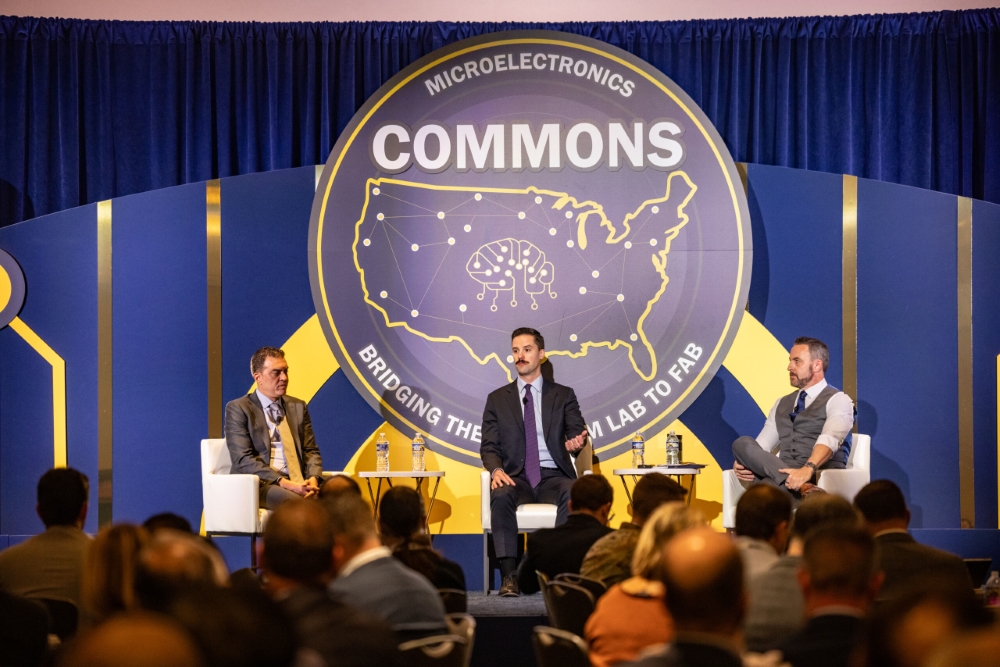
Microelectronics Commons discuss achievements so far and the road ahead at the network’s annual meeting in March in Washington, D.C.
Photo courtesy of Microelectronics Commons
A Massachusetts program is one of eight hubs seeding next-gen semiconductor innovation across the nation.
In mid-April, a new cohort of eight startups in four states received more than $1 million in combined funding from the Powering Regional Opportunities for Prototyping Microelectronics (PROPEL) program. Launched in 2024, by Massachusetts Technology Collaborative’s Boston-based Northeast Microelectronics Coalition (NEMC), PROPEL aligns to NEMC’s role within the federally funded Microelectronics Commons, which a release by MassTech describes as “a national network advancing domestic semiconductor innovation in areas that include 5G/6G technology, artificial intelligence (AI) hardware and quantum technology. This approach ensures that the most promising innovations are supported regardless of location or affiliations, strengthening the broader ecosystem and creating downstream opportunities for collaboration, domestic manufacturing and workforce development across the region.”
Five of the eight startups in the new cohort are based in Massachusetts, including the cohort’s largest award of $200,000 to Cambridge-based Lightfinder for “work developing chip-scale spectrometers and imaging solutions that deliver lab-grade optical sensing in a miniaturized, scalable form.” Other awards went to such firms as AmpVisions in Orange, Connecticut; Fresnel, Inc., in Leander, Texas; Ozark Integrated Circuits Inc. in Fayetteville, Arkansas; and Lintrinsic and Ayo Electronics, both based in Boston.
“Public-private collaboration is essential to ensuring Massachusetts, and its neighboring states, remains competitive in microelectronics innovation,” said Massachusetts Secretary of Economic Development Eric Paley. “PROPEL is helping startups move faster from breakthrough ideas to real-world impact by reducing development barriers and strengthening the regional and national innovation pipeline.”
I asked MassTech for the full set of PROPEL award data so we could track the geography of all 50 startups the program has funded with $4.7 million since its launch.
Thirty-eight of the 50 awards have landed at 29 Massachusetts firms, including three separate awards to Lintrinsic and to Advanced Silicon Group, based in Lowell, which was also among the eight new award recipients in April. All told, the Massachusetts grants come to $3,585,758. Lintrinsic leads all PROPEL-supported firms with total funding of $320,537, followed by the $200,000 to Lightfinder, another $200,000 to Vertical Horizons (which spun out of work at MIT in Cambridge) and a cumulative $200,000 via two separate awards to Finwave Semiconductors, based in Waltham.
Just under that total is the $199,500 that went to BioSens8, a wearables company that moved in 2023 to The Engine, an incubator and accelerator in Cambridge.
National Network
Where have the other 12 awards gone? Georgia has garnered three of them, with two of them (totaling $176,500) going to Atlanta-based Plaid Semiconductors, a company “pioneering advanced glass substrates for next-generation AI computing, offering a 50% reduction in signal and power losses compared to traditional silicon interposers,” said a 2025 release from NEMS.
Two awards in New Jersey include $196,862 to Magneton, based in Branchburg, which is “advancing single-photon detection through single-photon avalanche diodes (SPADs) with integrated readout electronics to revolutionize ultra-long-range LiDAR, defense tracking and secure communications.”
Two other awards have gone to firms in New York, with single awards going to firms in Arkansas, Colorado, Connecticut, Texas and Vermont.
The Microelectronics Commons in late April announced that the U.S. Department of War (DoW), through the Naval Surface Warfare Center, Crane Division, and the Strategic and Spectrum Mission Advanced Resilient Systems (S2MARTS) Other Transaction Authority (OTA), had announced over $200 million in year 2 awards across 26 Microelectronics Commons projects. Year one funding amounted to $270 million.
The Commons was established under the CHIPS and Science Act via Section 9903(b) of the National Defense Authorization Act for Fiscal Year 2021 with the goal of closing the gap from lab to fab. It is managed by NSTXL (National Security Technology Accelerator). In addition to NEMC, here are the other seven hubs that comprise the Commons, which held its annual meeting in the nation’s capital in March:
- California DREAMS: California Defense Ready Electronics and Microdevices, University of Southern California
- CLAWS: Commercial Leap Ahead for Wide Bandgap Semiconductors, North Carolina State University
- MMEC: The Midwest Microelectronics Consortium, Beavercreek, Ohio (Dayton)
- NORDTECH: Northeast Regional Defense Technology Hub, Albany, New York (statewide)
- Northwest-AI-Hub: California-Pacific-Northwest AI Hardware Hub, Stanford University
- SCMC: Silicon Crossroads Microelectronics Commons, Bloomington, Indiana
- SWAP: Southwest Advanced Prototyping Hub, Arizona State University, Phoenix, Arizona
Each hub has its own national network: The MMEC earlier this month announced $44.5 million in Project Year 2 follow-on awards. NORDTECH last month announced that four firms were selected by the U.S. Department of War (DOW) to receive more than $25 million in second year funding after achieving their key first-year benchmarks. “To date, these four projects will have received a total of $55.43 million in the technical areas of quantum and commercial leap ahead technologies,” NORDTECH stated.
Altogether, the Microelectronics Commons now represents 1,600 active members in 47 states and involves 123 workforce development initiatives. At the annual meeting it was announced that the Commons had:
- Catalyzed $1.2 billion in matched non-CHIPS investment from industry, academia, and partners.
- Fabricated more than 61,000 chips domestically
- Advanced over 220 technologies through the Microelectronics Commons pipeline
- Achieved 14 cumulative Technology Readiness Level (TRL) increases, with some projects advancing by full levels within a single year