
Sunset over Chicago, the No. 1 Top Metro in the U.S. for corporate facility investment.
Photo by Dice Sales courtesy of Enjoy Illinois
When Illinois Gov. JB Pritzker signed into law the Clean and Reliable Grid Affordability (CRGA) Act into law on January 8, it signaled to everyone that Illinois would get out in front of the movement to control runaway energy costs nationwide.
Prior to the Illinois General Assembly passing the landmark legislation on October 30, many leading Illinois businesses spoke out publicly in favor of it.
“CRGA is advancing smart, timely solutions,” said Sarah Cottrell Propst, senior vice president of the American Clean Power Association. “With new investments in energy storage and virtual power plants, Illinois is positioning itself to keep energy costs low, improve reliability, and create clean-energy and manufacturing jobs — proven strategies that benefit consumers and strengthen the economy.”
The landmark legislation establishes a 3 GW energy storage target, requires electric utilities in the state to develop virtual power plants and aims to reduce costs for Illinois customers who saw their electricity bills rise by 15% last year.
In an extensive interview with Site Selection, ComEd CEO Gil Quiniones says the state’s largest electric utility welcomes the new law and says his firm is ready to do its part to match policy goals with concrete action.
ComEd — a company that began in the late 1800s as a Chicago Western Edison Light Company, one of several local firms owned by inventor Thomas Edison in Chicago — is today a unit of Chicago-based Exelon Corp., a Fortune 200 energy company with 10 million customers. ComEd supplies power to more than 4 million customers across Northern Illinois, or 70% of the state’s population. ComEd’s service territory borders Iroquois County to the south around Interstate 80, the Wisconsin border to the north, the Iowa border to the west and the Indiana border to the east.
As an energy delivery company, ComEd does not own power plants and does not make electricity. ComEd delivers electricity to homes and business. To do that, the utility manages more than 90,000 miles of power lines over an 11,400-square-mile territory.
Since 2001, ComEd has invested more than $5 billion into electrical transmission and distributions system throughout Northern Illinois.
Four-Year Grid Plan Targets Costs
Keeping rates low has been a top priority of Quiniones and his workforce of over 6,600 employees. The most recent benchmarking from the Edison Electric Institute reveals that ComEd electric rates ranked among the most competitive in the nation for 2025. ComEd’s average residential rates of 15.34 cents per kilowatt hour (kWh) remained at 22% below average residential rates of 20.26 cents per kWh in the nation’s top 20 metropolitan markets and 1% below the U.S. average residential rate of 16.14 cents per kWh. ComEd improved to 7% below the average residential rate for other Midwest utilities of 16.53 cents per kWh. Currently, ComEd’s total average monthly residential bill is $106.
“It is really remarkable that we have one of the most competitive rates for both residential and commercial customers compared to large metro areas,” says Quiniones. “We are also the most reliable utility in the U.S. We are ranked No. 1 in overall reliability in the nation. We are a good deal. We make sure that every investment we make is cost-effective.”
The Illinois Climate Equitable Jobs Act (CEJA), passed in September 2021, requires electric utilities in the state to prove that their investments are cost-effective and that they pass the energy burden test. “The test is that if you heat with non-electric methods, your bill should not exceed 3% of your income,” the CEO says. “If you use electric heat, your bill should not exceed 6% of your income. We are currently at the 1% level.”
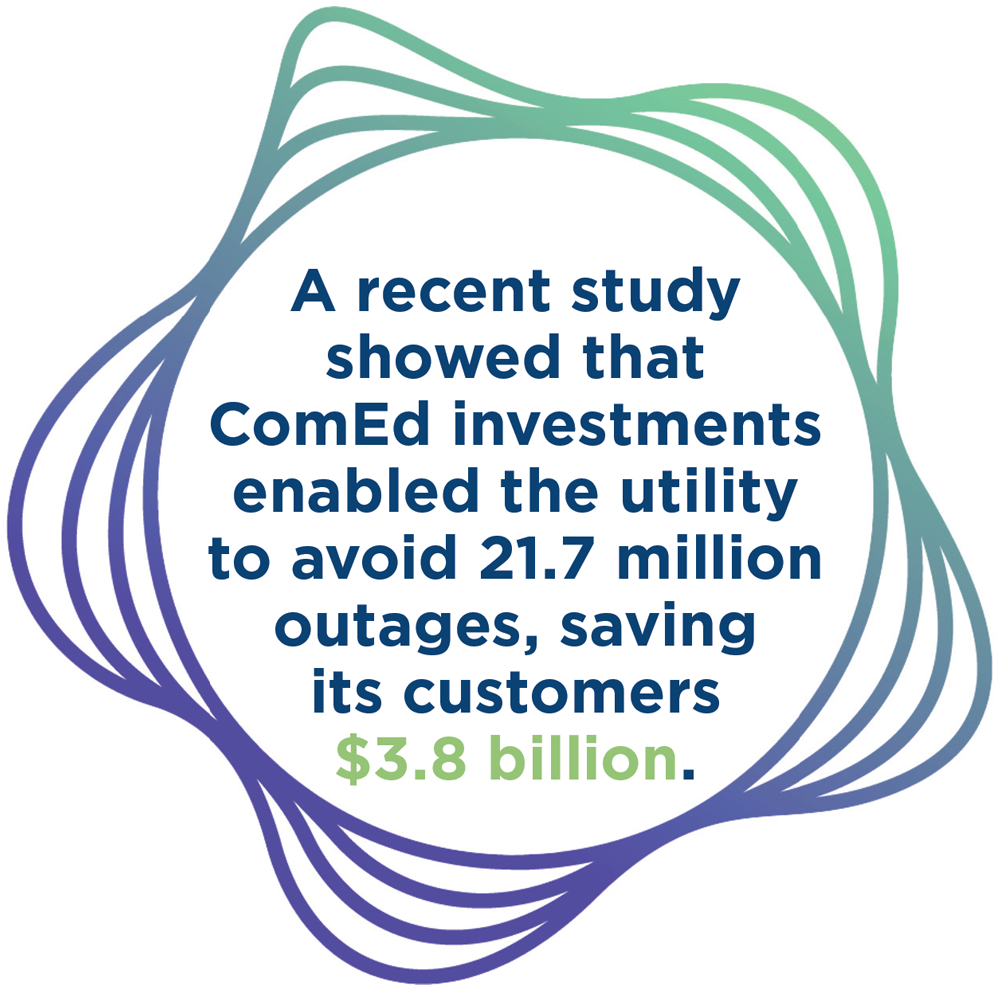
ComEd recently filed its four-year grid plan, focusing on sustaining reliability, maintaining affordability and adapting to rising energy demand. “It ensures continued reliability of the grid for the nine million residents of Northern Illinois that we serve,” says Quiniones. “We have reduced outages.” A recent study showed that ComEd investments enabled the utility to avoid 21.7 million outages, saving its customers $3.8 billion.
Part of the PJM Interconnection Grid that serves 13 states in the Midwest and the Mid-Atlantic, ComEd like other utilities has seen electricity prices rise in recent years due to exploding demand caused by energy-intensive data centers, quantum computing installations, EV manufacturers, semiconductor fabs and other large projects.
“As a deregulated state, all of the power plants in Illinois are owned by private companies. We are on the PJM Grid. Increases in prices in the 13-state region are driving this issue,” the CEO says. “We have held our operation and maintenance costs flat from 2020 to 2025. That enables us to keep bills affordable.”
In order to keep up with skyrocketing demand for power, Quiniones says that ComEd will continue to invest in the grid to accommodate large loads at data centers and quantum computing centers, both of which have a significant presence in Northern Illinois.
“We know that this is a PJM issue,” he says. “We need to make investments in transmission and distribution and generation as well. In our state, due to the two laws enacted in 2021 and 2026, we are looking to invest in clean generation in our state. The state is looking into a resource planning process to see what other actions the state should take to make sure we have enough supply to power large economic development projects and small businesses as well. This is not just about increasing supply. We need to invest in our grid. It will require an all-of-the-above approach to meet this unprecedented load growth.”

“This is not just about increasing supply. We need to invest in our grid. It will require an all-of-the-above approach to meet this unprecedented load growth.”
— Gil Quiniones, CEO, ComEd
Record-Setting Project Pipeline
Part of that is making sure that new large load users pay their fair share, Quiniones notes. “We are instituting measures that protect our residential and small business customers from cost-shifting,” he says. “We require transmission services agreements with data centers before filing. Here is what they do: They ensure that if a data center does not materialize as planned, all of the upgrades that are made on the grid — those costs are not shifted to all of our other customers. We think that is the fair thing to do. The Data Center Coalition thinks this is fair, too. This is important in the economy as a whole. We are doing everything we can to make sure we are attracting the right kind of developments.”
In January, ComEd announced new Transmission Security Agreements (TSAs) designed to protect customers and ensure fairness in the cost of connecting and providing transmission service to those new large loads requesting service from the grid. “These agreements include revenue commitments tied to the transmission services requested by eight large customers, who represent a forecasted new load greater than 6.5 GW,” ComEd announced. “Together, the eight agreements will prevent existing ComEd customers from bearing responsibility for more than $2 billion in transmission charges over a 10-year period.”
To put the increasing demand into perspective, Quiniones says that there are more than 30 GW of projects in the ComEd economic development pipeline right now. “Our all-time peak load as a company was 23 GW in July 2011,” he says. “Obviously, not all of these prospective projects are going to happen, but it does show the attractiveness of our locations in Northern Illinois. That has happened because policy makers have created an environment to make our state open for business.”
Tracey Hyatt Bosman, managing director at Biggins Lacy Shapiro & Co., calls the new CRGA legislation “extremely ambitious. It seeks to re-engage the nuclear sector, amp up distributed generation or virtual power plants, enhance the attractiveness of solar programs, and dramatically increase battery storage capacity, all while improving energy efficiency support for low-income households and offering alternative rate structures to benefit consumers. The energy industry has long advocated an all-of-the-above approach to growing capacity as well as clean generation alternatives. This legislation is clearly trying to follow on that call to action. Whether it can deliver on all these fronts remains to be seen, of course.”
Jay Garner, president of Atlanta-based Garner Economics LLC, says he will wait before judging the effectiveness of CRGA, but he does like some aspects of it.
“All one needs to do is to study the EU model of energy transition and how it has failed them,” he says. “Energy costs in Europe are more than double the U.S., and very unreliable in the winter. So much so, that certain countries like France and Germany had to bring coal back when solar and wind didn’t work because of atmospheric conditions.”
On the positive side, Garner notes that “I am glad to see that Illinois is starting nuclear once again. Natural gas and nuclear energy are the way to go. … Solar and wind are expensive and unreliable compared to natural gas, nuclear, hydro and coal.”