On the heels of the successful Artemis II mission, which took one CSA and three NASA astronauts on a 10-day deep space journey in April 2026, global interest has undoubtedly piqued for the future of space exploration.
Roughly 238,855 miles from the lunar surface, defense, national security and space technology manufacturer Voyager Technologies has been occupied sharpening its defense readiness capabilities through domestic expansion and intentional collaborations.
The company is in the midst of a significant expansion of its Voyager American Defense Complex, located in Pueblo, Colorado, as part of a greater $280 million initiative to reinforce Voyager’s defense production activities. The PuebloPlex site once served as the Pueblo Army Depot, which came outfitted with extensive storage infrastructure that included more than 1,000 earth-covered magazines essential for safely handling and storing energetic materials — a resource that would take years and significant capital to build from scratch.
Aside from the site’s physical infrastructure, the facility was designed to support high-volume production of weapon systems-enabling components and propulsion systems, in addition to engineering support for black powder development. Combined with a strong workforce pipeline and a community that understands defense manufacturing, these factors made Pueblo a natural fit for growth, according to Voyager Technologies Chairman and CEO Dylan Taylor.

The expansion, which broke ground in January 2026, comes as a result of what Taylor says is an inflection point on two fronts. In terms of defense, one aspect comes in response to the Pentagon’s urgent call for the nation’s defense industrial base to scale production of missile defense systems and tactical munitions. In January 2025, the Trump Administration unveiled the Golden Dome for America initiative, which was developed to build a “system of systems” for integrated air and missile defense systems in order to protect the U.S. from foreign aerial attacks. With greater capacity, Voyager can help answer these calls directly.
“On the space side, the White House has set a concrete goal of establishing a permanent presence on the Moon by 2028, and the window to build the infrastructure required to support that is now,” says Taylor. “If you want to be a foundational provider of lunar infrastructure, or a reliable supplier in the missile defense supply chain, you have to be building capacity today.”
Construction is expected to be completed before the end of the year. Once operational, the complex will offer 150,000 sq. ft. of space for advanced manufacturing, operations and testing for the production of weapon systems-enabling components, propulsion systems, controllable propulsion technologies and assembled energetic grains used by the U.S. military.
In March 2026, Voyager announced its new 140,000-sq.-ft. facility in Long Beach, California, an area coined “Space Beach” for its aerospace reputation. This site will focus on the development and production of advanced electronics and mission hardware, space infrastructure for LEO, lunar and deep space missions and communication and autonomy technologies.
Maximizing Lunar Potential
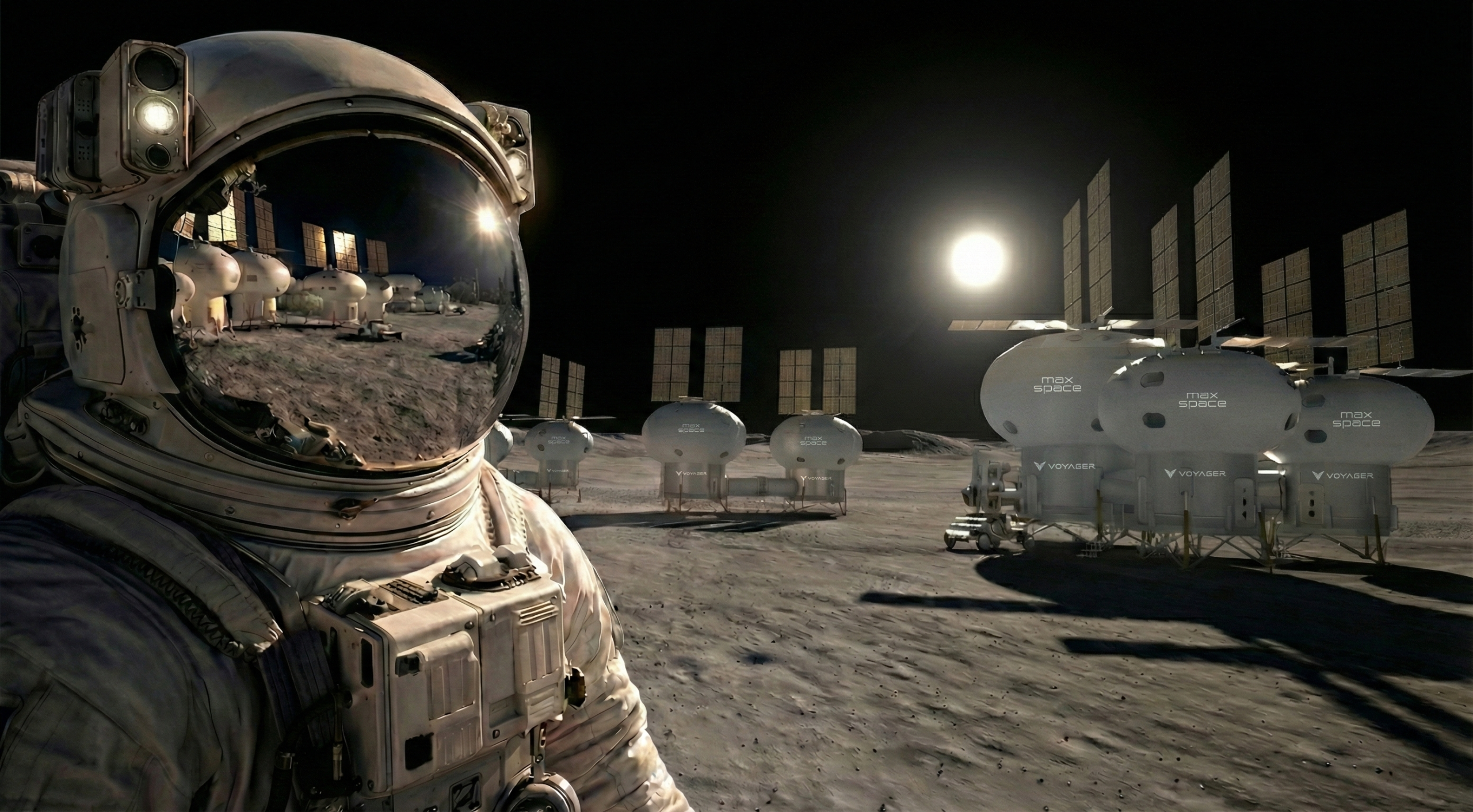
As Voyager’s defense capabilities grow, new strategic partnerships aim to transform the concept of humans living and working on the Moon into durable, scalable infrastructure. Taylor says the company began to seriously map out what a comprehensive lunar roadmap would look like and it emerged that habitat volume was one of the hardest constraints to solve. The challenge is a shared focus of Miami-based space real estate company Max Space, which led to an organic connection between the two.
“Max Space had developed a genuinely differentiated answer to that problem with their expandable architecture,” he continues. “The more conversations we had, the more the complementarity became obvious. Voyager brings the mission management, logistics, propulsion and power systems. Max Space brings the habitat itself.”
“If you want to be a foundational provider of lunar infrastructure, or a reliable supplier in the missile defense supply chain, you have to be building capacity today.”
— Dylan Taylor, Chairman and CEO, Voyager Technologies
In March 2026, Voyager announced a multi-million-dollar investment into Max Space, which will advance development of the company’s expandable space habitats, in addition to bolstering R&D activity. Max Space’s subscale demo mission, Mission Evolution, is slated for February 2027, launching its expandable habitat technology on the SpaceX Falcon 9 rocket. Through this collaboration, Voyager’s goal is to understand how expandable habitat architecture performs when encompassing a full spectrum of lunar mission requirements, from early surface deployment to long-duration habitation. Taylor notes that “every step of this collaboration, from ground validation through in-space demonstration, will generate engineering and operational insights that sharpen our roadmap.”
As for what’s next for Voyager Technologies, Taylor says the company’s immediate priority is growth acceleration. The company recently announced a new mission management contract with New York-based startup Icarus Robotics as it prepares to test out Joy — a free-flying robotic platform — on the International Space Station in 2027. Voyager will support the mission by spearheading launch coordination, a role the company has managed for over 1,400 missions to date.
“We’re continuing to build out the integrated platform — the logistics, propulsion and systems capabilities — to support faster production at scale,” he says. “We’re also continuing to evaluate additional strategic investments in companies that strengthen our broader capabilities for space, defense and national security.”
Signs of the company’s strength came in a trio of daily announcements April 13-15. First, the company announced it had doubled the production capacity at its Denver-metro facility from just one year ago, helping meet growing demand for commercial and national security satellite constellations such as Golden Dome. Following Voyager’s acquisition of ExoTerra Resource, a leading developer of electric propulsion systems, in October 2025, the Littleton facility expanded from 8,000 to 40,000 sq. ft., increased its workforce and expanded test equipment and training.
The next day, Voyager announced it had signed MOUs with Yonsei University in Seoul, South Korea, and Obuda University in Budapest, Hungary, expanding the global reach of Voyager Institute for Space, Technology and Advancement (VISTA), the first U.S. science park dedicated to in-space research and manufacturing, located at The Ohio State University.
Finally, on April 15, Voyager signed an order with NASA for the seventh Private Astronaut Mission to the International Space Station, launching no earlier than 2028.