When the nation’s first public community college planted roots in Joliet, Illinois, in 1901, its concept sought to emulate curriculum offerings students typically encounter in the first two years of a four-year college or university.
This innovative launch carved a new path for higher education opportunities that emphasize the needs of the local community. At the time, Joliet Junior College served just six postgraduate high school students, a number that has now grown to an average of 27,000 students per year.
The state’s roster has risen to 48 colleges across 39 community college districts who see more than 500,000 students per year. On a greater scale, this initiative led to the development of over 1,000 two-year public institutions now positioned throughout the U.S., consistently moving skilled talent into careers vital to the nation’s economic success.
The Great Lakes region is a known manufacturing powerhouse that depends on skilled talent across a diverse range of industries. From Minnesota to New York, one can find more than 230 community colleges in the Great Lakes states. In the Canadian provinces, Ontario holds 24 publicly assisted colleges, half of Quebec’s 48 public colleges.
Many of these institutions have become the center of talent development strategies for businesses located in or coming into the region. A peek into current activity provides insight into a few ways community colleges and industries located across the Great Lakes are perfecting the region’s talent pool.
Amazon
When Amazon Web Services announced plans to distribute $20 billion across multiple data center campuses throughout Pennsylvania in July 2025, it additionally brought news of up to 1,250 new high-tech jobs.
Two site locations — Salem Township and Falls Township — have already been identified for development, although the company has stated there are many more coming down its project pipeline. In the meantime, the Pennsylvania Commission for Community Colleges (PACCC) is wasting no time ensuring local talent are prepared for an influx of new construction and technology roles.
Under PACCC leadership, four regional institutions — Luzerne County Community College, Lehigh Carbon Community College, Northampton Community College and Bucks County Community College — will come together to form an ADVANCEPA Technology and Trades Workforce Consortium. Prime proximity to Amazon’s sites in Luzerne and Bucks counties presents an ideal opportunity to cultivate targeted workforce development programs that hit on technology and skilled construction trades related to hyperscale data centers.
PACCC Vice President Dr. Nicholas Neupauer says the beauty of Pennsylvania’s overall network of 15 community colleges is that they always do the right thing for the almost 240,000 students that enter these institutions each year. Industry collaboration has been key to refreshing curriculum and programming. He says this opportunity will “elevate the credibility, worthiness and value of partnering with community colleges,” when crafting a local workforce pipeline.
The consortium will launch three pillar training academies: a Career & Technology Academy, a MicroCredential Academy and a Construction & Trade Pre-Apprenticeship Academy. Dr. Neupauer says the consortium is in the midst of its planning stages to identify which colleges will be responsible for specific trainings.
“In the big picture, this approach encompasses a ton of what we in Pennsylvania call high-priority occupations. Electricians, carpenters, plumbers, HVAC, construction and the list goes on,” he continues. “So, while this is specific to data centers, and in this case AWS, this is going to encompass a very wide scope for our local communities, the region and Commonwealth as a whole.”
A closer look into the purpose of each academy shows that talent, at any level, can tailor their approach to skills development.
The Career & Technology Academy seeks to form new regional partnerships between the community colleges and career and technical center high schools in northeast Pennsylvania. The goal will be to highlight post-secondary construction or technology credential programs that lead to entry-level roles for high school students. For seasoned talent looking to upskill or switch careers, the MicroCredential Academy is designed to be a quick and cost-effective avenue to explore roles in high demand industry clusters. This academy provides flexibility by enabling participants to gain credentials in-person or online.
The Pennsylvania Building and Construction Trade Unions will partner with the consortium as part of the Construction & Trades Pre-Apprenticeship Academy, providing talent with targeted curriculum that guides them through a preferred apprenticeship. This on-the-job training is vital to landing direct employment, but more importantly keeping skilled talent at home.
“We do plan on replicating this model across the state for data centers as a whole, not just AWS,” says Neupauer. “While we’re kicking things off with AWS, we are creating a model, and this will be our debut. We are looking to replicate the model with other community colleges across the state and other data centers as they emerge.”
He says while this is an incredibly big initiative for members of the consortium and PACCC, this approach is far from unique for Pennsylvania’s community colleges. It builds upon years of community and industry engagement hitting on in-demand occupations, which will only continue as large-scale project investments continue to pour into the state.
“[This] really speaks to our sector’s agility and nimbleness to move forward, plan quickly, adapt, fall back on the expertise of our faculty and staff at representative colleges and move forward and help the communities we serve,” says Neupauer.
Johnson Controls
Since 2021, building technology, software and services company Johnson Controls has been on a nationwide mission to expand academic programming specific to HVAC, fire, security and building automation systems. The company’s goal is to invest $15 million into community colleges located in regions that hold a strong customer and Johnson Controls employee presence by 2026.
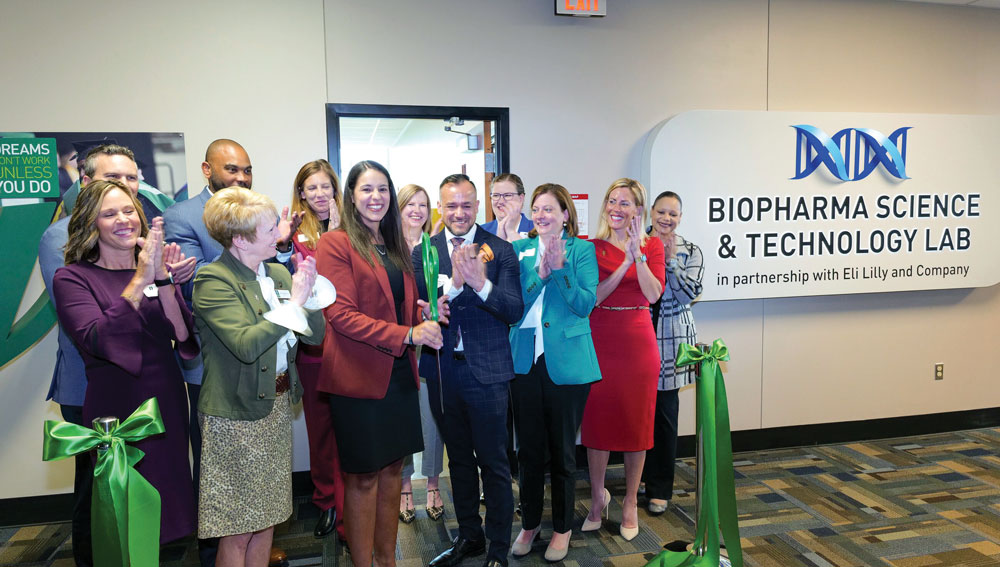
In December 2024, Ivy Tech and 16 Tech Community Corporation opened the Biopharma Science and Technology Lab at Ivy Tech’s Indianapolis campus.
Photo courtesy of Ivy Tech Community College
It turns out nine colleges in the Great Lakes fit the bill so far: Henry Ford Community College in Detroit, Michigan; Kennedy-King College in Chicago, Illinois; Milwaukee Area Technical College in Milwaukee, Wisconsin; Suffolk College in Selden, New York; Dakota County Technical College in St. Paul, Minnesota; Community College of Allegheny County in Pennsylvania; Durham College in Oshawa, Ontario; Harrisburg Area Community College in Harrisburg, Pennsylvania; and Pennsylvania College of Technology in Williamsport.
Over 30 community colleges now participate in the program, each receiving an initial $100,000 in grant funding or in-kind donations, which can be renewed each year if eligible. This funding can be used to provide scholarships, hire new staff, create new curriculum and for various marketing or recruitment purposes. In addition, the company allows its employees to serve as mentors to students in their respective communities, sharing advice and sharpening skills students can carry into an internship or full-time role with Johnson Controls.
Kennedy-King College was part of the program’s first cohort (2021-2022) and, to date, has received $373,000 in funding and $101,000 worth of in-kind equipment from Johnson Controls. At a recent partnership showcase at the college in June, the Chicago community was invited to learn how the duo are enhancing the college’s HVAC program, which featured a facility tour and live skills demonstration.
“My long-term goal is to become a licensed technician and one day start my own service company,” said current Kennedy-King HVAC student Michael Whiting at the event. “What I’m learning in this program is going to help me get there. I’m especially interested in emerging smart HVAC technologies and being able to work with Johnson Controls techs, currently in the field, has been important in learning how that tech is being used today. I’m excited about the career ahead of me.”
Eli Lilly and Company
A month prior to global pharmaceutical manufacturer Eli Lilly and Company injecting a $5.3 billion investment increase into the company’s planned $3.7 billion Lebanon, Indiana, expansion project, activity at the Biopharma Science and Technology Lab at Ivy Tech’s Indianapolis campus officially ramped up.
The fresh lab space, located just over 30 minutes from Lilly’s active pharmaceutical ingredients manufacturing site, features 4,000 sq. ft. full of equipment and technology typically found at production sites. Students can now interact and observe how Lilly’s manufacturing processes work — ranging from cell cultivation to quality control —while building new skills that carry into high-quality roles.
“Lilly’s contribution to Ivy Tech allows us to expand and enhance education and training opportunities at Indiana’s largest postsecondary institution while nurturing a strong pipeline of local talent that will fill the competitive and in-demand jobs being created by Lilly,” said Eli Lilly and Company EVP and President of Manufacturing Edgardo Hernandez. “Together, we’re shaping the future of the biopharmaceutical industry and Indiana’s economy.”
Aside from nurturing a robust talent pipeline, Lilly additionally looks to enhance its innovation activity in the state. In December 2024, Ivy Tech and the 16 Tech Community Corporation announced the Ivy Tech Manufacturing Innovation Center was officially open.
The 4,700-sq.-ft. biopharmaceutical training center provides companies like Lilly room to explore digital transformations and new advanced technologies, and to support budding entrepreneurship. The center has also become a learning hub for Lilly Scholars, who are Ivy Tech students pursuing a pharmaceutical career. Lilly’s scholarship program works to cover tuition and supplies costs for Ivy Tech students, which can last up to eight semesters for Indiana residents interested in biotechnology, smart manufacturing or industrial tech.
“This initiative not only bridges the gap between education and industry but also empowers students from diverse backgrounds to access high-quality, hands-on learning experiences that pave the way for successful, in-demand careers,” said Ivy Tech Indianapolis Chancellor Dr. Stacy Atkinson.